

 BBC
BBC 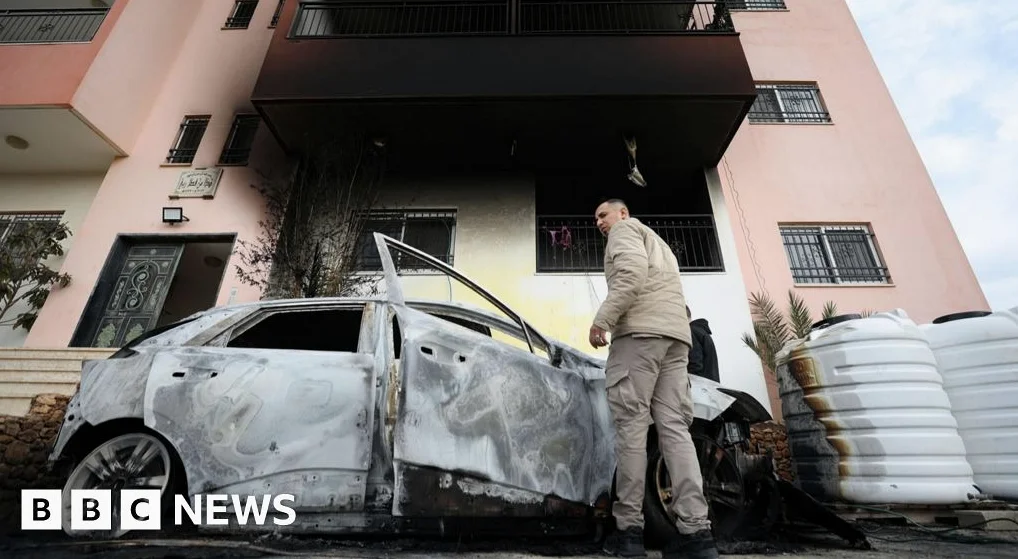
Palestinians in the West Bank are warning of a dangerous escalation in settler violence, with attacks growing in frequency and intensity, according to BBC reports. In Deir al-Hatab. Near Nablus. A family’s home was set ablaze and fired upon by Israeli settlers, leaving the house in charred ruins. Barhan Omar. A local bank manager. Described the assault as ‘organised terrorism’ and said it was meant to ‘kill women and children.’.
Violence Spreads Across the West Bank
According to BBC, the recent violence in Deir al-Hatab has left at least 10 people injured, with injuries ranging from stones to a gunshot to the foot. The village, which had not previously experienced such a major attack, is now a focal point of concern for residents who fear a broader pattern of violence.
The incident followed the funeral of Yehuda Sherman, an 18-year-old Israeli killed in an all-terrain vehicle accident near the settlement of Elon Moreh. Hundreds of mourners and Israeli politicians attended the funeral, drawing attention to the tensions that have since flared up in the region.
According to the UN, six Palestinians have been killed by settlers since the start of the Iran war, which has diverted global attention away from the West Bank. The violence has escalated in recent months, with incidents such as the sexual assault and beatings of residents in Khirbet Humsa, where Israeli police have made seven arrests.
Settler Violence and Land Displacement
According to the UN’s humanitarian office, between January 2023 and mid-February 2026, at least 4,765 Palestinians from 97 locations have been displaced by settler violence. Most of these displaced individuals are from Bedouin and herding communities in Area C of the West Bank, where Israel maintains full security and administrative control.
In January 2026 alone, 600 people were forced from the Bedouin village of Ras Ein al-Auja in the Jordan Valley, according to the UN. This displacement is part of a broader trend where settlers have moved into Area B, which is under Palestinian civil control but still under Israeli security oversight.
Allegra Pacheco, chief of party for the West Bank Protection Consortium, stated that the movement of settlers into Area B is not random. ‘This is an intentional policy,’ she said, noting that the goal is to ’empty out these areas to enable Israel to annex them and expand the settlements.’
Political Drivers and International Response
Israel’s far-right Finance Minister Bezalel Smotrich, a settler himself, has been a key driver of government policy on settlements. He has been sanctioned by the UK and others for inciting West Bank violence. Smotrich has declared vast areas ‘state land’ and claims to have approved or retroactively authorized 69 new settlements.
At the funeral of Yehuda Sherman, Smotrich criticized the ‘disgrace of Oslo,’ referring to the 1993 peace accords that divided the West Bank into areas A, B, and C. He vowed to ‘settle all our land in all its parts.’
Israel’s military chief of staff, Lt Gen Eyal Zamir, has condemned the violence, calling it ‘morally and ethically unacceptable.’ However, the IDF has faced criticism for its failure to stop or prosecute those responsible for the attacks. In Deir al-Hatab, residents reported that soldiers in a nearby watchtower ignored the violence and delayed the arrival of ambulances and firefighters.
The violence has left many Palestinians in a state of fear. From the rooftop of his burned home, Samer Omar, a father-of-four, expressed his concern about the encroaching settlements. ‘There’s no safety anymore,’ he said, adding that he wants to build a taller wall but is unsure if it will help.
Barhan Omar, the bank manager, struck a more defiant tone, warning of the risk of a new Palestinian uprising as pressure builds. ‘Netanyahu should know that we won’t stand watching,’ he said. ‘The Palestinian people will remain steadfast, defending their land and their lives.’






Comments
No comments yet
Be the first to share your thoughts