

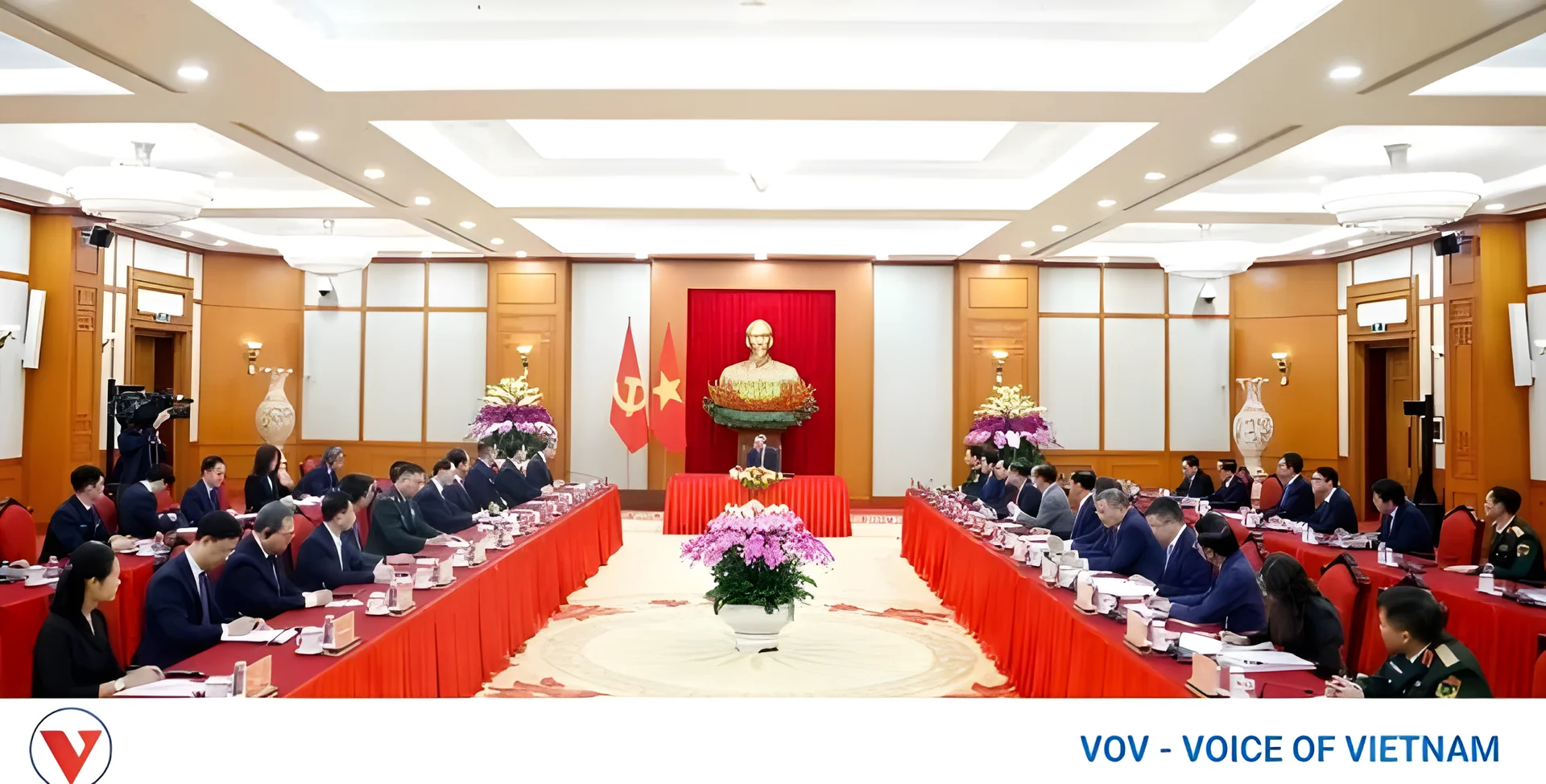
General Secretary of the Communist Party of Vietnam, To Lam, proposed key directions for strengthening strategic cooperation with China in a new phase during a meeting with senior Chinese officials in Hanoi on March 16, 2026. The meeting marked the first ministerial-level ‘3+3’ strategic dialogue on foreign affairs, national defence, and public security between the two countries, reflecting a deepening of bilateral relations in a complex geopolitical landscape.
Strategic Alignment and Regional Stability
The dialogue, co-chaired by Chinese Foreign Minister Wang Yi, Minister of Public Security Wang Xiaohong, and Minister of National Defence Dong Jun, aimed to reinforce political trust and strategic coordination between Vietnam and China. To Lam described the dialogue as an important step in demonstrating the shared responsibility of both nations in maintaining regional peace, stability, and development.
To Lam conveyed his greetings to Chinese President Xi Jinping and thanked the Communist Party of China for its support of Vietnam’s 14th National Congress, which concluded earlier in the year. He also expressed confidence in China’s ability to implement its socio-economic development plans, signaling a positive outlook on bilateral cooperation.
Vietnam has consistently pursued an independent, self-reliant, and diversified foreign policy, as emphasized by To Lam. He reiterated the country’s commitment to its ‘Four No’s’ defence policy, which outlines Vietnam’s stance on non-alignment and non-interference in regional affairs.
Cooperation in Key Sectors
During the dialogue, To Lam highlighted the importance of developing relations with China as a top priority and a strategic choice in Vietnam’s foreign policy. Both countries have established a solid political foundation for stable bilateral ties, with significant contributions from diplomatic, defence, and public security sectors.
Looking ahead, To Lam stressed that the top priority for both sides is to further strengthen strategic alignment to ensure Vietnam-China cooperation delivers more concrete outcomes and tangible benefits for the two peoples. He also expressed readiness to maintain close exchanges with the Chinese leader to guide ministries, sectors, and localities in both countries from the outset of the new term.
The foreign ministries of both countries were encouraged to strengthen coordination in organizing high-level exchanges and promoting practical cooperation, particularly in economic and trade relations and infrastructure connectivity. Railway cooperation was highlighted as a key area that could facilitate trade and people-to-people exchanges between the two nations.
Defence, Security, and Maritime Cooperation
In the fields of defence and security, To Lam proposed that both sides continue effectively implementing existing cooperation mechanisms while strengthening coordination in law enforcement, crime prevention, and safeguarding political security. He noted that expanded cooperation between the defence and public security forces of the two countries would help strengthen strategic trust and create a stable environment for development.
At the same time, To Lam stressed the importance of managing and resolving maritime differences through peaceful means in accordance with international law, including the 1982 United Nations Convention on the Law of the Sea (UNCLOS), in order to maintain peace, stability, and mutual trust. This is a critical issue in the South China Sea, where both countries have overlapping territorial claims.
Chinese officials reaffirmed that China considers Vietnam a priority in its neighborhood diplomacy and expressed readiness to work closely with Vietnamese agencies to effectively implement the agreed cooperation directions. Both sides also agreed to expand cooperation in areas such as trade, investment, science and technology, artificial intelligence, education, tourism, and people-to-people exchanges, further deepening the Vietnam-China relationship in the coming years.
The launch of the first ‘3+3’ ministerial strategic dialogue is expected to set a new framework for cooperation between the two countries, with implications for regional security, economic integration, and multilateral diplomacy in Southeast Asia. Analysts suggest that the dialogue could serve as a model for other regional partnerships and may influence the broader geopolitical dynamics in the Indo-Pacific region.
Vietnam and China have long maintained a complex relationship, shaped by historical ties, economic interdependence, and territorial disputes. The new dialogue mechanism aims to address these challenges through structured cooperation and strategic alignment. The success of this initiative will depend on the ability of both countries to balance their national interests with regional stability.
With both countries set to play a key role in the evolving geopolitical landscape, the outcomes of the ‘3+3’ dialogue will be closely watched by regional and global stakeholders. The cooperation framework is expected to be further developed in the coming months, with upcoming high-level meetings and policy reviews likely to shape the trajectory of bilateral relations.

Comments
No comments yet
Be the first to share your thoughts