

 BBC
BBC 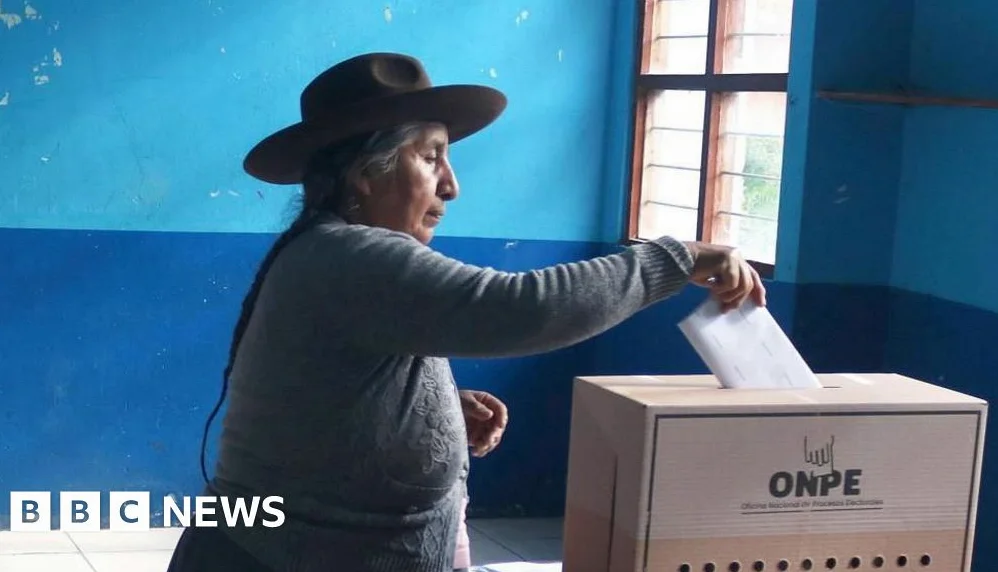
Peru’s general election has been extended into a second day after tens of thousands of voters were unable to cast their ballots due to technical and logistical problems at polling stations, according to the BBC. The electoral authorities have granted a one-day extension to more than 50,000 voters who could not cast their ballots on Sunday.
Delayed Voting and Logistical Chaos
According to the BBC. Scores of polling stations opened late or, in some cases, not at all. Voters in Lima and at polling stations abroad, such as in Orlando, Florida, and Paterson, New Jersey, will be able to cast their ballots on Monday, the electoral authorities ruled. Peru’s current President José María Balcázar said that the company hired to deliver the voting material had failed to do so in time.
Voting is mandatory for Peruvians aged between 18 and 70, and those failing to cast their vote can incur a fine; In total, more than 27 million Peruvians were asked to vote for members of both houses of Congress and for a new president. Whoever wins the presidential race will replace the 83-year-old Balcázar, who has only been in the job since February.
Political Landscape and Run-Off Uncertainty
Peru’s political establishment has been rocked by a series of scandals and impeachments that have led to the resignations, ousters, and impeachments of six presidents in the last decade. The last president to serve out his term in full was Ollanta Humala, who governed from 2011 to 2016. Whoever wins this election will have to try to win back the trust of an electorate that is deeply suspicious of politicians, whom they often view as only serving their own interests and contributing to the political instability of the country.
A total of 35 candidates are in the running for the top job but analysts say that who gets elected to the newly re-established Senate will also be key. Unlike the lower house of Congress. The 60-member-strong Senate cannot be dissolved by the president and is therefore expected to wield considerable political power.
Ahead of the elections, voters demanded that candidates do more to tackle corruption and rising rates of crime. Extortion in particular has been increasing, with public transport workers often falling victim to people demanding ‘protection money.’
Contestants and Campaign Promises
Keiko Fujimori, who is currently leading in counted votes, is running for the fourth time, having been beaten in the previous three run-offs. But her loyalty to her late father, who was convicted of crimes against humanity, makes her unpalatable to voters who opposed Alberto Fujimori’s rule. Both Keiko Fujimori and another of the front runners in the opinion polls, Rafael López Aliaga, have promised to use an ‘iron fist’ to tackle the crime wave the country is experiencing.
Fujimori said as the count was under way that ‘the enemy is the left,’ highlighting her hope that no left-wing candidate would reach the run-off. However, exit polls suggest that the race still remains wide open, meaning that a left-wing candidate, such as ex-tourism minister Roberto Sánchez, could overtake one of his conservative rivals to win a place in the run-off.
In an unmatched move, Peru’s electoral agency ONPE announced on Sunday night that it would extend voting for an extra day to allow tens of thousands of Peruvians in the country and abroad, who had been unable to vote, to cast their ballots. Authorities said that 52,000 people would be allowed to vote on Monday after 15 polling stations in southern Lima had cancelled voting due to technical issues.
Peru’s foreign ministry announced that several thousand voters living in the US cities of Paterson, New Jersey, and Orlando, Florida, would also be able to vote on Monday. The technical problems came amid unsubstantiated accusations of fraud and calls from candidates to extend voting into the night. Two former Lima mayors, an autocrat’s daughter and a comedian are contending to become Peru’s ninth president in a decade marked by intense political instability and corruption scandals.
Exit polls, partial results, and independent tallies so far show that the four-time presidential candidate Keiko Fujimori is in the lead, though she is well short of the 50% needed to win outright, and it is still unclear who she will face in the second round. Voting is mandatory for Peruvians aged 18 to 70. Failure to vote carries a fine of up to $32.
While 15 polling stations were shuttered on Sunday, several others faced delays and voting began late. At a polling station in Lima’s Miraflores district on Sunday, frustrated voters chanted: ‘We want to vote!’ One of them, Rosa María Yaksetig, said that voting had not begun until about 11.30am, adding: ‘The printers had run out of ink, and there was a fair amount of disorganisation, so people began to protest.’
ONPE said that no official first-round result would be available until after the additional voting had concluded on Monday.





Comments
No comments yet
Be the first to share your thoughts