

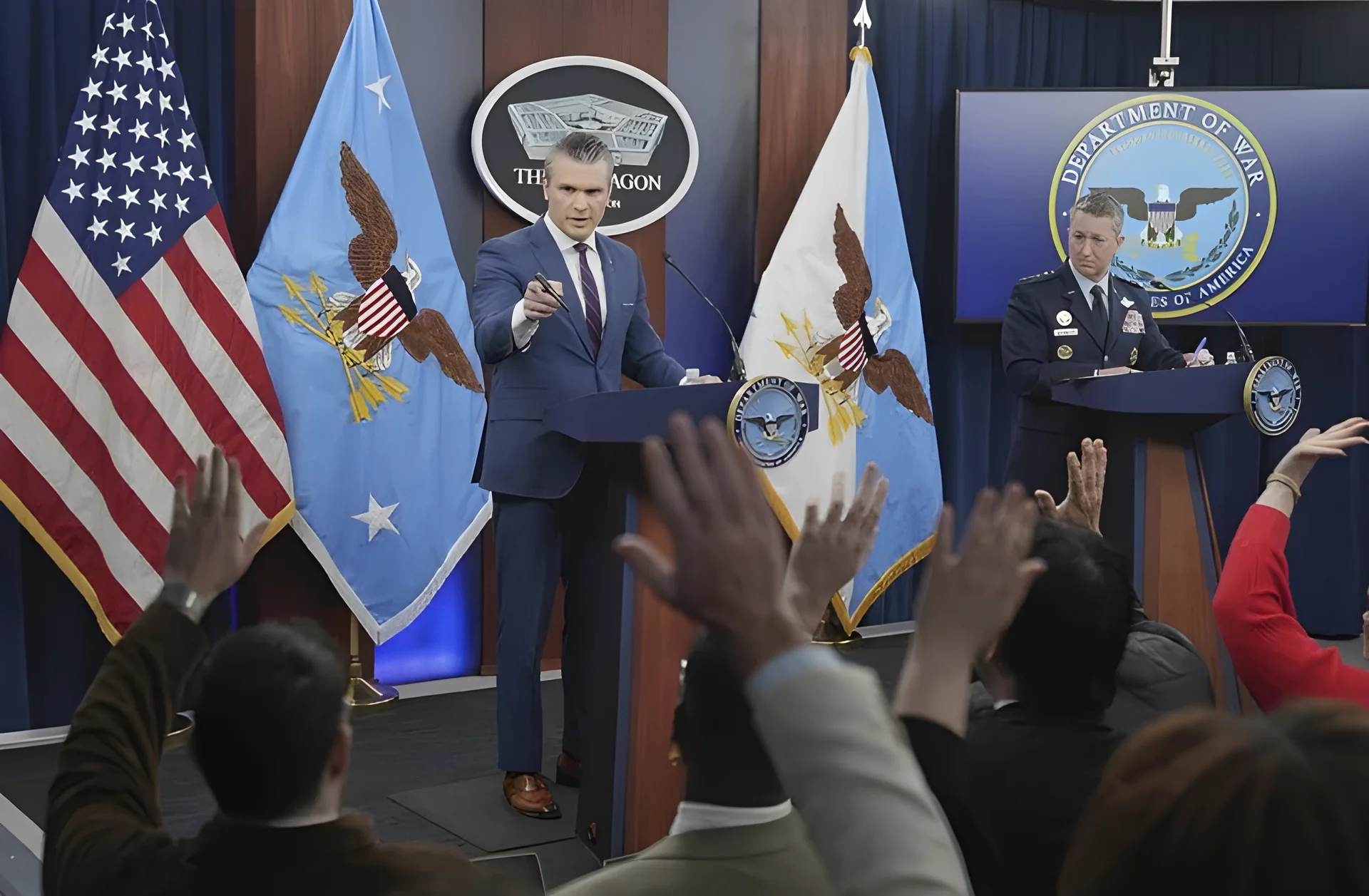
Secretary of War Pete Hegseth and Chairman of the Joint Chiefs of Staff Dan Caine have provided an update on Operation Epic Fury, stating that the U.S.-led campaign against Iran is only beginning and not a ‘Mission Accomplished’ situation. The operation, launched under President Donald Trump, has seen significant progress in the first four days, but Hegseth cautioned that the conflict is far from over.
Early Successes and Ongoing Challenges
Hegseth emphasized that while the U.S. and Israeli forces have made substantial gains, the campaign is still in its early stages. He noted that the U.S. military has taken control of Iranian airspace, allowing for continuous air operations against Iranian military infrastructure. This control means that U.S. and Israeli forces can conduct airstrikes at any hour, targeting missile systems, defense facilities, and leadership structures.
According to Hegseth, the operation has already delivered twice the air power of the 2003 Shock and Awe campaign in Iraq, without the complications of post-war nation-building. He added that the intensity of the campaign is seven times greater than Israel’s previous operations against Iran during the 12-Day War. More and larger waves of attacks are expected, with the U.S. military continuing to escalate its efforts.
Control of Airspace and Precision Strikes
The U.S. military has deployed a wide range of aircraft, including B-2, B-52, and B-1 bombers, as well as Predator drones and fighter jets, to dominate Iranian skies. Hegseth stated that the combination of U.S. and Israeli air power ensures that Iranian forces cannot mount an effective defense. The operation has also seen the use of GPS and laser-guided precision bombs, including 500, 1,000, and 2,000-pound variants, which are nearly unlimited in supply.
Hegseth noted that Iran has been unable to launch the same volume of missiles as in previous attacks, and its air defenses are now significantly weakened. He also highlighted the destruction of the Iranian Navy, including the sinking of the Iranian warship Soleimani, which was reportedly sunk by a U.S. submarine in the Indian Ocean. This marks the first time since World War II that an enemy ship has been sunk by a torpedo in international waters.
Leadership and Morale in Iran
Hegseth described the current state of Iran’s military leadership as in disarray. He claimed that senior Iranian leaders are either dead, missing, or cowering in bunkers, unable to coordinate a unified response. The Iranian Air Force, which was built for the 1990s, has been rendered obsolete by modern U.S. and Israeli technology. The Iranian Navy, once a significant force in the Persian Gulf, is now effectively non-existent.
The situation has had a severe impact on Iranian morale. Hegseth likened the predicament to a football team whose initial plays have been scripted, but now the team is unsure of how to proceed. He stated that Iran’s military is struggling to communicate and coordinate, which has made it difficult for them to mount a sustained offensive.
Hegseth also announced the killing of the Iranian leader who plotted to assassinate President Donald Trump. This marks a significant blow to Iran’s leadership and further undermines its ability to conduct coordinated attacks against U.S. interests.
Despite these successes, Hegseth acknowledged that Iran will continue to launch missiles and attack drones at civilian targets. However, he emphasized that U.S. forces have taken control of Iran’s airspace and waterways without deploying troops on the ground. He criticized the media for focusing on isolated incidents rather than the broader strategic picture.
Hegseth reiterated the president’s focus on eliminating Iran’s missile and drone capabilities, as well as its naval and nuclear infrastructure. He stressed that under President Trump’s leadership, Iran will not be allowed to develop a nuclear weapon, and that the U.S. will continue to take decisive action to ensure this.
The operation is expected to continue for an extended period, with the U.S. military planning further waves of attacks. The next phase of the campaign will focus on eliminating remaining Iranian military assets and ensuring that Iran cannot threaten U.S. interests in the region.






Comments
No comments yet
Be the first to share your thoughts