

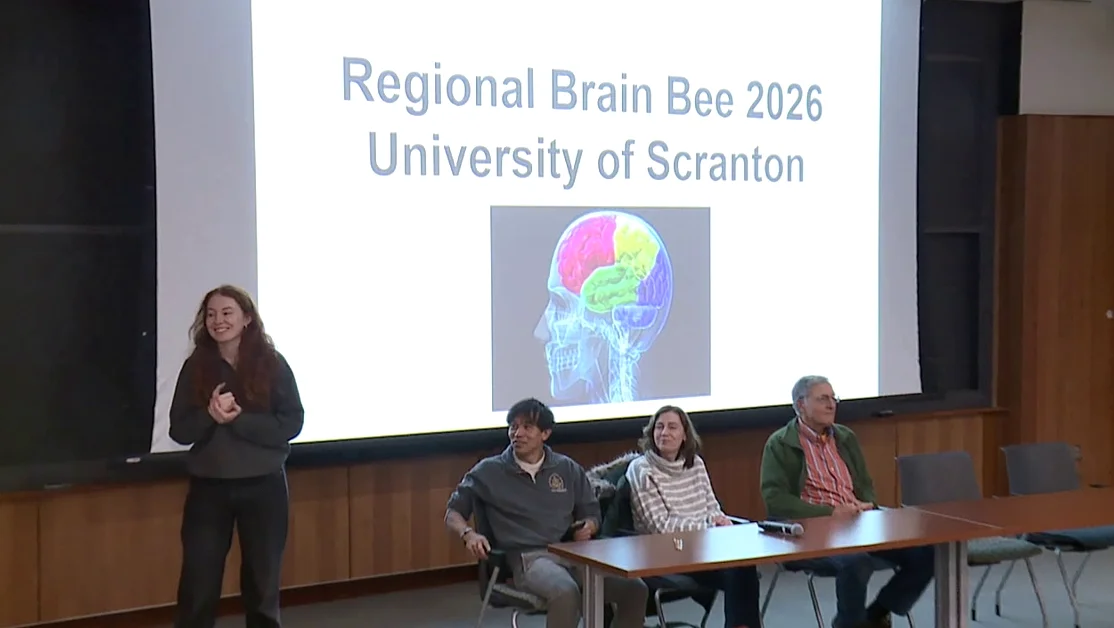
SCRANTON, Pa. — Eleven high school students gathered at the University of Scranton on Saturday for the 25th annual Northeastern Pennsylvania Brain Bee. They tackled questions on neuroscience topics from emotions to stress responses.
Muyan Liu took first place. The Philadelphia junior claimed the top prize of $400 cash and a $1,000 scholarship to the university. Her win punches her ticket to the national competition later this year in California.
“I think there will definitely be more competition there,” Liu said. “I’m really looking forward to keep preparing for the nationals and to learn more knowledge about neuroscience.”
Liu attends a high school in the Philadelphia area. She aims to study neuroscience and psychology at the University of Pennsylvania after graduation.
Robert F. Waldeck, the university’s neuroscience program director and Brain Bee coordinator, led the event alongside student organizers. The competition tests high schoolers’ grasp of brain science through written exams, image identification and oral presentations.
The regional event acts as a qualifier for the National Brain Bee, run by the Society for Neuroscience. That contest draws top young minds from across the U.S. to Baltimore each spring, though this year’s nationals head west.
Interest in brain science education has surged at the high school level. Events like the Brain Bee expose teens to advanced research and career options in a field changing medicine and psychology.
The University of Scranton has hosted the NEPA Brain Bee for a quarter century. Officials credit the program with sparking passion for STEM among local students.
“This competition provides a unique platform,” Waldeck said in event materials. It lets participants dive into complex concepts early.
Liu’s path reflects that impact. She discovered the Brain Bee through school channels and spent months studying textbooks, lectures and brain anatomy slides. Her preparation paid off against competitors from schools across northeastern Pennsylvania.
Other participants received recognition too. Runners-up earned certificates and smaller awards, according to organizers. The full roster included students from as far as Pike County.
The Society for Neuroscience launched the Brain Bee in 1999 to combat a shortage of brain researchers. Today, it reaches thousands of students yearly through hundreds of regional qualifiers.
At Scranton, the event draws consistent crowds. This year’s 11 entrants matched recent years, signaling steady enthusiasm despite pandemic disruptions.
Liu now shifts focus to nationals prep. She plans extra study sessions on advanced topics like neural circuits and disorders. Success there could open doors to internships and top colleges.
The university’s role extends beyond hosting. Faculty judge rounds and mentor winners. Scranton’s neuroscience program, one of the oldest in the region, benefits from the influx of scholarship talent.
For Liu, the win caps a school year packed with science fairs and clubs. She credits teachers for building her foundation. Next stop: California, where she’ll face the country’s sharpest young neuro-minds.

Comments
No comments yet
Be the first to share your thoughts