

Philippines foreign investment approvals fell by half in 2025 to 4.7 billion U.S. dollars, marking the largest decline in five years as global uncertainties and domestic challenges weigh on the manufacturing sector. According to the Philippine Statistics Authority, the drop to 272.4 billion pesos (4.7 billion dollars) reflects a significant shift in investor confidence, driven by global trade uncertainties, natural disasters, and a flood control corruption scandal.
Central Luzon Attracts High-Value Manufacturers
Despite the overall decline, Central Luzon has emerged as a preferred destination for high-value manufacturers. The region accounted for nearly two-thirds of total foreign pledges, amounting to 171.2 billion pesos (3 billion dollars). The manufacturing sector alone contributed 81.4 billion pesos (1.4 billion dollars) of the total approved foreign investments, with both regions hosting the majority of these pledges.
Higher-value manufacturers are gravitating towards Central Luzon, taking advantage of the region’s industrial parks, skilled manpower, and improving connectivity to Metro Manila. Major investments from Coca-Cola and Ajinomoto in Aboitiz InfraCapital’s TARI Estate in Tarlac highlight the region’s growing appeal. Clark Freeport Zone also continues to attract significant manufacturing locators, including UET Box Manufacturing, All Fashion Gloves, and DeviceDesign.
UET Box Manufacturing Corp. invested 169.7 million pesos (2.9 million dollars) to expand by 10,000 square meters and produce high-quality knitted products and custom shipping boxes. French firm All Fashion Gloves, a pioneer locator in Clark, will invest 18.27 million pesos (315,000 dollars) for the construction of new facilities. DeviceDesign, a South Korean company specializing in wireless technology for the Internet of Things (IoT), invested 103 million pesos (1.8 million dollars) for a new factory inside Clark Freeport, which will employ more than 500 individuals.
Industrial Supply Growth Expected in Central Luzon
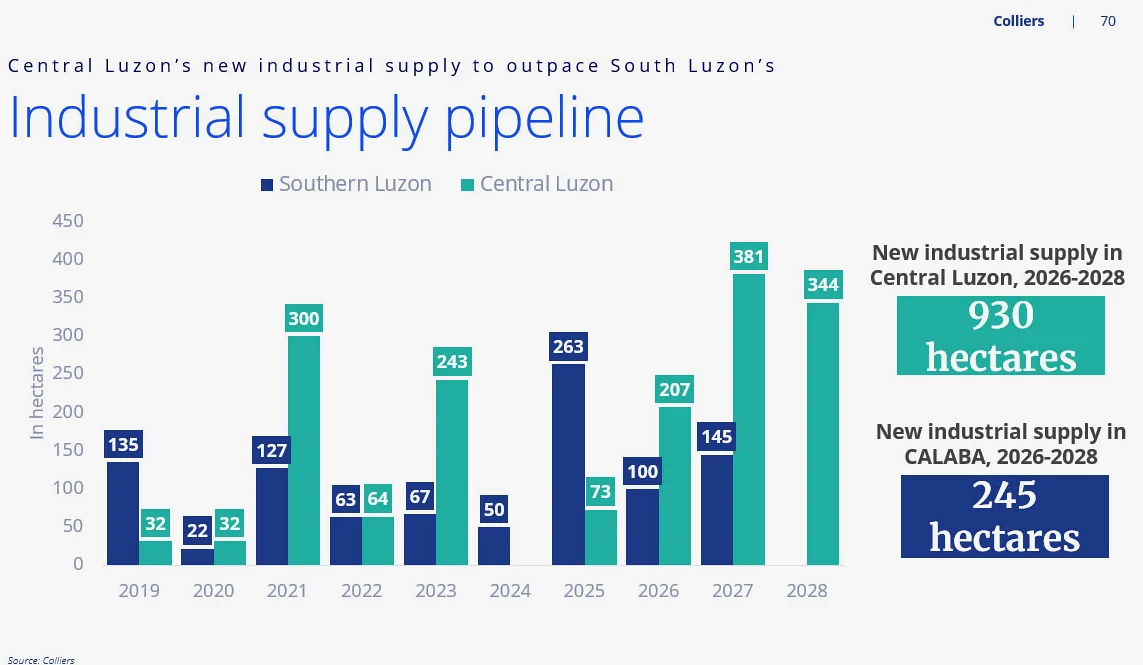
Colliers, a leading real estate services firm, forecasts the delivery of 930 hectares of new industrial supply in Central Luzon from 2026 to 2028, significantly higher than the 245 hectares expected in Southern Luzon during the same period. This growth is expected to create more opportunities for manufacturers and locators to negotiate competitive lease rates.
Julius Guevara, senior director and head of Capital Markets and Investment Services at Colliers Philippines, said, ‘The improving business environment and bullish prospects for the region suggest that more higher-value manufacturers will locate in Central Luzon, especially in Pampanga, Tarlac, Bulacan, and Bataan.’
With an improving business environment and bullish prospects for the region, the likes of Pampanga, Bulacan, Tarlac, and Bataan will likely remain attractive industrial locations given their skilled manpower and improving infrastructure. Colliers Philippines believes that the completion of significant industrial supply in Central Luzon should provide opportunities for manufacturers and locators to negotiate more competitive lease rates.
The improving quality of these industrial spaces and warehouses should also ensure that the region’s industrial facilities are ready to accommodate high-value manufacturers. The entry of major manufacturers should eventually develop the profile of locators in the region, enhance the industrial region’s supply chain system, and raise the volume and quality of commodity exports coming from the Central Luzon corridor.
Calabarzon Remains a Key Industrial Hub
While Central Luzon is gaining traction, some manufacturers continue to prefer locating in the Calabarzon (Cavite, Laguna, Batangas) corridor in Southern Luzon, the country’s major industrial hub. Among the profiles of locators which recently occupied industrial space in the region include those involved in the manufacturing of printers, air conditioners, air fresheners, and electronics.
The government is under pressure to address issues such as the sanctity of contracts, infrastructure network enhancement, and high power costs to make the country more attractive to investors. Analysts argue that these measures are crucial if the government wants to create more job-generating investments and support inclusive economic growth across the Philippines.
According to Joey Roi Bondoc, director and head of Research at Colliers Philippines, ‘The government must prioritize these issues to ensure sustained growth in the manufacturing sector and maintain the Philippines’ position as a competitive industrial location in the region.’






Comments
No comments yet
Be the first to share your thoughts