

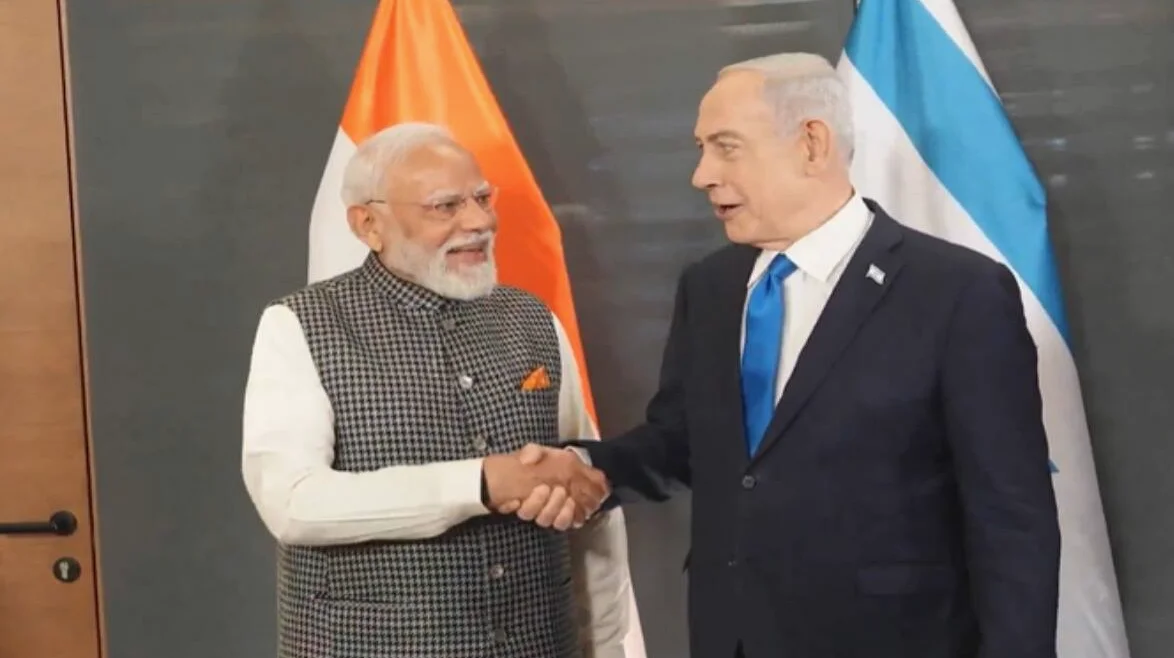
Prime Minister Narendra Modi arrived in Tel Aviv on 25 February for a two-day visit, signaling a new phase in India-Israel relations. This marks his second visit to Israel in eight years, with discussions expected to center on defense, aerospace, and artificial intelligence. The trip comes amid global tensions surrounding the Israel Gaza conflict and rising geopolitical shifts.
Deepening Strategic Partnership
Israeli Prime Minister Benjamin Netanyahu announced Modi’s visit earlier this month, emphasizing the ‘tremendous alliance between Israel and India.’ He highlighted India’s population of 1.4 billion and its growing global influence. Modi’s first visit to Israel in 2017 was historic, making him the first Indian prime minister to set foot in the Jewish state. The two leaders have since built a warm relationship, with Netanyahu visiting India in 2018.
In 2020, India abstained from a UN resolution condemning Israeli actions in Gaza, a shift from its previous stance. Indian officials have increasingly referred to Hamas as a terrorist organization, a term they had previously avoided. According to surveys, Israelis hold a positive view of India, and pro-Israel sentiment has grown in India, with many seeing Israel as a ‘first-rate strategic partner.’
Bilateral trade between India and Israel reached approximately $10 billion in 2024, excluding defense. India is one of Israel’s largest defense customers, accounting for 34% of all Israeli defense exports between 2020 and 2024. The two nations have collaborated on water technology, food security, and military equipment, including radars, missiles, and unmanned aerial vehicles (UAVs).
High-Level Engagements and Defense Cooperation
In 2025, Israeli ministers of tourism, economy, agriculture, and finance visited India, laying the groundwork for a Free Trade Agreement (FTA) between the two countries. In November 2025, India and Israel signed a landmark agreement to enhance defense, industrial, and technological cooperation. This includes sharing advanced technology to promote co-development and co-production of defense systems.
A Joint Working Group (JWG) of Israel and India met in Tel Aviv in November 2025. The meeting, led by Israel’s Ministry of Defence Director General Maj Gen Amir Baram and India’s Defence Secretary Rajesh Kumar Singh, focused on deepening cooperation in defense, technology, and industry. Baram stated that the partnership is based on ‘deep mutual trust and shared security interests.’
During a special panel with Israeli defense industry CEOs, innovative technologies were presented, including ideas for joint planning, training, and defense industrial cooperation. Key areas for collaboration include science and technology, research and development, artificial intelligence, and cyber security.
In February 2026, a delegation from the Society of Indian Defence Manufacturers (SIDM) visited Israel and signed a Memorandum of Understanding (MoU) with Israel’s International Defence Cooperation Directorate (SIBAT). This agreement aims to bolster defense industrial cooperation between the two nations.
India’s Role in the Board of Peace
The Board of Peace (BoP), established by former U.S. President Donald Trump, is an international organization aimed at promoting peacekeeping efforts, particularly in the Israel Gaza conflict. The board was formally established in January 2026 on the sidelines of the World Economic Forum. Trump chaired the first BoP meeting on 19 February 2026 in Washington, D.C., with officials from nearly 50 countries attending.
India participated as an observer, with its Chargé d’Affaires at the Indian Embassy in Washington, Namgya C Khampa, representing the country. India made it clear that it is willing to engage with the BoP even if it is not ready to be a full-fledged member yet. The U.S. has pledged $10 billion for the BoP, and nine other members have pledged a combined $7 billion for a relief package for Gaza.
While the BoP could benefit Israel by potentially ending the Gaza war, its composition includes countries with mixed or hostile stances toward Israel, such as Qatar, Turkey, and Pakistan. India’s cautious approach reflects its need to balance regional and global interests, particularly in the context of the Israel Gaza conflict.
In early 2026, India’s Defence Acquisition Council approved an $8.7 billion procurement from Israeli defense firms, including precision-guided bombs, air-to-surface missiles, and air-launched ballistic missiles. This procurement includes systems from Rafael Defense Systems, Elbit Systems, Israel Aerospace Industries (IAI), and Rafael.
India-Israel defense relations have grown significantly since the establishment of diplomatic ties in 1992. In 1996, formal defense ties were established, and the partnership has continued to strengthen. Today, Israel is a top defense supplier to India, while supporting indigenous Indian capabilities through technology transfers.
Collaboration between the two nations includes the joint development of the Barak-8 MRSAM (Medium Range Surface-to-Air Missile), drones, and radar systems. These efforts align with India’s ‘Make in India’ and ‘Aatmanirbhar Bharat’ (Self-Reliant India) initiatives, aiming to boost domestic defense production.






1 Comment