

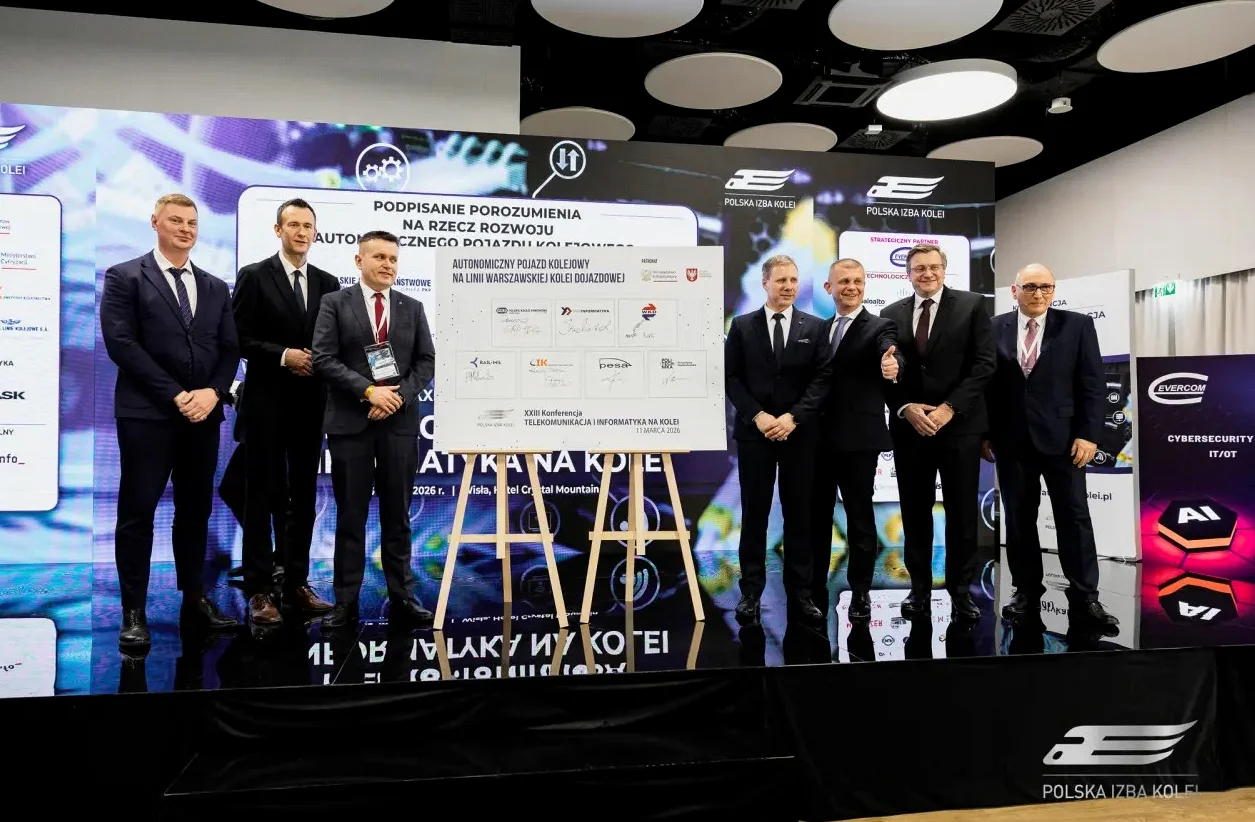
Poland is preparing to conduct tests on an autonomous train as part of a joint project involving the state-owned railway company PKP, technology firms, and academic institutions. The initiative, supported by the Polish Ministry of Infrastructure, aims to develop and test advanced rail systems using the ATO (Automatic Train Operation) framework. The project was officially announced during the ‘Telecommunications and IT on the Railways’ conference in Wisła, where stakeholders outlined the technical and logistical details of the upcoming trials.
Collaborative Efforts Across Sectors
The project brings together a consortium of railway companies, IT firms, and research institutions, each contributing specialized knowledge in areas such as rail traffic control, software development, and automation. The goal is to create a fully integrated autonomous train system that can operate safely and efficiently under real-world conditions. PKP Vice President Dariusz Grajda highlighted the historical role of the rail sector in pioneering technological innovation.
‘Railways have always been at the forefront of new technologies,’ Grajda said during the conference. ‘For nearly 200 years, the solutions implemented in rail transport have been a symbol of modernity and innovation.’ He emphasized that the current project is a continuation of that legacy, using modern advancements in artificial intelligence and automation.
Test Site and Technical Implementation
A section of the WKD Line No. 48, stretching between Podkowa Leśna and Milanówek near Warsaw, has been selected as the primary test site. The route was chosen due to its relatively simple infrastructure and low traffic density, which allows for controlled testing without disrupting regular operations. The first phase of the project will involve creating a ‘digital twin’ — a digital simulation of the rail infrastructure and the autonomous train.
This digital model will be used to test various scenarios, including obstacle detection and train navigation, using visual analysis algorithms powered by cameras installed on the train. The system will be able to identify potential hazards and assist the train operator in making real-time decisions. This phase is crucial for validating the reliability of the technology before moving to real-world testing.
In the second phase, a prototype EN97 train, manufactured by the Polish company PESA and operated by WKD, will be used for actual tests on the WKD Line. The train will be equipped with sensors and specialized software to enable testing at the GoA2 (Grade of Automation 2) level — meaning the train will be operated with a driver but assisted by automated systems. This level of automation is considered a stepping stone toward full autonomy.
Future Goals and Safety Considerations
The project’s long-term goal includes exploring the feasibility of fully autonomous trains, where no driver is needed. However, project leaders stress that achieving this will require extensive testing and rigorous safety protocols, particularly concerning interactions with road traffic and level crossings. Safety remains the top priority, as the integration of autonomous systems into existing rail networks poses unique challenges.
‘Such a phase would require extensive testing and rigorous safety checks, especially in the context of level crossings and interaction with road traffic,’ the project’s authors stated in a press release. The tests are expected to last several months, with initial results and performance metrics to be evaluated in early 2027.
The project aligns with broader European trends toward automation in rail transport. Similar initiatives have been launched in Germany, France, and the Netherlands, where autonomous trains are already in limited operation. Poland’s efforts are part of a larger push to modernize its infrastructure and improve transport efficiency across the country.
The tests on the WKD Line are expected to provide valuable insights into the performance and safety of autonomous rail systems in a European context. If successful, the technology could be expanded to other rail lines across Poland, potentially reducing operational costs and improving punctuality.
Experts in the field suggest that the adoption of autonomous trains could have a significant impact on public transport in Poland. According to a 2025 report by the European Transport Research Review, autonomous rail systems could reduce delays by up to 30% and improve energy efficiency by 15% through optimized speed and braking patterns.
The involvement of Polish companies like PESA in the project also highlights the potential for domestic manufacturing and technological development. By developing autonomous train technology locally, Poland could reduce its reliance on foreign suppliers and strengthen its position in the European rail industry.
As the tests progress, the Polish government and railway authorities will be closely monitoring the outcomes. The results could influence future investment decisions and policy directions for rail infrastructure development in the country. The project also has the potential to attract international interest and partnerships, further positioning Poland as a leader in rail innovation.






Comments
No comments yet
Be the first to share your thoughts