

 BBC
BBC 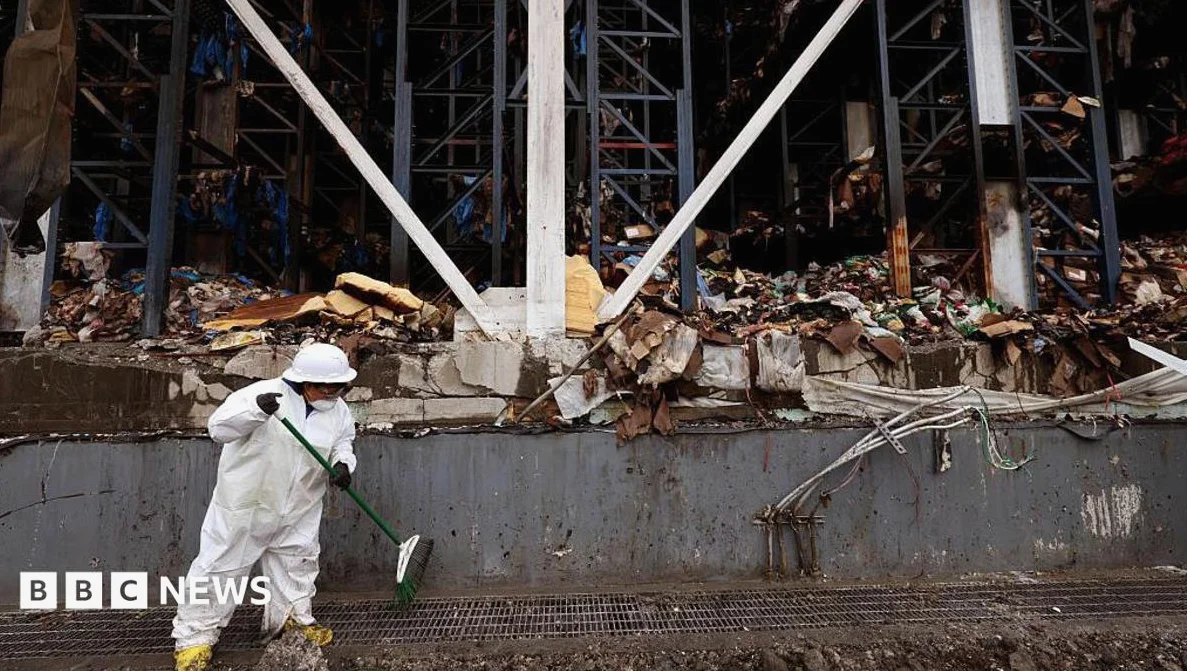
On any typical day, Alexis Sicairos and his girlfriend have a line of patrons waiting to order a banana buzz latte or a cloud matcha at their Los Angeles coffee stand. But now, the street corner where they sit is largely empty.
Stench Lingers After Fire
The reason is clear the second you walk into the neighborhood: it stinks. On 17 June, a fire destroyed a large cold-storage warehouse in the area, leaving behind some 85 million lb (39 million kg) of rotting food, including beef, pork, poultry, and seafood.
Nearly two months later, residents of Boyle Heights say the clean-up has taken a lot longer than expected, and they’ve grown frustrated with the pungent odor hovering over the area.
“It smells really bad, like really bad… to the point that you want to throw up,” says Mesha, a 37-year-old security guard stationed outside a marijuana dispensary. She likens the smell to that of a dead body.
Company and City Officials Disagree on Progress
Lineage, the company that operated the warehouse, said that as of Monday about 80% of the food waste had been removed; But city officials said this week that the company’s response “has fallen short,” and that they have issued public health and safety violation notices.
“It’s been tough,” Sicairos, 30, says. After shutting down his coffee stand for two weeks because of the fire, Brew Sting has reopened – but the demand hasn’t been the same.
He says flies have been swarming relentlessly over the past weeks, since the food that was stored in the warehouse began rotting — the warehouse workers that would previously line up to buy coffee haven’t been showing up over the past two months.
“Due to the fire, obviously most of them aren’t here,” Sicairos says. “So we lost those customers, but we also lost customers that don’t want to be around the smell, the smoke, the flies. It’s understandable. But we have to keep paying our bills, so we’re still here.”
Health and Safety Concerns
One cannot walk through the area, which is mostly a warehouse district surrounded by homes, without swatting away countless flies, both big and small, including black, blue and green ones. As Sicairos packs up his coffee stand for the day, flies are landing on his tables and his body. He acknowledges that patrons don’t want to see flies when they’re purchasing food or drinks to consume.
A city-commissioned inspection report found that waste and high temperatures at the warehouse could speed up the breeding of flies capable of infecting wounds in both people and animals, a local NBC affiliate reported. The report from a pest control company said it could put people and animals with open wounds at risk of contracting disease.
People in the community have also reported seeing large rats, and they say traps placed along sidewalks aren’t big enough to hold them. Many residents blame the city for what they deem an inadequate response to the fire and a lack of transparency and resources.
“I understand why residents are frustrated,” Los Angeles Mayor Karen Bass told the BBC in a statement. “They deserve transparency, clear communication, and meaningful support. Since day one, I have been in Boyle Heights listening to residents, meeting with families, and making sure their voices guide our response.”
The mayor, who is up for re-election this year, said she directed city departments to work with local, state, federal, nonprofit, and community partners to deliver immediate support and solutions. Bass has also issued executive orders to mobilize resources and speed up the cleaning process. The city says they and other local partners have brought mobile health clinics to the neighborhood and delivered thousands of air purifiers.
Late last month, the county’s public health department fined Lineage for “unsanitary and nuisance” conditions with $500-a-day citations. The mayor has given Lineage a 13 August deadline to complete the cleanup. The company said on Monday they are 80% of the way there – up from 60% on July 31.
“Our goal is to complete bulk food waste removal from the site next week,” a Lineage spokesperson told the BBC on Wednesday. They expect to spend between $80 million to $100 million on the cleanup.
Outside the warehouse, dozens of workers in hard hats and neon vests can be seen tackling the effort, some wearing face coverings. Officials with the local air quality authority and sheriff’s office were also on site.
In an letter shared on Tuesday, Bass said the company’s response “has fallen short.”
“Residents, public agencies, and elected officials have repeatedly sought timely information regarding the cleanup, remediation, environmental monitoring, and recovery,” Bass wrote in the letter to Lineage shareholders. “Too often, those requests have been met with delayed communication, limited transparency, and insufficient public engagement”.
The mayor also directed city departments to halt plans to rebuild the warehouse “until the health and safety of the community are protected.” Lineage, which is a temperature-controlled warehousing and logistics company, says “cleanup crews are working around the clock to remove food waste, clear debris and dismantle damaged sections of the structure. However, this is a highly complex operation,” they say, adding that reducing odours is a “key priority” in their cleanup effort.






Comments
No comments yet
Be the first to share your thoughts