

 BBC
BBC 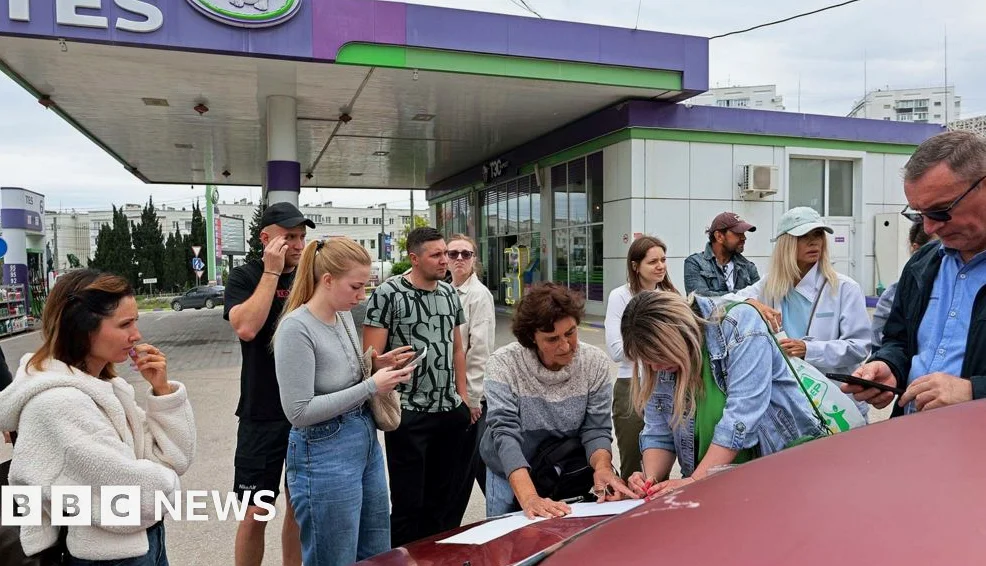
Russia’s fuel crisis is worsening as Ukraine increases its drone strikes on Russian-occupied territories, disrupting Moscow’s supply lines — the attacks have intensified an existing fuel shortage triggered by long-range strikes on Russia’s oil refineries.
Crimea’s Logistical Struggles
Crimea, which Russia annexed in 2014, is facing significant logistical difficulties and shortages. Recent Ukrainian strikes on a key motorway and bridge linking the southern Russian city of Rostov to Crimea via the occupied port city of Mariupol have exacerbated the situation.
“The road is basically the backbone of Russian occupation in the south,” said Clément Molin, an analyst at the French-based think tank Atum Mundi. He noted that Ukraine has carried out 300 drone strikes on trucks, including 30 tankers, since the start of May, with the campaign intensifying this month.
Robert Brovdi, Ukraine’s drone forces commander, reported a 71% decrease in military cargo traffic on the road between late May and early June.
Impact on Civilians and Tourism
The operation is having a tangible effect on Crimea, a strategic location for Moscow due to its use as a launch site for drones and missiles targeting Ukraine. The peninsula’s Mediterranean climate and long beaches also make it a popular summer holiday destination for Russians.
Disgruntled tourists and locals have taken to social media to express frustration over fuel shortages; Videos show long lines at petrol stations, with residents queuing for up to 10 hours for fuel.
“I walk to work now. Of course. This is less convenient than driving. But not a huge problem. ” said one resident of Simferopol. As “All I’ve got to do now is buy a horse!” he added.
At most Crimean petrol stations, locals are now limited to purchasing up to 20 litres (4 gallons) of fuel each using prepaid vouchers, if fuel is available at all. Russian tourists who arrived before the crisis began are now struggling to find fuel to leave the region; the issue has become so acute that local Moscow-installed authorities have launched a special hotline to assist them.
Reports of skyrocketing petrol and diesel prices due to shortages have also emerged. Sergei Aksyonov, the Kremlin-appointed regional head, admitted on 5 June that it was “unfortunately not possible to fully satisfy the demand for fuel at the current moment.” He also noted that hundreds of buses would not be leaving depots due to shortages.
Supply Challenges and Military Impacts
On the evening of 8 June, Russia’s energy ministry acknowledged fuel supply problems in “the southern regions,” likely referring to the occupied parts of Ukraine. The ministry cited enemy air attacks as the cause and stated it had established a permanent headquarters to resolve these difficulties.
Despite these efforts, roads remain the primary supply route to the peninsula. The sea route is too dangerous, as several ferries serving Crimea have been taken out of action by Ukraine. Previous attacks or the threat of them have also restricted traffic on the Kerch Bridge, which links Crimea with mainland Russia.
“I wouldn’t want to put a truck full of diesel on the Kerch Bridge right now — that’s just asking for trouble,” said Craig Kennedy, an expert in Russia’s oil industry. “So you’ll have to bring it in by land, via Mariupol. And there you’re vulnerable all along the way.”
Pro-Kremlin sources argue that Ukrainian attacks on logistics routes have already affected the Russian army’s ability to fight. Rybar, a pro-Kremlin Russian military analysis account, posted on its Telegram channel that the strikes that empty fuel stations for civilians also affect supplies to troops in the south.
“The logistics crisis does not distinguish between military and civilian needs, it hits everything at once,” the account stated. On two nights, 6-7 June and 8-9 June, Ukrainian strikes damaged a key bridge in Chonhar in northern Crimea, which linked it to the rest of Ukraine and was used by Russian troops and civilian vehicles along the R-280 motorway. Traffic across the bridge was suspended.
Problems with fuel supplies are compounded by Ukraine’s long-range strikes against oil refineries and oil depots in Russia, which Kyiv has been carrying out for several months. President Volodymyr Zelensky said that nearly 40% of Russia’s “primary oil refining capacity” was disabled in May because of such strikes.
Craig Kennedy noted that Ukraine’s expanding campaign against Russia’s supply network is now focusing on smaller, local distribution networks. “This is having a more focused or concentrated impact on local populations and the military in certain regions such as Crimea,” he said.
Drone attacks have also affected other parts of occupied Ukraine, including the regions of Luhansk and Kherson. The 413th separate battalion “Raid” of Ukraine’s Unmanned Systems Forces, whose commander Yevhen Karas spoke to the BBC from an undisclosed location, has been involved in these attacks. Karas said his drones encountered little resistance from Russian air defences during recent missions.
“It was a beautiful feeling when we can fly anywhere we want,” he told the BBC. He emphasized that disrupting Russia’s military logistics is a key priority for his unit. “The main dish is Russian storage, oil and fuel tanks, buildings and even small bunkers with Russian officers,” he added.
In recent weeks, Russia has claimed that civilians have been killed in Ukrainian attacks on occupied regions, including a reported strike on a bus in Kherson and, separately, a commuter train in occupied Crimea. Aksyonov, Crimea’s Russia-appointed leader, said a Ukrainian drone had again struck a passenger train in the region, killing its assistant driver and injuring the driver. Karas did not comment on these incidents specifically but noted that “mistakes can happen, but this is not a deliberate targeting of civilian vehicles.”
As a result of the strikes, civilian movement on two key roads linking the occupied regions to Russia has been restricted. The Moscow-installed authorities in occupied Luhansk region have banned bus and coach services on two motorways leading to Mariupol and Crimea and have urged local residents not to use them “for security reasons.”
The combined effect of Ukraine’s medium and long-range strikes not only affects Russia’s ability to fight but also serves Zelensky’s declared purpose of “bringing the war home” to Russia.





Comments
No comments yet
Be the first to share your thoughts