

A recent study published in Nature Microbiology has uncovered a critical link between skin-secreted androgens and the virulence of Staphylococcus aureus (S. aureus) infections, shedding light on why men are more prone to severe staph infections than women. Researchers found that testosterone and other androgens secreted by the skin directly stimulate the bacteria’s quorum-sensing system, which regulates toxin production and infection severity.
Human Skin Secretes Nanomolar Levels of Testosterone
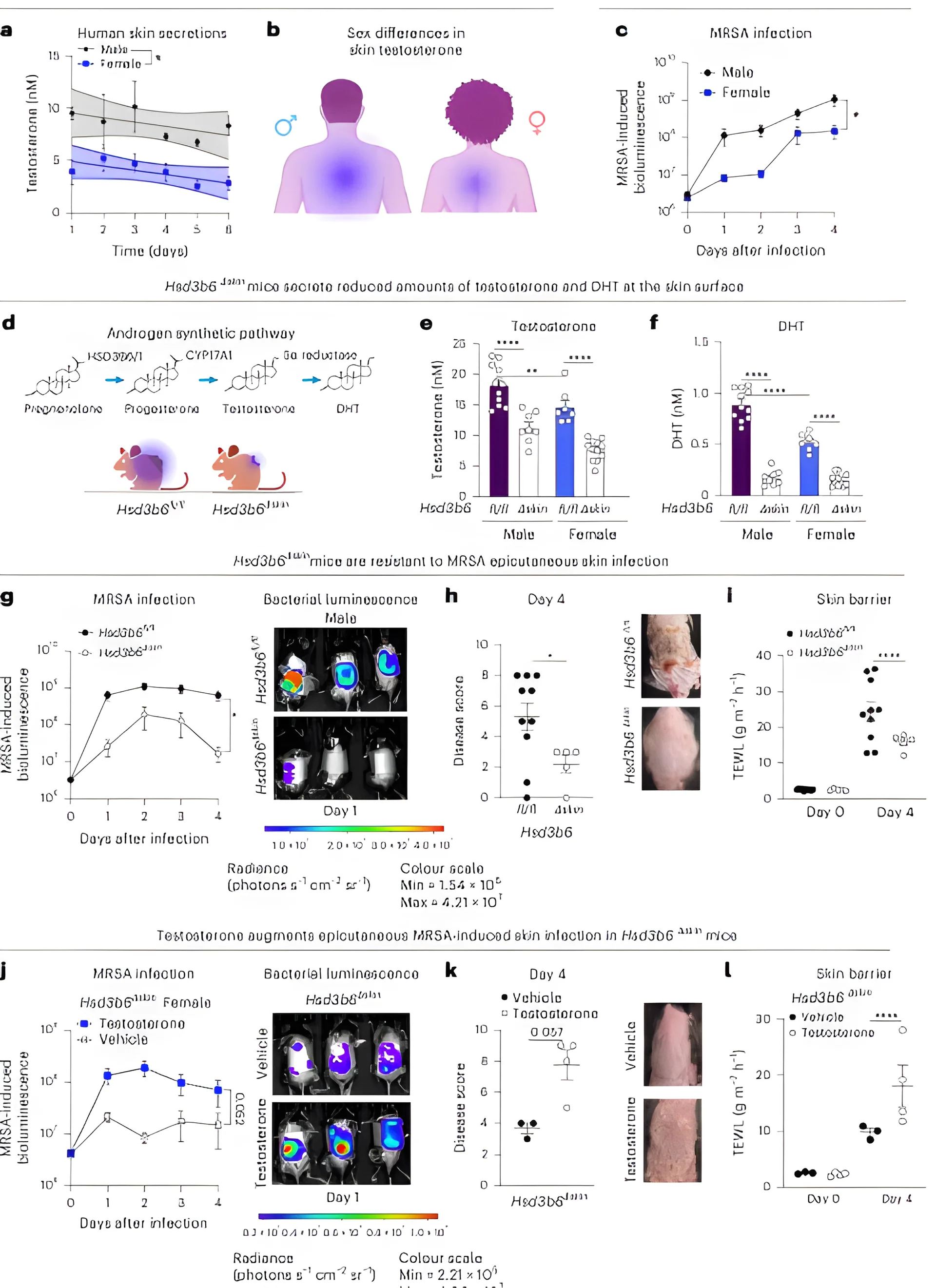
The study measured testosterone secretion from human skin through daily sebum samples collected over six days from male and female participants without skin disease. Results showed that human skin consistently secreted between 5 nM and 10 nM of testosterone, with stable levels across days. Male participants secreted higher amounts of testosterone compared to females, a finding that aligns with previous research on larger cohorts.
Using a bioluminescent strain of methicillin-resistant S. aureus (MRSA), researchers epicutaneously infected male and female mice. They observed significantly higher infection severity in male mice, as indicated by greater bioluminescence, worse disease scores, and more severe skin barrier damage. This was attributed to the higher levels of testosterone and dihydrotestosterone (DHT) secreted by the skin of male mice.
Reduced Hormone Secretion Leads to Lower Infection Rates
To test the role of skin-derived androgens, researchers created mice lacking the steroidogenic enzyme 3β-hydroxysteroid dehydrogenase 6 (HSD3B6), which is critical for hormone production. These mice secreted lower levels of testosterone, DHT, and progesterone at the skin surface compared to controls. When infected with MRSA, the Hsd3b6 mice showed reduced bioluminescence, lower disease scores, less skin damage, and thinner epidermis, suggesting they were more resistant to infection.
Interestingly, when female Hsd3b6 mice were treated with topical testosterone, their infection severity increased, indicating that the hormone can directly promote infection. The study also found that reducing skin-secreted hormones minimized the sex-based differences in infection severity between male and female mice, further confirming the role of androgens in infection dynamics.
Testosterone Activates Quorum Sensing in Staph Bacteria
The researchers then examined the effects of testosterone on the bacterial transcriptome. They treated a methicillin-sensitive strain of S. aureus (HG003) with 10 nM testosterone and found that the hormone specifically upregulated genes in the agr quorum-sensing pathway, including agrB, agrD, agrC, agrA, psmα, psmβ, and RNAIII. These genes are known to regulate toxin production and virulence.
Testosterone also increased the expression of haemolysins hlgB and hlgC, which damage human red blood cells. In contrast, genes repressed by agr activation, such as coa, rot, and spa, were less abundant in testosterone-treated bacteria. Pregnenolone, a hormone with a similar carbon count to testosterone, had no effect on the transcriptome, suggesting that the structure of the hormone is critical to its impact on S. aureus.
Further experiments confirmed that testosterone and DHT activated the agr-P3 promoter in S. aureus strains, similar to the established quorum-sensing ligand AIP-I. However, estrogen and progesterone had no effect on agr activation, reinforcing the specificity of androgen action.
The study also tested the effect of testosterone across various S. aureus strains, including MRSA types II and III. All strains showed increased expression of virulence factors in response to testosterone, suggesting that the hormone’s influence is not limited to a specific strain. This is particularly significant because over 90% of S. aureus strains are classified as agr types I-III, which are all responsive to testosterone.
Given the strong association between S. aureus and atopic dermatitis (AD), the researchers tested strains obtained from diseased skin. Testosterone treatment increased the expression of virulence-related genes in these strains, including psmα, RNAIII, and agrA. The AD04.E17 strain showed a particularly strong response, similar to the effect of AIP-II stimulation, suggesting that testosterone may mimic or activate the bacterial quorum-sensing system.
The findings suggest that skin-secreted androgens play a key role in modulating the virulence of S. aureus infections. This insight could have important implications for the development of new treatments for skin infections, particularly in men who are more susceptible to severe staph infections. By targeting the skin’s hormone levels or the bacterial quorum-sensing pathways, it may be possible to reduce the severity of infections and improve patient outcomes.
Researchers now plan to explore how these findings can be translated into clinical applications, including the potential for hormone-modulating therapies or quorum-sensing inhibitors to combat S. aureus infections. The next step will involve testing these hypotheses in human trials and investigating the long-term effects of hormone regulation on bacterial virulence.






Comments
No comments yet
Be the first to share your thoughts