

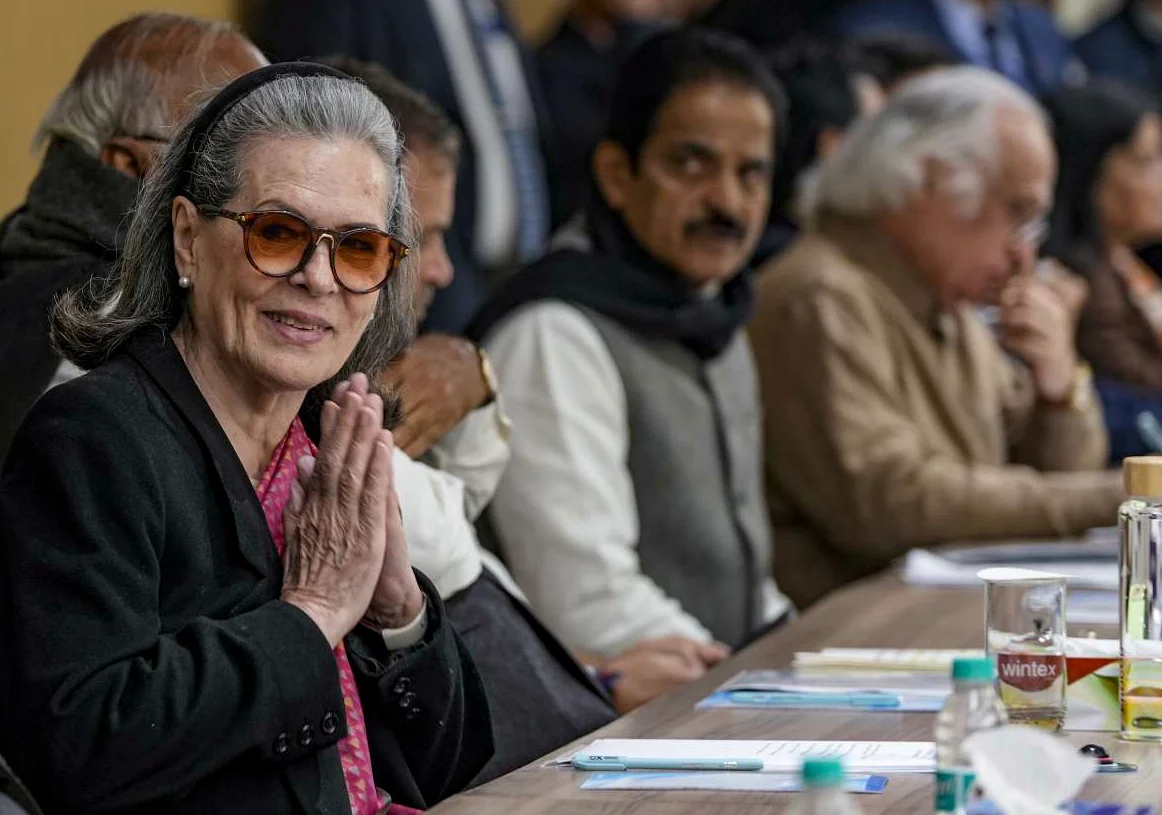
Sonia Gandhi, chairperson of the Congress Parliamentary Party, has called for an urgent parliamentary debate on India’s response to the assassination of Iran’s Supreme Leader Ayatollah Ali Khamenei, which she described as a dangerous escalation with significant regional and global consequences. In an article published in The Indian Express, Gandhi criticized the Indian government for its silence on the killing, stating that it raises serious doubts about the direction and credibility of India’s foreign policy.
India’s Silence on Khamenei’s Assassination
Gandhi highlighted that the assassination of Khamenei occurred on February 29, 2026, during ongoing diplomatic negotiations between Iran and other nations. She noted that the attack, carried out by the United States and Israel, took place without a formal declaration of war and during an ongoing diplomatic process. This, she argued, directly violates Article 2(4) of the United Nations Charter, which prohibits the use of force against a state’s territorial integrity or political independence.
According to Gandhi, the Indian government has not condemned the assassination or the violation of Iranian sovereignty. She criticized Prime Minister Narendra Modi for initially focusing only on condemning Iran’s retaliatory strike on the UAE, without addressing the sequence of events that led to the attack. Later, Modi expressed ‘deep concern’ and emphasized ‘dialogue and diplomacy,’ but Gandhi argued that this is precisely what was underway before the unprovoked attacks by Israel and the U.S.
Impact on International Norms and Foreign Policy
Gandhi warned that if such acts pass without principled objection from the world’s largest democracy, the erosion of international norms becomes easier to normalize. She also pointed out that the timing of the assassination was particularly concerning, as it occurred just 48 hours after Modi’s return from a visit to Israel, where he reiterated his support for Prime Minister Benjamin Netanyahu’s government.
Gandhi noted that Modi’s high-profile political endorsement of Israel, amid ongoing global outrage over civilian casualties in Gaza, marks a visible and troubling departure from India’s traditional stance of non-intervention and peaceful dispute resolution. She emphasized that India’s foreign policy, as outlined in Article 51 of the Constitution, is based on principles of sovereign equality, non-intervention, and the promotion of peace.
According to Gandhi, the current reticence from the Indian government appears not merely tactical but discordant with India’s stated principles. She further pointed out that the Congress party has unequivocally condemned the bombings and targeted assassinations on Iranian soil, describing them as a dangerous escalation with grave regional and global consequences. The party has extended condolences to the Iranian people and to Shia communities worldwide.
What’s Next for India’s Foreign Policy
Gandhi has called on the Indian government to address the issue openly when Parliament reconvenes for the second part of the Budget session. She emphasized the need for a debate that is ‘open and without evasion’ on the government’s stance regarding the breakdown of international order.
Analysts have noted that India’s position on the Israel-Iran conflict has been increasingly complex in recent years. With major powers and India’s BRICS partners, including Russia and China, maintaining a cautious distance, India’s high-profile political endorsement of Israel has drawn criticism from various quarters. The assassination of Khamenei has only heightened these concerns, as it has the potential to further destabilize an already volatile region.
According to a report by the Institute of Peace and Conflict Studies, the region has witnessed a 40% increase in cross-border tensions in the past year, with Iran and Israel being the primary actors involved. The targeted killing of a sitting head of state could potentially trigger a wider regional conflict, with far-reaching consequences for global trade and security.
Gandhi’s demand for a parliamentary debate comes at a critical juncture, as the international community grapples with the implications of the assassination. With the United Nations expected to hold an emergency session on the matter, the pressure on India to take a principled stance is mounting.
As the situation unfolds, the world will be watching closely to see how India handles its foreign policy in the wake of this unprecedented event.





Comments
No comments yet
Be the first to share your thoughts