

 BBC
BBC 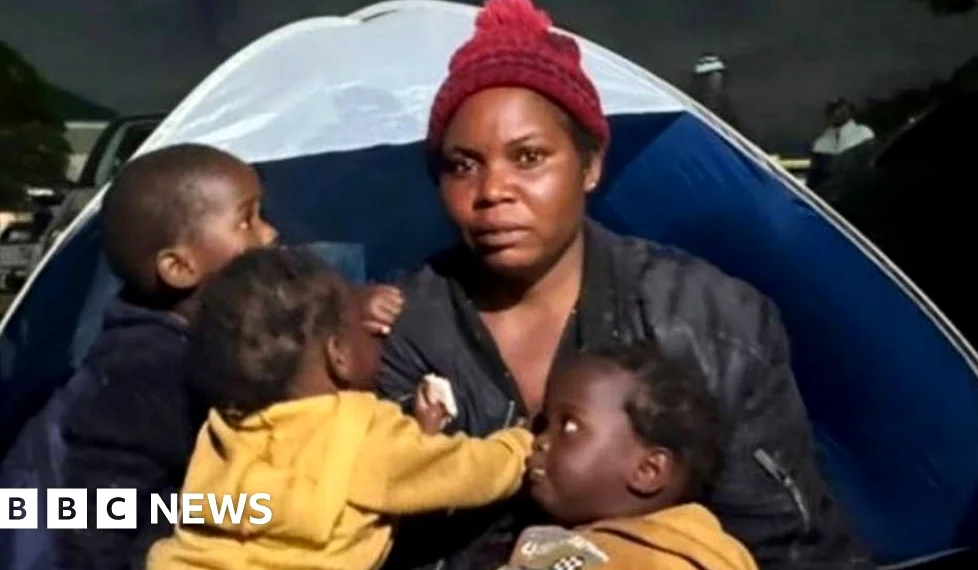
South Africa has become a hostile place for undocumented migrants, as a deadline set by protesters for them to leave the country approaches, according to the BBC. ‘I am very scared and traumatised,’ Esnat Joseph, a 36-year-old Malawian woman, told the BBC as she tried to comfort her crying one-year-old triplets. She fled her home in an informal settlement in the port city of Durban, in KwaZulu-Natal province, seeking refuge in an open field where up to 7,000 foreigners – mainly Malawians – began gathering with their belongings two weeks ago.
Violence and Intimidation
‘The people came to my house and told me: ‘You must leave. We don’t want you people to stay here any longer, so you have to go to your country.’ There were 10 and they were carrying weapons,’ she said, describing how the group of South African men were holding machetes and whips. ‘They cut my husband on his head and his neck. They were holding his neck like they wanted to kill him. Because of God he still survived, but he’s in the hospital.’
Many others at the field, where aid groups have been giving out blankets and food, report such door-to-door intimidation. It follows a series of mainly peaceful protests this year led by the anti-migrant group March and March, opposition party ActionSA and others which have set 30 June as the deadline for undocumented migrants to leave. Sticks in hand, the marchers have been chanting ‘Mabahambe’ – a Zulu phrase meaning ‘They must go.’
Government Response and Repatriation Efforts
As the countdown continues, President Cyril Ramaphosa warned South Africans on Tuesday that the ‘scapegoating of vulnerable people’ was not the solution to country’s complex economic challenges. Joseph came to South Africa three years ago and was working as a domestic servant before having her children. Her legal status is not clear – she says she lost her passport and other paperwork in a robbery. She aims to go back to Malawi on one of the buses the Malawian consulate has been arranging with the help of donations for its desperate citizens to leave Durban.
Ghana, Mozambique, Nigeria and Zimbabwe have also been organising repatriations by air or bus over the last few weeks – with about 3,500 foreigners volunteering to leave so far. The South African authorities said the more than 500 Nigerians recently repatriated had been in the country illegally. Arriving in Lagos last week after nearly nine years in South Africa, Benjamin, a returnee who only gave his first name, told the BBC: ‘South Africans don’t like foreigners, especially Nigerians. South Africa is not a place to be – it’s a place you can lose your life at any time.’
Protesters’ Perspective and Broader Context
Protest organisers deny their actions are xenophobic. They say they are sick of other Africans abusing the system and, as March and March leader Jacinta Ngobese-Zuma put it, ‘playing the victim card.’ ‘If you come into South Africa with a passport that allows you to stay for 30 days. When it’s 50 days, when it’s two years, when it’s five years, you know you’re breaking the law,’ she told the BBC at one protest in Durban. ‘We can’t have South Africa being turned into a refugee site for all failed African states… every country prioritises its citizens and we want the South African government to do the same.’
Latest figures show South Africa is home to more than three million foreigners, about 5% of the population – most from neighbouring countries in southern Africa. But the statistics do not record the many more migrants believed to be in the country without papers – a bone of contention for the protesters. Their anger is rooted in growing hardship as the country grapples with growing youth unemployment and economic inequality. South Africa has one of the highest rates of unemployment in the world at 32.7%, according to Statistics South Africa, which recorded 350,000 job losses in the first quarter of 2026 – the majority of whom are young people.
However, the continent’s most-developed economy remains a magnet for citizens of poorer countries who risk their lives to go there to seek work such as security guards and domestic servants. Protesters, like Mecha Ramorola, also point to the country’s strained public services with South African ‘people fighting for scarce resources.’ ‘We are struggling to get our children into schools. We are struggling to get our old people into hospitals,’ Ramorola told the BBC during a march in the capital, Pretoria. But there are fears these protests could lead to a repeat of the violence that broke out in 2008, when 62 people, including 21 South Africans, were killed in riots that forced thousands from their homes. There were also outbreaks of xenophobic violence in 2015, 2016 and 2019.



Comments
No comments yet
Be the first to share your thoughts