

 BBC
BBC 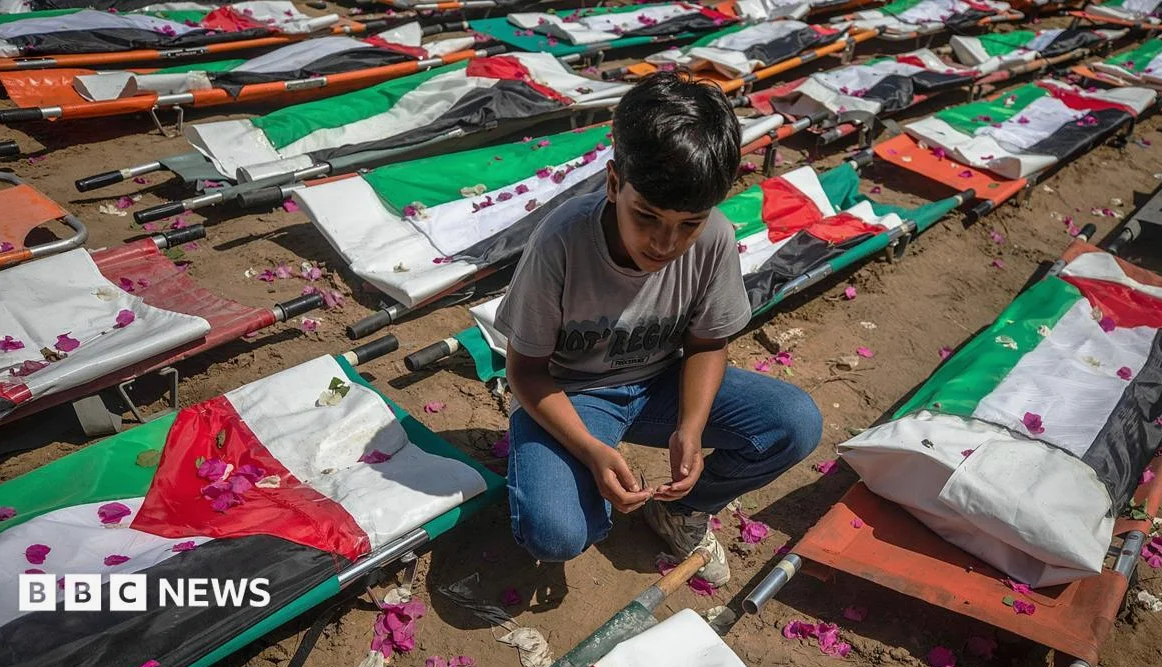
Large crowds gathered in Gaza City for the mass funeral of 112 people, mostly women and children, who were killed in an Israeli strike on a residential block in late 2023, early in the Gaza war. The remains of members of two extended families were recovered from the rubble in a two-week-long operation.
Rescue and Recovery Efforts
Dramatic footage showed the remains lined up in rows, each covered with a Palestinian flag and some with a photo of the deceased. Relatives carried the bodies away for burial. The funeral is said to be the biggest of its kind to have taken place in Gaza.
Forty-four children, 38 women, and seven people with disabilities were among the dead from the Abu Sharia and Hassayna families. They were killed when a residential block in the Sabra neighborhood of Gaza City was attacked by Israel on 22 November 2023.
This attack occurred six weeks after the 7 October Hamas-led assault on southern Israel, which resulted in 1,200 deaths and 251 hostages being taken. The BBC has not yet received a response from the Israel Defense Forces (IDF) regarding what was targeted in the attack.
Impact and Casualty Numbers
Since the start of the war, at least 73,377 people have been killed in Gaza, according to the Hamas-run health ministry, whose figures are considered reliable by the UN. The recovery work was carried out by the Civil Defence, which operates under the Hamas-run interior ministry. Its efforts have been supported by the International Committee of the Red Cross (ICRC).
‘We provide material support – literally the gloves, shovels, protective equipment and body bags they use,’ said Patrick Griffiths, spokesperson for the ICRC. ‘We provide training, supporting them to do their work safely, in line with professional practice ensuring the deceased are treated with dignity.’
Griffiths also mentioned that the ICRC has supported the operation by renting two of the only excavators available for this work in Gaza for hundreds of hours. ‘It’s not an answer any family wants to receive – confirmation that your loved one has been killed,’ he added. ‘But it’s essential towards them receiving closure and being able to mourn their loss in their own way.’
Community and Personal Accounts
Ali Abu Sharia, one of the mourners, said the funeral provided a sense of relief despite the pain of loss. ‘I think this is a feeling that was supposed [to be felt], a feeling of pain, grief and loss,’ he said. ‘After we managed to retrieve them and bury them, perhaps we can be partially relieved despite the pain of loss and all we’re still living through.’
Last month, the BBC filmed the start of the operation to uncover bodies in Sabra. A single bulldozer picked through the rubble before more delicate work was done by hand. ‘This multi-storey building has been levelled. There were maybe more than 180 civilians inside. Most of them, around 90%, were killed,’ said Civil Defence spokesman Mahmoud Basal at the time.
Relatives of the dead were present during the recovery work, guiding the teams and expressing relief at being able to give their loved ones a proper burial. ‘It’s a devastating and sad feeling that resonates with everyone who was here,’ said Nahed al-Hassayna as he showed the BBC the rubble of his family’s living room. ‘The kids – what did they do? Why were they killed?’
Yousef Abu Sharia, a sole survivor of his family, said, ‘Today, I’m talking to you [as] the one who lost my mother, my father, my uncle and my cousins and all my family. I lost them under this rubble.’
It is believed that dozens more bodies are yet to be recovered at the site. Across the Gaza Strip, thousands of people are unaccounted for, with the remains of many still thought to be under the rubble left by intense Israeli air strikes during the war.

Comments
No comments yet
Be the first to share your thoughts