

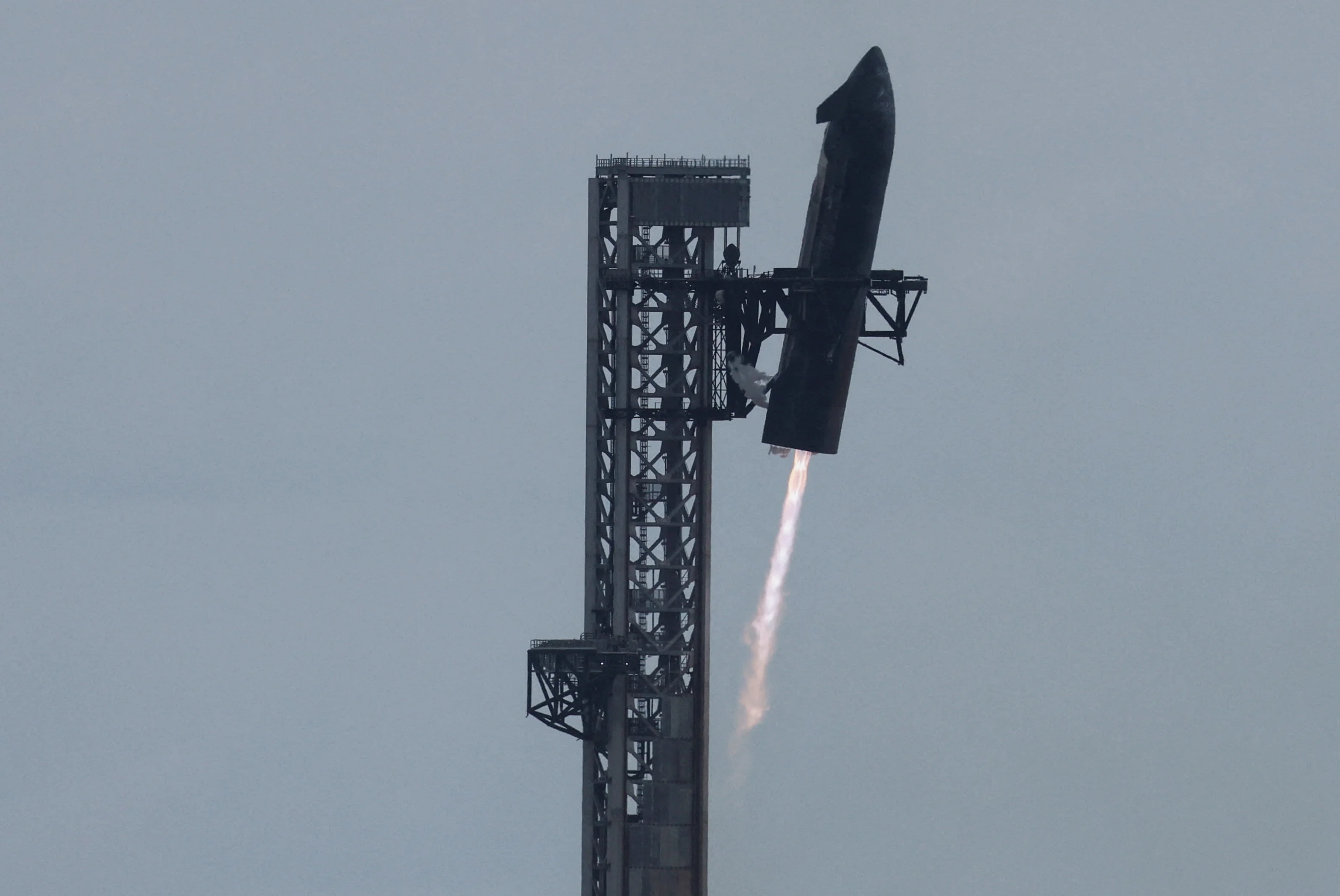
The first-stage Super Heavy booster was not caught during the launch on November 13. The guidance system detected it was not in the correct position and aborted the catch, diverting it to the Gulf of Mexico where it self-destructed in a fireball before hitting the water. “The booster was not in the place that it was supposed to be to proceed with the catch,” SpaceX spokesman Dan Huot said.
Despite the booster failure, the Starship spacecraft performed well in orbit, deploying 26 of the latest Starlink v3 satellites. The spacecraft completed 14 orbits of Earth, significantly more than previous missions. “Overall the ship’s still looking healthy,” Huot said. The satellites will expand SpaceX’s Starlink satellite internet constellation, which now includes over 11,000 satellites.
The return path for Starship was carefully planned to avoid populated areas, with the spacecraft flying over lightly inhabited desert regions and making a “giant swoosh manoeuvre” before its final approach. Senior SpaceX engineer Lars Blackmore noted that the return over land involved a 21-minute period where operators could not intervene.
NASA, which is relying on Starship for its Artemis lunar missions, praised the achievement. NASA Administrator Jared Isaacman called the launch “another spectacular launch” and later described the capture as “almost magic.” The agency expects Starship to serve as a lunar lander for future missions to the Moon.
Elon Musk celebrated the success, posting a video on X of the upper stage after it was caught. He praised his team for the achievement. SpaceX aims to use Starship for both commercial and government missions, including expanding Starlink, ferrying astronauts to the Moon, and eventually supporting Mars colonization.
This was the 15th test flight of the full-scale Starship system since 2023 and only the second time the spacecraft has reached orbit. The company has previously caught the Super Heavy booster three times, but this was the first time the upper stage was successfully recovered after an orbital flight.
The reports differ in tone and emphasis. The Straits Times and CNBC focus on the technical details and the missed opportunity to catch the booster, while Al Jazeera and BBC News highlight the success of the upper stage catch as a historic achievement. Al Jazeera and BBC also emphasize the crowd reaction and the emotional significance of the event, whereas The Straits Times and CNBC focus more on the engineering and operational aspects. CNBC also mentions the FAA and Hawaii DOT responses to the flight, which are not covered in the other reports.





Comments
No comments yet
Be the first to share your thoughts