

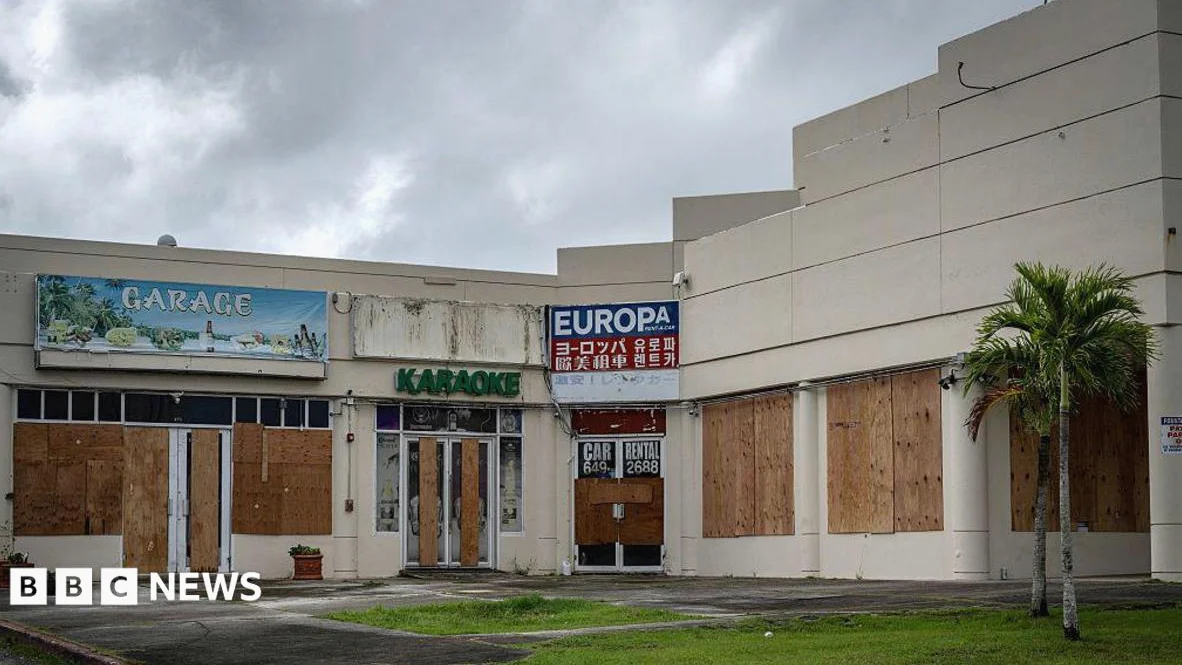
Super Typhoon Bavi made landfall on the U.S, as Pacific islands on Monday, bringing wind gusts as high as 333 km/h (207 mph), according to the National Weather Service (NWS). The western eyewall of the storm was moving over the island of Rota, located between Guam and the Northern Marianas, with maximum sustained winds of 280 km/h (173 mph) as reported by the Joint Typhoon Warning Center (JTWC).
Storm Intensity and Predicted Path
The NWS described Bavi as a “very dangerous” typhoon with the potential to cause “catastrophic wind damage” near the storm’s eye; the storm was forecast to pass closest to Rota at around 8 am on Monday (2200 GMT Sunday), bringing “extremely dangerous hurricane winds.”
Bavi, classified as a super typhoon with winds exceeding 240 km/h (150 mph), is equivalent to a Category 4 or Category 5 hurricane in the U.S. system, the NWS noted. The Joint Typhoon Warning Center confirmed the storm’s strength, emphasizing its potential for widespread destruction.
Impact and Warnings
The NWS issued urgent warnings. Urging residents to treat the imminent extreme winds as if a tornado was approaching; “Move immediately to an interior room or shelter NOW!” the agency said in a post on X. The agency warned that “many non-concrete, non-reinforced homes will be destroyed, with total roof failure and wall collapse.”
Flash flood warnings were also in effect for Saipan and Tinian in the Northern Marianas — If Bavi moves over or close to Rota as forecast, much of the area will be “uninhabitable for weeks, perhaps longer,” the NWS said. Nearly all trees will be snapped or uprooted, and power poles will be downed, leading to power outages that may last weeks to months.
Residents in the region have been moving to emergency shelters and making last-minute preparations before the storm’s arrival. In the Northern Mariana Islands. The mayor’s office issued an advisory urging residents to prepare for “destructive winds,” noting that “conditions are expected to deteriorate rapidly, making it unsafe to be outdoors.”.
Evacuation Efforts and Climate Context
Guam, a tourist destination with a population of about 170,000, has opened five evacuation centers in its schools, with a maximum capacity of around 1,700 people. These sites are primarily intended for vulnerable individuals. As of 1 pm local time on Sunday, one of the evacuation centers had already reached maximum capacity, and people were being redirected to another site.
Scientists have noted that while storms of this strength are unusual for the U.S. islands, climate change is making powerful typhoons more common. Pinky Cubacub. A resident of Guam, told AFP that she had been boarding up the windows of her eatery with $500 worth of plywood to prepare for the storm.




Comments
No comments yet
Be the first to share your thoughts