

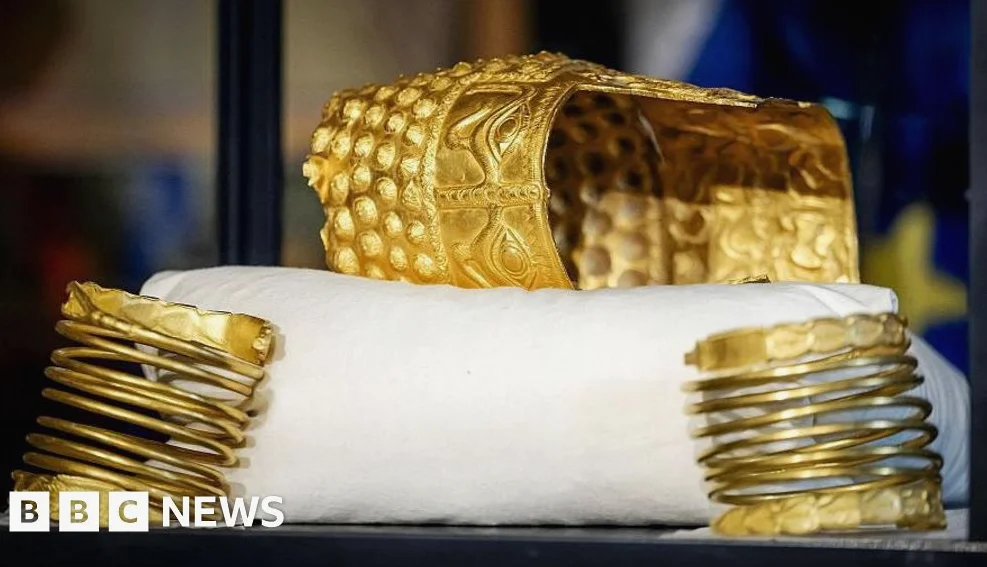
Three men were sentenced to 47 months in prison for their roles in the theft of a 2,500-year-old golden helmet and three bracelets from the Drents Museum in Assen, Netherlands. The stolen artifacts. Part of Romania’s national heritage from the Dacia civilization, were recovered in a plea deal with two of the suspects, while the third bracelet remains missing.
Artifacts Stolen from Loaned Exhibition
The Coțofenești helmet and three gold bracelets were on loan from Romania’s National History Museum for an exhibition at the Drents Museum when they were stolen in a 2022 heist. The museum’s general director at the time called the theft “a dark day” for the institution. According to CBS News. The artifacts were described as “relics of our historical memory” by Cornel Constantin Ilie, interim director of the National History Museum in Bucharest.
The theft occurred when a gang used a large crowbar and explosives to break into the museum. A security video showed three individuals entering through a forced door. The court noted that the artifacts were insured for about $6.6 million but stressed that their true value is immeasurable. The recovered items were returned to Romania in “perfect condition,” except for a minor, barely visible damage to the helmet.
Plea Deals and Sentencing
In April, Dutch authorities announced the recovery of the helmet and two of the three bracelets after reaching a plea deal with two of the suspects: Jan B, 21, and Douglas Chesley W, 37. According to AOL.com, the prosecution initially requested a 44-month sentence for the pair. The third suspect, 35-year-old Bernhard Z, refused a deal and faced a 66-month sentence demand.
Despite the plea agreements, the court imposed the same 47-month sentence on all three men. The court emphasized that “only a substantial prison sentence will suffice” given the gravity of the offenses. The process of negotiating the plea deal was described as “long, intensive and complex” by prosecutors.
Artifacts of National Importance
The artifacts, dating back to around 450BC, are considered among Romania’s greatest treasures. They were part of an exhibition on the Dacia civilization, which inhabited present-day Romania before the Roman conquest in 106AD. The court’s verdict highlighted that “the art treasures are part of Romania’s past and are of great importance to current and future generations.”
The remaining bracelet is still missing, and the search for it continues. While only two suspects assisted in the recovery, the court ruled that all three should “profit from the return of the treasures.” The court also noted that the items were returned in a condition that allowed for their safe repatriation to Romania.






Comments
No comments yet
Be the first to share your thoughts