

 BBC News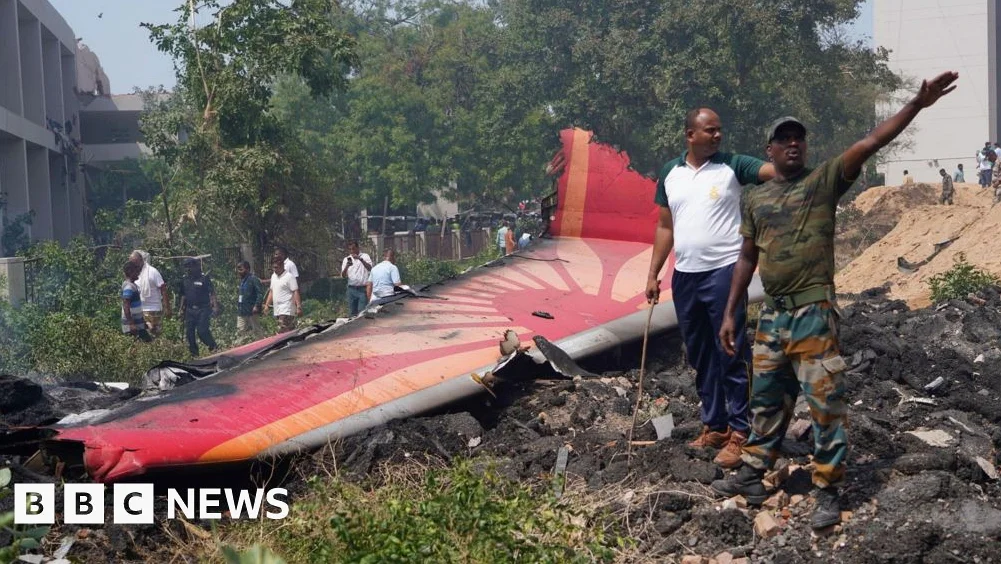
The Aircraft Accident Investigation Bureau (AAIB) announced on the first anniversary of the crash that ‘significant progress’ has been made in the investigation but emphasized that the final report will not be released yet. The Boeing 787 Dreamliner crashed shortly after taking off from Ahmedabad on 12 June 2025 en route to London.
Ongoing Analysis of Evidence
The crash occurred about 6km (3.7 miles) from the airport, with the plane crashing into a building used as doctors’ accommodation at the Byramjee Jeejeebhoy Medical College and Civil Hospital. The incident caused a massive explosion that left 19 people dead on the ground and 241 on board, including 169 Indian nationals and 53 Britons. Only one person, Viswashkumar Ramesh from Leicester, survived.
According to the AAIB, the investigation team has conducted an ‘extensive and rigorous examination of all relevant technical, operational, organisational and human factors associated with the accident.’ The AAIB noted that significant progress has been made in the analysis of aircraft systems, flight recorder data, engine-related components, maintenance and operational records, and other evidence.
Preliminary Findings and Speculation
A preliminary report published on 12 July last year found that fuel-control switches abruptly moved to the ‘cut-off’ position just seconds after take-off, causing a total power loss to the engines. Audio recordings from the cockpit captured one pilot asking the other why the action was taken, with the other replying that he had not done it. Investigators have not yet identified which pilot made the statements.
Following the release of the preliminary report, media attention turned to the pilots. The Wall Street Journal and Reuters reported that the focus of the investigation had shifted towards the senior pilot, Capt Sumeet Sabharwal. According to Reuters, a cockpit recording of the dialogue between the two pilots suggested that the captain cut the flow of fuel to the plane’s engines. The AAIB did not comment on this specifically.
Reactions and Criticism
The reports prompted strong criticism from pilots’ associations in India, who rejected the suggestion that the senior pilot had caused the crash. Pushkar Raj, a pilot in his 90s, said, ‘Every time an accident takes place, the pilot is blamed. Why? It’s the simplest way to close the chapter. He is no more and cannot defend himself.’
The AAIB emphasized that the ‘sole purpose of an accident investigation is to enhance aviation safety through the identification of lessons and safety recommendations, and not to apportion blame or liability.’ The statement also extended the AAIB’s condolences to the families of the deceased.
India’s civil aviation minister had earlier indicated that the investigation was in its ‘last stage’ and that the final report would be released ‘mostly… after a month.’ However, the AAIB’s recent update suggests that more time is needed for the inquiry.






Comments
No comments yet
Be the first to share your thoughts