

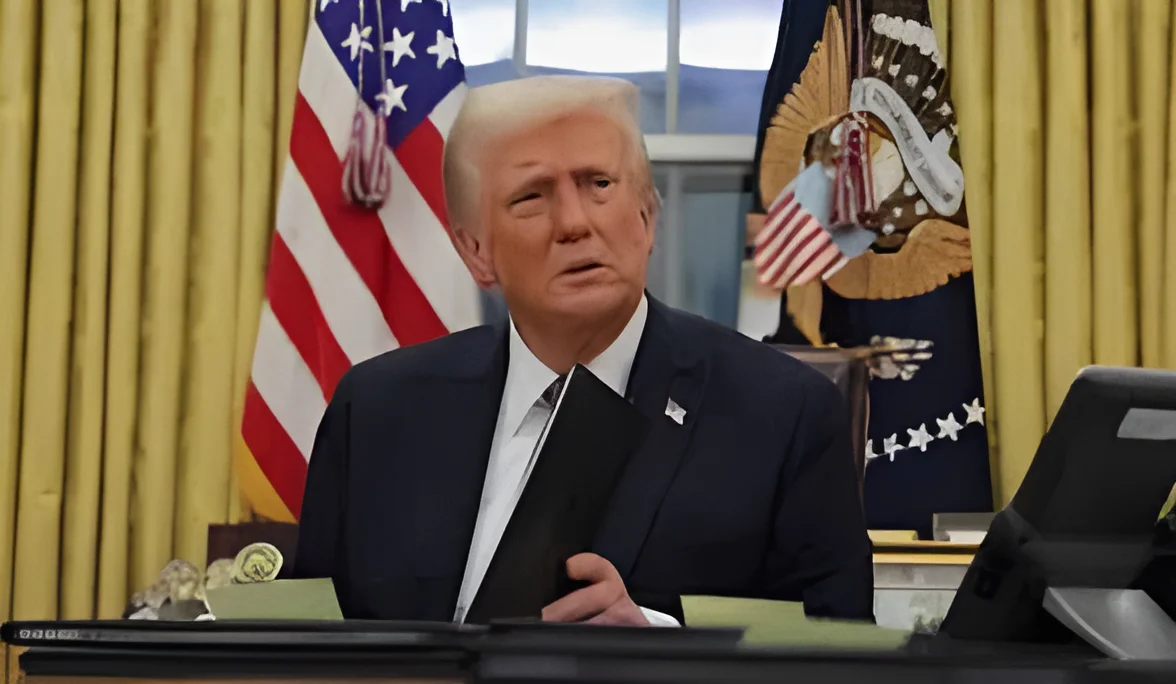
President Donald Trump has announced that 48 Iranian leaders were killed in recent U.S. military operations, as the conflict in the Gulf continues to escalate. According to Trump, the U.S. has also sunk nine Iranian naval ships and largely destroyed the country’s naval headquarters. The president made these claims in a phone call with Fox News’ Jacqui Heinrich and in a post on Truth Social, where he emphasized that the operation is progressing faster than anticipated.
Iranian Leadership and Nuclear Aspirations
Senior Trump administration officials confirmed that Iran possesses approximately 450 kg of 60% enriched uranium, placing the country just one week away from achieving 90% weapons-grade uranium, the threshold for producing a nuclear weapon. However, building an actual nuclear weapon would require months, according to a U.S. intelligence report from last June following U.S. and Israeli strikes on Iran’s nuclear facilities.
Trump has been overseeing the military operations from his Mar-a-Lago residence in Palm Beach, Florida. In a call with CNBC’s Joe Kernen, he described the operation as ‘moving along very well, very well — ahead of schedule’ and emphasized that the Iranian regime is ‘one of the most violent regimes in history.’
U.S. and Israeli Strikes Target Iranian Assets
The U.S. has reported sinking nine Iranian naval ships, some of which are described as relatively large and important. In a separate attack, the president claimed that the Iranian navy’s headquarters was ‘largely destroyed.’ He added that the U.S. is continuing its operations, stating, ‘They will soon be floating at the bottom of the sea, also!’ Despite this, Trump noted that ‘their Navy is doing very well.’
Trump also mentioned that Iran’s new leaders want to engage in talks with him. ‘They want to talk, and I have agreed to talk, so I will be talking to them,’ he said in a phone call with The Atlantic’s Michael Scherer. However, he did not specify when these talks would take place.
Civilian Toll and Regional Impact
The conflict has resulted in significant civilian casualties. In Israel, nine people were killed in a missile strike in the city of Beit Shemesh, according to medical services. In the United Arab Emirates, three people were killed and 58 injured in Iranian missile and drone attacks. The UAE’s defense ministry reported that 165 ballistic missiles were detected, with 152 destroyed, and two cruise missiles intercepted. Additionally, 506 out of 541 Iranian drones were shot down.
In Kuwait, one person was killed and 32 injured since the attacks began. In Oman, which helped mediate U.S.-Iran talks, the port of Duqm was targeted by two drones, with one striking a mobile workers’ accommodation and injuring a foreign worker. An oil tanker off the coast was also targeted, with four crew members injured.
The Gulf Cooperation Council (GCC) is set to convene via video-link to discuss a unified response to Iran’s attacks. UAE presidential adviser Anwar Gargash criticized Tehran for the attacks, calling them a ‘miscalculation’ that has isolated Iran at a critical juncture. ‘Your war is not with your neighbours,’ Gargash said.
Meanwhile, in Pakistan, at least seven people were killed in pro-Iran demonstrations in the northern city of Gilgit. Rescue official Zaheer Shah reported that many others were injured. Earlier, nine people were killed during a protest at the U.S. consulate in Karachi.
The conflict has also raised concerns about the potential for a wider regional conflict. Iran’s interim leadership council, formed after the killing of Supreme Leader Ayatollah Ali Khamenei, is expected to choose a new leader in ‘a day or two,’ according to Iran’s foreign minister. However, the uncertainty surrounding the new leadership has added to the tension in the region.
Trump has expressed confidence that the ongoing operation will not lead to a significant increase in oil prices, despite the potential for market volatility. ‘This could have been a huge price increase with respect to oil, if things went wrong,’ he said, suggesting that the successful execution of the operation has mitigated such risks.
As the conflict continues to unfold, the international community is closely watching the situation, with concerns over the potential for further escalation and the impact on global security and trade.





Comments
No comments yet
Be the first to share your thoughts