

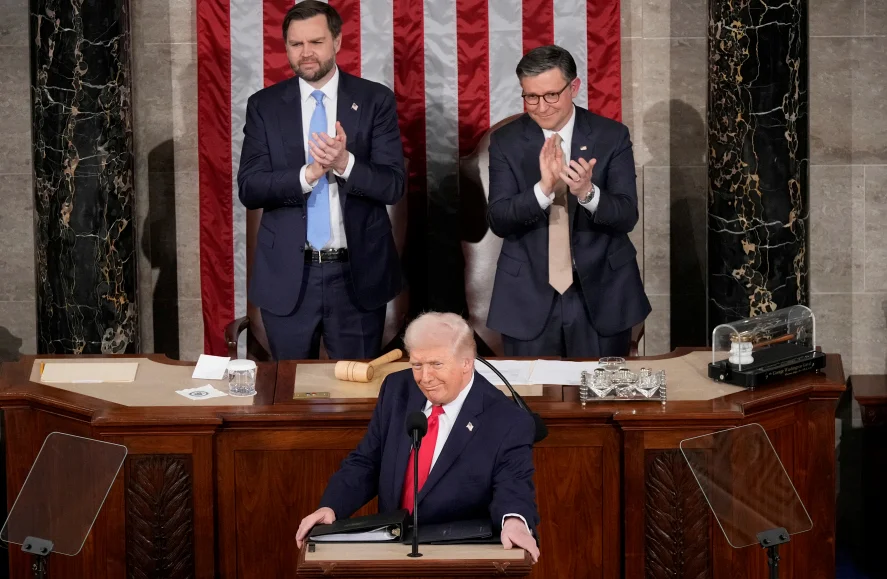
WASHINGTON — President Donald Trump delivered the longest State of the Union address in history on Tuesday, speaking for 108 minutes to assert that the United States is ‘winning so much’ and urging voters to support Republicans in the November midterm elections. The extended speech, which surpassed the previous record by eight minutes, marked a strategic attempt to counter his declining approval ratings and reinforce his administration’s achievements.
Record-Breaking Duration and Strategic Messaging
Trump’s address, which lasted 108 minutes, was the longest in the history of the State of the Union speech, a tradition that dates back to 1790. The previous record was set by Trump himself during his 2020 address, which lasted 100 minutes. According to White House officials, the extended duration was designed to emphasize key policy points and counter criticisms of the administration’s performance.
Trump largely avoided his usual hyperbolic rhetoric, instead focusing on economic achievements and foreign policy successes. He emphasized the economic recovery, pointing to record-low unemployment rates and rising stock market indices. ‘We’re winning so much,’ he declared, a phrase that became a recurring theme throughout the speech.
Use of Special Guests to Bolster Message
As in previous addresses, Trump relied on surprise special guests to punctuate his message. Among those present were U.S. military veterans, athletes, and a former political prisoner released after U.S. forces played a role in the ousting of Venezuelan President Nicolás Maduro. The most enthusiastic applause of the evening came when Trump invited the U.S. men’s Olympic gold medal-winning hockey team into the House chamber, a gesture intended to highlight American exceptionalism and national pride.
Trump also took aim at Democrats, criticizing their legislative agenda and accusing them of undermining national security and economic stability. He highlighted the administration’s efforts to impose a new global order, particularly through trade policies and diplomatic initiatives that he claimed had reshaped international relations.
Economic Claims and Voter Appeal
The president’s main objective was to convince increasingly wary Americans that the economy is stronger than many believe and that they should continue to support Republican candidates in the upcoming midterm elections. Trump pointed to economic data, including a 3.5% unemployment rate and a strong stock market, to underscore his argument.
‘The American people are tired of the chaos and the dysfunction,’ Trump said, addressing what he called a ‘broken system’ in Washington. He framed his policies as the solution to the country’s challenges, emphasizing that ‘the American dream is alive and well.’
Analysts have noted that Trump’s focus on economic success is a key component of his campaign strategy, aimed at mobilizing his base and countering the narrative that the economy is underperforming. According to a recent poll by the Pew Research Center, 52% of Americans believe the economy is doing well, a figure that Trump hopes to further solidify through his message.
Despite his claims of success, Trump faces a challenging political landscape. His approval ratings have been declining, with recent surveys indicating that his favorability has fallen below 40% among the general public. The president’s strategy hinges on using the current economic climate to bolster his political standing ahead of the November midterms.
What remains to be seen is how effectively Trump’s message will resonate with voters. With the midterms approaching, the administration is expected to ramp up its outreach efforts, including a series of town halls and campaign events across key battleground states. The outcome of these efforts could significantly influence the balance of power in Congress.
According to White House officials, the president is confident that his message will be received well. ‘The American people know the truth,’ he said during his speech. ‘They see the progress we’ve made, and they’re ready to keep moving forward.’






Comments
No comments yet
Be the first to share your thoughts