

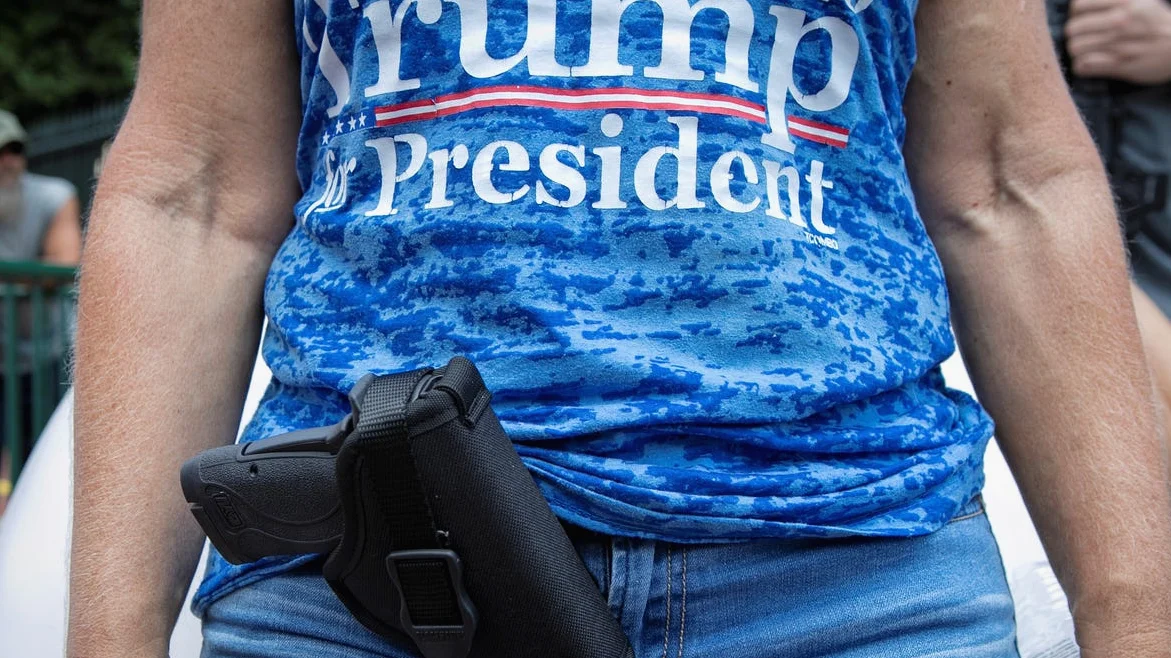
The Trump administration has quietly restored gun rights to 22 individuals this year, including Arizona state Senator Jake Hoffman, as it revives a long-dormant program that could see as many as one million applications. The move has sparked debate over the implications for public safety and the rights of non-violent felons.
Restoration of Gun Rights Sparks Debate
The Department of Justice listed the names of nearly two dozen individuals in late February in the Federal Register, many of whom had previously applied for pardons or had recently sued the department. Their crimes ranged from non-violent drug offenses to bribery and fraud.
One notable case is Arizona state Senator Jake Hoffman, who was charged in the state’s fake elector scheme to keep Donald Trump in the White House in 2020. Although Trump pardoned Hoffman for any federal charges, he remains federally prohibited from buying new firearms due to a state indictment. Hoffman declined to comment when reached by USA TODAY.
Federal law generally prohibits felons from possessing guns and blocks gun sales to those convicted of domestic violence. The Trump administration is now ramping up a relief procedure that has been dormant since 1992 to make it easier for non-violent felons to regain their gun rights.
Gun Rights Groups and Opponents React
Gun rights groups like the National Rifle Association and the National Association of Gun Rights support the move, while gun violence prevention groups like Everytown and the Consortium for Risk-Based Firearm Policy oppose it. Kris Brown, president of Brady, a gun control group, criticized the administration for restoring gun rights without completing the rule-making process.
“Who are these people, and why are their rights to purchase deadly weapons being restored? The Trump administration once again believes itself above the law and is sloppily restoring gun rights to people without finishing the rule making process,” Brown said. “That means the public’s comments about what this new restoration process will entail – meaning its potential to arm domestic abusers and hurt communities – are being blatantly ignored.”
Despite the opposition, the proposed rule outlines several ‘presumptively disqualifying crimes’ including felony sex offenses and other violent crimes. It proposed a waiting period of 10 years after completing a sentence for serious offenses and a 5-year time period for all other offenses.
Public Comments and Legal Challenges
A USA TODAY analysis of the 3,400 comments received on the proposal showed roughly 90% were in favor of the proposal. Some comments argued for fewer restrictions, no waiting periods, and sought an appeals process. A minority of comments, including some by survivors of violence, opposed the restorations outright.
“Having been the victim of domestic violence, I am deeply concerned about perpetrators of abuse regaining gun ownership rights,” one woman wrote. “Women will lose their lives if this is allowed to go through. Their blood will be on your hands.”
A majority of the 22 individuals named in February by the attorney general had their rights restored after applying for full pardons at the department. Those pardon applications are still pending for 14 people who now can possess firearms.
One man, James Michael Klos, was granted a pardon by President Trump for his 2005 possession of an unregistered firearm charge. Another route to a faster restoration of rights appears to be lawsuits. That’s the path taken by at least two people on the list released in February.
Philadelphia real estate developer George Manosis, 63, sued DOJ and ATF in 2023 seeking his gun rights. He was convicted in 2005 for bribery, in what his attorney called a ‘low-level pay to play scheme’ involving local building inspectors. After Trump’s executive order, a DOJ staffer reached out to inform Manosis about the restoration process.
Manosis formerly carried a .380 Colt Mustang he plans to replace with a modern version. He said he’s taken responsibility for his crime and as a landlord he gives people with convictions a second chance.
John Mastrangelo, 45, of Parkland, Florida received his gun rights back in February. He sued DOJ in 2024 and was also invited to apply for the restoration process. Mastrangelo was convicted in 2001 of conspiracy to possess with intent to distribute narcotics and was sentenced to 47 months in prison.
“He’s the perfect candidate who came back and built a business and shouldn’t be permanently barred from firearms,” said Pat Wilson, an attorney who represented Mastrangelo. “He was very into hunting before he was disarmed, which was the primary motivating factor.”
Nick Sabatine, 74, is an attorney in Wind Gap, Pennsylvania, who had his firearm rights restored. He was charged in 2013 with tax fraud for filing an incorrect return tied to a Ponzi scheme operated by another man. Sabatine kept his law license after the charge and cooperated with federal authorities on the case.
“It was unfortunate, I made a mistake, I regret it, it was my fault. But this is for people who don’t pose a threat to society and I never saw it as a valid punishment,” Sabatine said, adding that he’d like to protect his two Schnauzers from a black bear that roams his yard.
Sabatine said he had no tie to the Trump administration, but ran for Congress on the Reform Party ticket in 1996. He performs in a conservative rock band ‘The Patriot All-Stars’ and performs a song, ‘Don’t Blame Me (I Voted for Trump).
The issue became a flashpoint early in the Trump administration when Academy Award-winning director and actor Mel Gibson and nine others had their gun rights restored in April 2025. Justice Department Pardon Attorney Liz Oyer refused to add Gibson to the pilot program, leading to her being fired.






Comments
No comments yet
Be the first to share your thoughts