

In the dead of night, as the world watched, President Donald Trump stood before a joint session of Congress and delivered the longest State of the Union address in U.S. history. At one hour and 48 minutes, Trump’s speech shattered previous records, including those set by Bill Clinton in 2000. Yet, while the length of the address was unprecedented, the content was anything but unifying.
A New Record, Old Patterns
Trump’s 2026 State of the Union was not only the longest in modern history, it was also emblematic of the patterns that have defined his presidency. The speech, delivered in the shadow of a polarized nation, was filled with familiar themes: criticism of the media, claims of corruption, and a heavy emphasis on national security. It was a speech that reflected both the ambitions and the controversies of his second term.
According to the American Presidency Project, which has meticulously tracked the lengths of these speeches since 1964, Trump’s address was the longest in at least 60 years. It surpassed his own previous record of 99 minutes from March 2025 and outstripped Clinton’s 89-minute address in 2000. The speech was a marathon, but it was also a mirror — reflecting the deep divisions in American society.
A Divisive Address
The speech was met with a mix of reactions. While some supporters hailed it as a bold and thorough address, critics saw it as an attempt to distract from the president’s low approval ratings. The address was also marked by moments of controversy, including a thinly veiled attack on the Somali community in Minnesota. Trump claimed that members of the Somali community had plundered $19 billion from the American taxpayer, a statement that was immediately challenged by Rep. Ilhan Omar, a Somali-American congresswoman.
“That’s a lie — you’re lying!” Omar shouted, as Trump continued with his rhetoric, painting the Somali community as a source of corruption and lawlessness. The incident underscored the broader themes of the speech: a focus on perceived threats to American values and a tendency to conflate immigration with national decline.
Context and Controversy
The State of the Union address, a tradition that dates back to George Washington in 1790, is meant to be a unifying moment. However, Trump’s speech was anything but unifying. It was a 108-minute journey through a series of grievances, policy proposals, and personal attacks. It was a speech that reflected the president’s deepening isolation and the challenges of governing a deeply divided nation.
Amid the speech, the international stage was also in motion. In Geneva, Switzerland, U.S. envoys were preparing to meet with Iranian counterparts to discuss nuclear negotiations. Meanwhile, crude oil prices remained volatile, with traders waiting for clarity on the outcome of these talks. The geopolitical landscape was shifting, but Trump’s address was more focused on domestic politics than international diplomacy.
Domestic Politics and National Unity
Despite the global tensions, Trump’s address was firmly rooted in domestic politics. He emphasized his commitment to national security, vowing to prevent Iran from acquiring a nuclear weapon. Yet, his approach was not solely diplomatic. The U.S. had positioned military forces in the Middle East, signaling that the risk of military action remained very real.
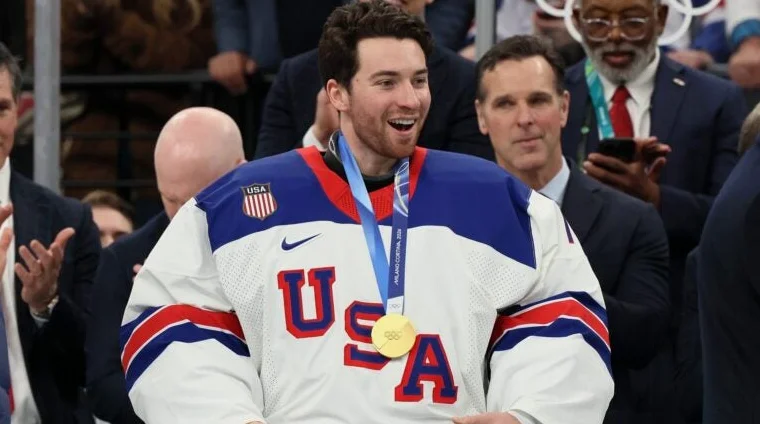
Domestically, the president’s speech was also marked by moments of reflection. In the wake of the U.S. men’s hockey team’s victory at the 2026 Winter Olympics, the viral moment of the locker room phone call with Trump had sparked a mix of reactions. Bruins’ goaltender Jeremy Swayman, speaking to reporters in Boston, acknowledged that the team should have reacted differently to Trump’s joke about the U.S. women’s hockey team.
“We should have reacted differently,” Swayman said, expressing regret over the team’s reaction to Trump’s comment. “We are so excited for the women’s team. We have so much respect for the women’s team, and to share that gold medal with them is something that we’re forever grateful for.”
A Moment of Reflection
The viral moment had sparked a wave of backlash, particularly from fans of the U.S. women’s hockey team. Swayman’s admission of regret underscored the complex relationship between sports, politics, and public perception. While the men’s team had celebrated their gold, the women’s team had also secured a historic third Olympic gold medal. The call from Trump had inadvertently overshadowed their achievement, a fact that Swayman was quick to acknowledge.
“Now that we’re home, we get to share that together forever and see the incredible support that we have from the USA and sharing this incredible gold medal,” Swayman said, emphasizing the importance of recognizing the women’s team’s accomplishments.
A Nation at a Crossroads
As the nation grapples with the challenges of the 21st century, the State of the Union address serves as a barometer of the times. Trump’s speech, while record-breaking in length, was a reflection of a president who is both polarizing and powerful. The address was a statement of intent, but it also revealed the deepening divides in American society.
Whether the speech will serve as a turning point or further deepen the divisions remains to be seen. What is clear is that Trump’s approach to governance is as unorthodox as it is controversial. In a nation facing economic uncertainty, geopolitical tension, and social unrest, the president’s message is one of strength, but also of division.
The road ahead is uncertain, but one thing is clear: the State of the Union has become more than just a political ritual. It is a reflection of the times, and a testament to the challenges that lie ahead.



Comments
No comments yet
Be the first to share your thoughts