

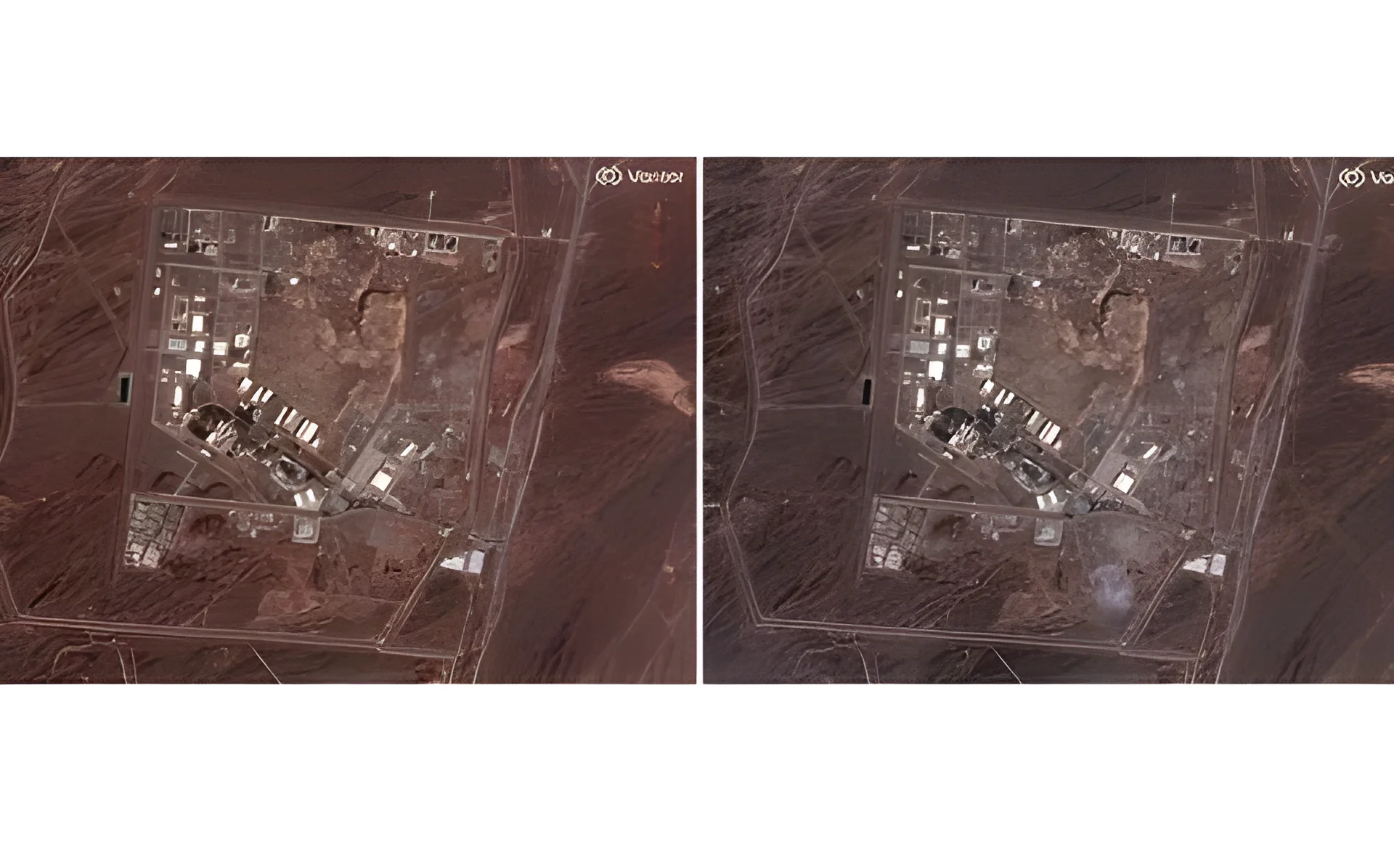
U.S. special operations forces may be required to secure Iran’s enriched uranium stockpiles, as concerns grow over the potential weaponization of nearly 1,000 pounds of material, analysts say. The uncertainty surrounding the fate of canisters containing enriched uranium has raised the prospect of a high-stakes ground operation, following a series of airstrikes by the U.S. and Israel targeting Iran’s military infrastructure.
Impact on Nuclear Security
Analysts warn that nearly 1,000 pounds of enriched uranium could be weaponized if Iran’s centrifuges remain operational, despite previous airstrikes that were believed to have set back the country’s nuclear program by years. Barbara Slavin, an expert on Iran with the Stimson Center think tank, described the potential operation as requiring ‘the mother of all commando raids’ to retrieve the canisters.
Suspected locations for the material include damaged tunnel complexes at Iran’s Esfahan site and inside facilities at Fordow and Natanz. Recovering the material could require digging through rubble in harsh terrain while a war is underway, analysts say.
Threat of Power Vacuum
If the current conflict leads to the erosion and eventual loss of control by the Iranian regime, the security of nuclear materials, technology, and knowledge will become a major issue, according to experts at the International Institute for Strategic Studies. A regime downfall could create an opening for groups like Hamas, Hezbollah, and the Islamic State to seize centrifuges and materials.
Barbara Slavin, in a Stimson Center analysis co-authored with proliferation experts Richard Cupitt and Christina McAllister, warned that the instability could lead to the theft of nuclear materials by non-state actors. ‘The security of nuclear materials will be a major issue if the Iranian regime loses control,’ she wrote.
Recovering the material would likely involve elite special operations forces supported by heavy equipment and technical experts. The Stimson Center report stated that the United States may yet have to ‘put boots on the ground’ to secure vulnerable weapons of mass destruction (WMD)-relevant material in Iran.
Preparation and Readiness
President Donald Trump has not ruled out such a move in the future, though he said the U.S. is currently focused on decimating Iranian military targets. ‘We wouldn’t do it now,’ he said aboard Air Force One. ‘But (it’s) something we could do later on.’
The Pentagon’s stated main objective of Operation Epic Fury is the dismantling of Iran’s ability to project military power, including the destruction of its missile and drone programs. Retired Air Force Lt. Gen. David Deptula, dean of the Mitchell Institute for Aerospace Power Studies, said many of the administration’s goals can be achieved by airstrikes.
Deptula emphasized the level of detailed intelligence on Iranian targets that has enabled the U.S. and Israel to achieve air dominance and operate at will. ‘It is the intelligence with respect to knowing where the systems and capabilities that you want to have an effect upon are located,’ he said.
However, the Stimson Center report noted that while the overall attack appears to have been planned for months with the explicit goal of encouraging the overthrow of the government, it is less clear that there has been any associated forethought given to securing the stockpiles.
Deptula added that it is a virtual certainty that military commanders have been planning through scenarios to contain Iran’s nuclear program and ensure the material does not fall into the wrong hands. ‘We demonstrated over and over again how that is possible with air power,’ he said.
The potential need for a ground operation to secure Iran’s nuclear materials highlights the broader challenge of ensuring compliance with international agreements and preventing the proliferation of WMDs. Analysts warn that the situation remains fluid, and the U.S. must be prepared to act swiftly if the threat materializes.






Comments
No comments yet
Be the first to share your thoughts