

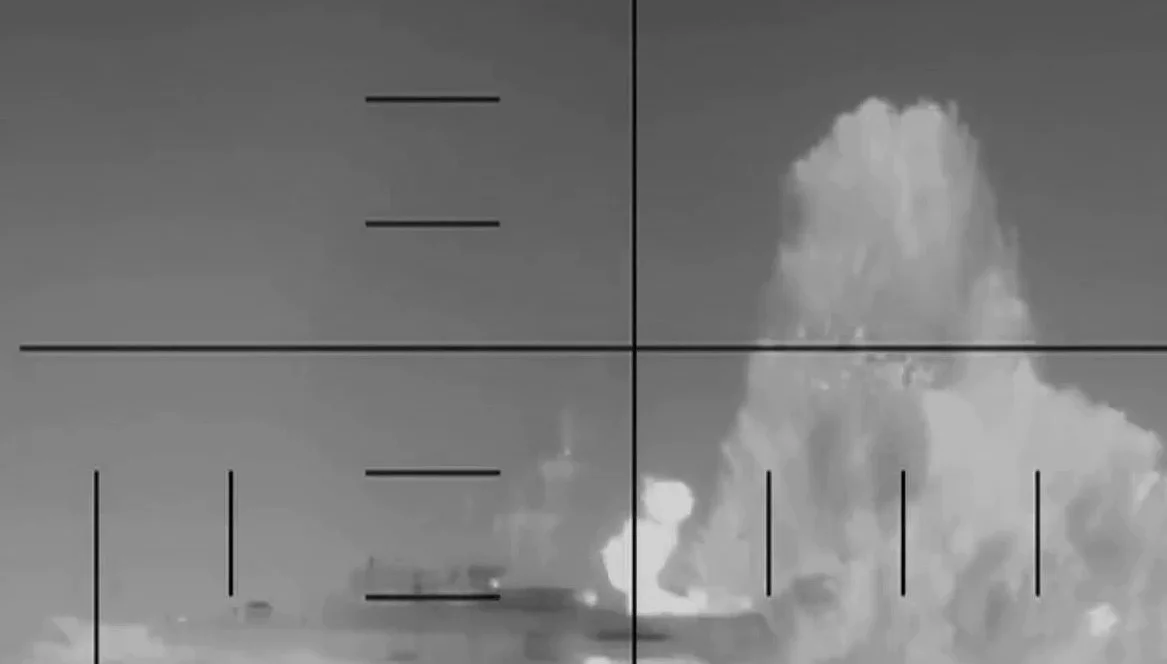
A U.S. submarine reportedly sank an Iranian warship in international waters off the coast of Sri Lanka on Wednesday night, marking the first such attack since 1945 and escalating tensions into a potential global conflict. The incident occurred when a torpedo fired from the U.S. submarine struck the Iranian vessel, Iris Dena, approximately 2,000 miles from Iran.
The Aftermath of the Torpedo Attack
Dramatic footage captured the moment of the explosion beneath the warship’s stern, followed by haunting scenes of the vessel sinking on Tuesday. The Sri Lankan navy responded to a distress signal and arrived at the scene, finding oil slicks and life rafts on the water’s surface. Rescue operations successfully saved 32 individuals from the Indian Ocean, while 87 bodies were recovered. As of Wednesday night, 70 more sailors were still unaccounted for and feared to have drowned.
Former Royal Navy chief Lord West told the Daily Mail that the sinking of the Iranian vessel transformed what had been a regional conflict into a ‘global war.’ He said, ‘It makes the situation rather tricky, as some will say this was outside the Area of Operations. While it is a horrible event, it is acceptable as the US is at war with Iran. Nobody declares war these days but that’s where we’re at. This is now a global war. There would be nothing wrong with Iran attacking US targets anywhere.’
U.S. Officials Confirm the Attack
U.S. Secretary of War Pete Hegseth confirmed the attack in a bombastic address at the Pentagon, calling it the ‘quiet death’ of the Iranian vessel. He noted that it is the first time since 1945 that an American submarine has sunk an enemy ship this way. In 1982, the UK torpedoed the Argentine ship Belgrano during the Falklands conflict.
Hegseth said the joint U.S.-Israeli operation to attack Iran had already delivered ‘twice the air power of shock and awe of Iraq in 2003’ and ‘seven times the intensity of Israel’s previous operations against Iran during the 12-day war.’ He added that the Iranian regime ‘are toast, and they know it, or at least soon enough, they will know it.’
U.S. officials stated that Iran has now lost 20 ships that U.S. forces have ‘struck or sunk to the bottom of the ocean.’ The country’s firing of ballistic missiles and suicide drones has also been slashed, according to the Pentagon. U.S. figures show Iran’s firing of ballistic missiles has dropped by 86 per cent and its drones by 73 per cent.
Escalation and Global Impact
Officials warned Iran could be saving missiles to bide its time, hoping to extend the conflict and increase pressure on Donald Trump to find an exit strategy. On Wednesday night, the Iranian regime said the death toll from the attacks had reached 1,045. That includes more than 150 people, mostly children, thought to have died when a stray U.S. missile struck a primary school in Iran.
Pentagon officials are investigating the incident on Saturday. In a bid to prevent more assassinations of its leaders, the Iranian regime announced on Wednesday it was postponing indefinitely the funeral of the Ayatollah Ali Khamenei. The event was expected to draw a crowd of thousands in Tehran.
Iran continued striking its neighbors on Wednesday, causing a total blackout in Iraq and firing drones towards a Baghdad airport. On Wednesday night, the U.S. advised all its citizens to leave Iraq. Tehran also fired a ballistic missile towards NATO member Turkey. After crossing Syrian and Iraqi airspace, it was about to enter Turkey when it was intercepted by its defensive systems.
Iran’s target may have been the joint U.S.-Turkish base at Incirlik used by America in previous Gulf Wars. Iranian projectiles were also reported in Saudi Arabia, Kuwait, and Israel. And four commercial ships transiting the Strait of Hormuz have been targeted in the last 24 hours.
Fighting also continued between Hezbollah and Israeli troops in southern Lebanon. The UK Foreign Office said it was withdrawing some staff from Bahrain over concerns of further attacks there. On Wednesday, concerns that the conflict could become drawn out led the Institute for Fiscal Studies to warn of slower economic growth, falling incomes, and rising inflation in the UK.
Former U.S. general David Petraeus, who led American troops in Iraq and Afghanistan, warned that air strikes would not lead to regime change. He said, ‘This regime is enormous, the police are very strong, the Republican Guards are hundreds of thousands, maybe over a million. We don’t see any cracks yet. Nobody has stepped away from the regime who could bring others with him. So what I am not sure what you can do is bring about regime change.’
On Wednesday night on social media, the Iranian president Masoud Pezeshkian told neighboring Gulf states the country had ‘no choice to defend ourselves’ in response to U.S. and Israeli attacks. Iranians have been warned to remain in their homes otherwise they could be shot – as Republican Guards are hunting for U.S. and Israeli spies.
Food prices have quadrupled since the conflict began on Saturday, and the regime had set up additional checkpoints to monitor its citizens.






Comments
No comments yet
Be the first to share your thoughts