

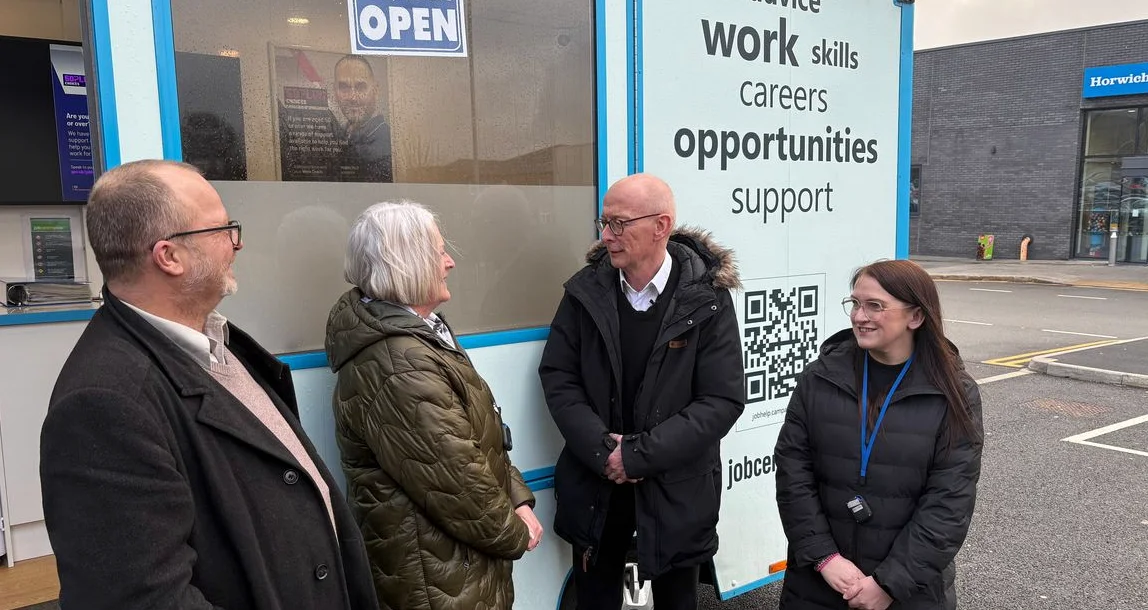
BOLTON, England — A mobile job centre that has brought employment services to football stadiums, mosques and leisure centres in Bolton will roll out to eight more locations after helping nearly 800 customers since its launch last January.
The scheme targets areas with high employment inactivity. Bolton’s rate stands at 29.2 percent, well above the national average of 20.8 percent. Many visitors to the vans — just over half — do not claim benefits, according to Department for Work and Pensions officials.
Staff park the vehicles at sites such as Bolton Wanderers’ stadium on match days, Horwich leisure centre, Masjid-e-Noorul mosque, family hubs and community centres. On board, work coaches assist with job searches, training, health-related support and childcare costs.
Work and Pensions Secretary Pat McFadden toured the Horwich leisure centre stop this week alongside Bolton Jobcentre staff Ian Henderson, Jen Farrimond and Gail Stocks. He called the service vital for economically inactive residents.
“We’re reaching many economically inactive people who may not engage with traditional job centres,” McFadden said.
The expansion triples the fleet and adds Blackpool, Wakefield, North Nottinghamshire, Barrow-in-Furness, Clevedon and Rhondda Cynon Taf/Bridgend to the pilot. It builds on earlier trials in the Scottish Highlands and north and mid Wales.
Officials described the vans as a way to deliver support directly to urban, rural, coastal and post-industrial communities with elevated unemployment. Customers board for one-on-one sessions with DWP coaches trained in overcoming barriers to work.
McFadden highlighted the approach during his visit. “We want to break down the barriers that stop people from finding good work, and that means meeting people where they are,” he said. “Jobcentres on Wheels are doing exactly that — bringing employment support into the heart of communities.”
The initiative addresses persistent joblessness in the North West and beyond. Bolton launched one of the country’s first pilots, proving the model before national rollout.
Users have included those intimidated by standard job centres. Staff report strong uptake, with services tailored to local needs like disabilities or family responsibilities.
DWP data shows the vans have connected hundreds to opportunities. Expansion aims to replicate this in diverse settings, from seaside towns like Blackpool to inland areas like Wakefield.
McFadden added that early results justify growth. “That’s why we’re building on the success we’ve already seen, expanding the service so we can unlock opportunities for even more people across the country,” he said.
The move comes amid government efforts to boost workforce participation. Officials track metrics like job placements and training enrollments to measure impact.






Comments
No comments yet
Be the first to share your thoughts