

 The New York Times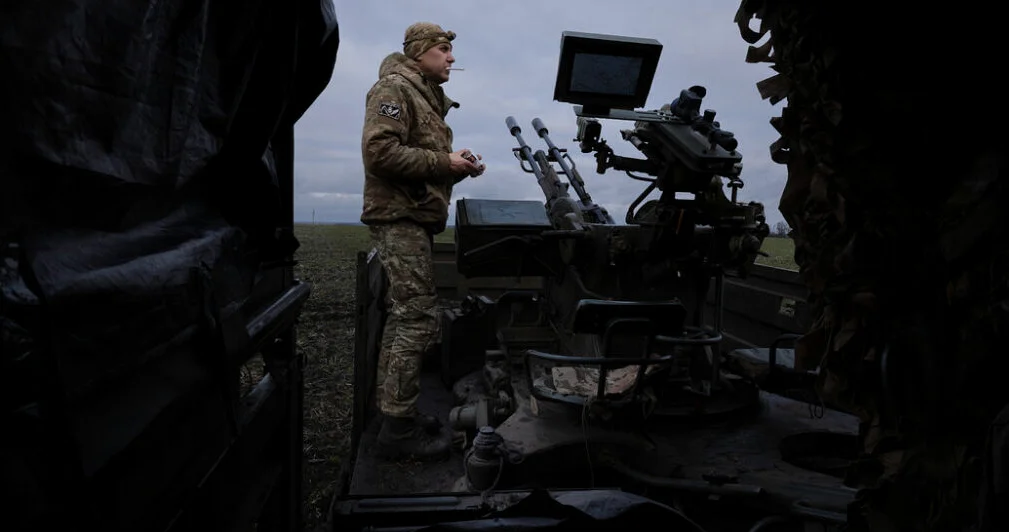
President Volodymyr Zelensky of Ukraine confirmed that his country has sent a team of drone experts and interceptor drones to protect U.S. military bases in Jordan in response to a request from the United States, according to an interview with The New York Times. The Ukrainian team left the country the day after the U.S. made the request and is expected to arrive in the Middle East soon.
Ukraine’s Growing Influence in the Middle East
Zelensky said the decision to send the team was made immediately after the U.S. request. ‘We reacted immediately,’ he said. ‘I said, yes, of course, we will send our experts.’ The White House did not respond to questions about whether the U.S. had formally asked for Ukraine’s assistance.
The ongoing war in Iran has raised concerns about the shifting focus of global attention away from the conflict in Ukraine. However, it has also provided Kyiv with an opportunity to showcase its advanced drone technology and expertise in a new region. Ukraine has offered to assist U.S. forces and their Middle Eastern allies in defending against the types of Iranian-designed attack drones that Russia has been using in the war in Ukraine for years.
Strategic Moves in Diplomatic and Military Arenas
Kyiv is hoping to gain favor with the United States during American-brokered peace talks. Zelensky emphasized that the U.S.-Israeli conflict in Iran could provide an opportunity to draw a contrast between Kyiv and Moscow. He noted that some Middle Eastern countries have strong ties with Russia and may be in a better position to influence Moscow to consider a pause in the war.
According to Zelensky, Russia has been sharing intelligence with Iran, including satellite imagery of American military positions. He also claimed that some of the drones currently attacking the Middle East have Russian components, though this claim could not be independently verified.
Zelensky acknowledged the need to balance requests from the Middle East with Ukraine’s domestic needs as the war enters its fifth year. He noted that the conflict in Iran could disrupt the flow of defensive weapons that Ukraine desperately requires. Kyiv has proposed trading its interceptor drones for more advanced systems to counter Russian ballistic missiles and has also offered assistance in exchange for diplomatic support in pushing Russia toward a cease-fire.
Ukraine’s Drone Technology and Cost Efficiency
No country has more experience in countering the long-range, one-way attack drones now being deployed by Iran than Ukraine. One such drone recently killed six U.S. service members at a command center in Kuwait. While the initial wave of Iranian ballistic missiles has slowed, the drone attacks continue to increase in volume.
Russia was among the first to adopt the Iranian Shahed drones and developed its own version based on the original design. Early in the war, Ukraine used expensive missiles and Patriot interceptors to destroy these drones, but this proved unsustainable due to the high cost.
A single Shahed drone can cost up to $50,000 to produce, while an American-made Patriot interceptor missile costs over $3 million. To address this imbalance, Ukraine adapted its strategy, using heavy machine guns, less expensive rockets fired by F-16s, electronic jammers, and new Ukrainian-built interceptor drones.
According to daily reports from the Ukrainian Air Force, Ukraine has been able to destroy most of the Russian one-way attack drones. In February, Russia launched about 5,000 such drones and decoys into Ukrainian cities, of which Ukraine downed approximately 87 percent, according to analysis by The New York Times.
In the days following the start of the U.S.-Israeli war in Iran, Zelensky said he and his team received calls from leaders in Bahrain, the United Arab Emirates, Jordan, Kuwait, Qatar, and Saudi Arabia seeking assistance. He confirmed that another team of Ukrainian experts would soon travel to the Middle East to help evaluate how these countries can better protect themselves from Iranian drones.
Zelensky emphasized that the use of Patriot interceptors is not a sustainable long-term solution, as they are in short supply. In 2025, only 620 of the most advanced Patriot systems were delivered to militaries worldwide, the lowest number in recent years. In the first few days of the Iran conflict, Middle Eastern countries used more than 800 Patriot missiles to counter over 2,000 Iranian attack drones and more than 500 ballistic missiles.
Dmytro Lytvyn, an adviser to Zelensky, noted that over the course of the four-year war in Ukraine, Kyiv received only about 600 of these advanced Patriot systems. This highlights the urgent need for more cost-effective and sustainable solutions, which Ukraine is now offering to its allies in the Middle East.






Comments
No comments yet
Be the first to share your thoughts