

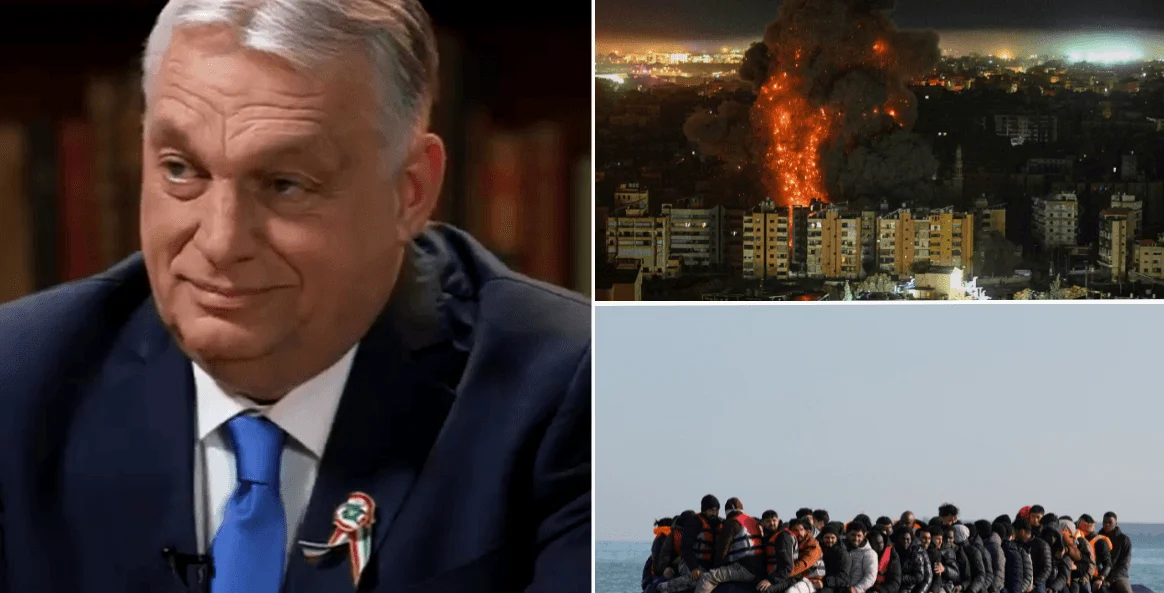
Hungarian Prime Minister Viktor Orban has raised alarms about the potential consequences of a possible conflict with Iran, warning that such a scenario could exacerbate the already volatile migrant crisis across Europe. In his first UK interview in 15 years, Orban spoke to GB News, offering insights into his views on the recent geopolitical developments involving the United States and Iran.
Orban’s Concerns Over Regional Stability
Orban, who has long been vocal about migration issues, emphasized that a war with Iran could have far-reaching implications for Europe’s stability. He noted that such a conflict might lead to a surge in migration, as people flee instability and violence in the Middle East and beyond.
“The question is whether he started a war or a peace. It hasn’t been decided yet,” Orban said, referring to U.S. President Donald Trump’s recent decision to attack Iran. He added, “Because if I understood his intentions clearly, which are based on my conversation with him several weeks ago in Washington, his understanding is that Iran is a source of war.”
Orban’s comments come amid growing concerns about the potential fallout of a military escalation in the region. He noted that the situation is still unfolding and that it is too early to determine whether the strikes will lead to peace or further conflict.
Historical Context and Similar Crises
Orban’s fears are not unfounded, as Europe has faced significant migration challenges in recent years, particularly following the 2015 refugee crisis. At that time, over 1.2 million asylum seekers arrived in Europe, many from war-torn Syria, Iraq, and Afghanistan. The crisis placed immense pressure on European nations, particularly Hungary, which has been at the forefront of resisting what it calls an ‘uncontrolled’ influx of migrants.
Hungary’s stance on migration has been shaped by its experience with the 2015 crisis, which led to the construction of a reinforced border fence along its southern frontier with Serbia. Orban has consistently argued that Europe needs a more unified approach to managing migration, warning that a lack of coordination could lead to further instability.
“I think we need some time to understand whether we are moving to peace by the strikes, or the opposite,” Orban said. “It is too early to say.”
What Analysts Say About the Risks
Analysts have echoed Orban’s concerns, warning that a potential war with Iran could lead to a new wave of migration. According to a report by the International Organization for Migration, a significant number of people in the Middle East and North Africa are already considering migration due to economic hardship and political instability.
“If the situation escalates into a full-blown conflict, we could see a significant increase in migration flows from the Middle East to Europe,” said Dr. Elena Vasquez, a migration expert at the European Institute for Security Studies. “The humanitarian and political consequences could be severe, especially for countries like Hungary that have already been dealing with the fallout from previous crises.”
Orban has also been critical of the current leadership in Europe, arguing that the continent needs ‘personal leadership’ to effectively address the challenges it faces. He pointed to his own leadership in Hungary as an example of how a strong, centralized approach can help manage migration and maintain national security.
“Europe needs leaders who are willing to take tough decisions and act decisively,” Orban said. “Personal leadership is essential, especially in times of crisis.”
What’s Next for European Policy
As tensions in the Middle East continue to rise, European leaders are being urged to consider the potential consequences of a conflict with Iran. The European Union has already expressed concerns about the risks of military escalation and has called for a de-escalation of hostilities.
“The EU remains committed to a peaceful resolution of the situation in the Middle East,” said European Commission spokesperson Margarida Barreto. “We are closely monitoring the developments and are ready to take appropriate measures to ensure the safety and security of our citizens.”
However, with the U.S. and Iran on a collision course, the risk of a wider conflict remains high. Orban has warned that such a scenario could have far-reaching consequences, not only for the Middle East but for Europe as well.
“If the situation deteriorates, we may see a new wave of migration that could overwhelm Europe’s already strained systems,” Orban said. “We need to be prepared for the worst-case scenario.”
As the situation continues to unfold, European leaders will have to decide how to respond to the growing risks. With Orban’s warnings ringing in the ears of policymakers, the need for a unified and decisive approach has never been more pressing.
“The time for action is now,” Orban said. “We cannot afford to be complacent in the face of such a significant threat.”




Comments
No comments yet
Be the first to share your thoughts