

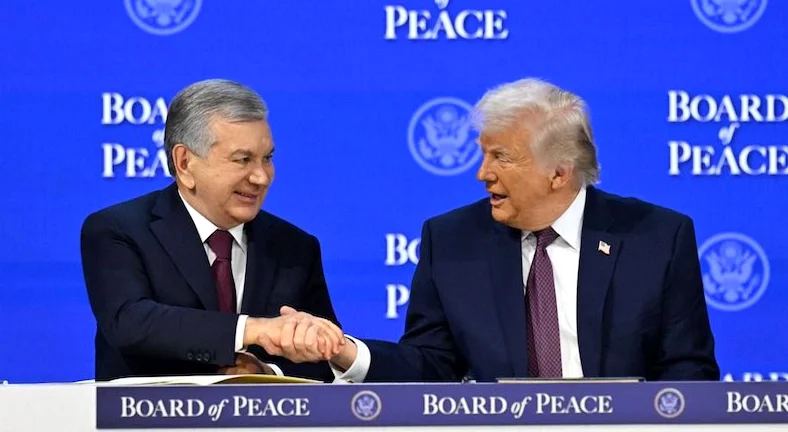
Presidents of Uzbekistan and Kazakhstan attended the inaugural meeting of U.S. President Donald Trump’s Board of Peace in Washington, D.C., on February 19, 2026. The gathering, held at the Trump International Hotel, marked the first official meeting of the board, which Trump has positioned as a vehicle for peacebuilding efforts, particularly in the context of the ongoing conflict in the Gaza Strip.
The Strategic Importance of Central Asia
With global institutions under strain and geopolitical tensions rising, the participation of two Central Asian leaders in Trump’s initiative highlights a shift in U.S. foreign policy. Kazakhstan and Uzbekistan, once considered peripheral to major global affairs, have emerged as key players in regional stability and economic cooperation. Their involvement highlights a broader effort to use non-Western partnerships in global peace efforts.
According to analysts, the inclusion of Uzbekistan and Kazakhstan reflects a calculated move to enhance the board’s credibility and reach. These countries have long been active in regional mediation and have built strong economic ties with both Western and Eastern powers.
Uzbekistan, in particular, has undergone significant transformation since its independence in 1991. Its foreign policy, rooted in de-escalation and regional cooperation, has positioned it as a mediator in complex disputes. This approach aligns closely with the goals of Trump’s Board of Peace, which aims to support dialogue and reduce conflict in volatile regions.
Uzbekistan’s Diplomatic Credibility
Uzbekistan has been instrumental in reducing historical tensions in Central Asia and promoting new economic links. Its leadership has facilitated cross-border water agreements, green energy cooperation, and transport connectivity, offering a model of conflict resolution that can be applied to other regions.
According to a statement by Uzbek President Shavkat Mirziyoyev, ‘Uzbekistan’s experience in supporting regional dialogue and cooperation is a testament to our commitment to peace and stability. We are proud to contribute to this initiative.’
Uzbekistan’s diplomatic credibility is particularly valuable in a world where U.S. initiatives often face skepticism. By participating in the board, Uzbekistan can act as a balancing voice, supporting stability without appearing to be an extension of American policy. This allows the board to widen its diplomatic reach without triggering backlash from non-aligned states.
Kazakhstan’s Institutional Expertise
Kazakhstan’s role in the board is equally significant. The country has long positioned itself as a venue for dialogue, hosting Syria peace talks, nuclear non-proliferation discussions, and OSCE initiatives. Its diplomatic corps is seasoned and technically adept, capable of handling complex negotiations between rival powers.
Kazakhstan’s macroeconomic perspective adds another layer of value to the board. As a major energy exporter and key actor in Eurasian logistics, it brings an understanding of how disputes over transit, pipelines, and trade corridors can be managed. This ensures that the board keeps the interplay between security and commerce at the forefront of its discussions.
According to a report by the Eurasian Economic Forum, Kazakhstan’s strategic location and economic influence make it a vital partner for any peace initiative. The country’s insights into cross-border infrastructure and regional security architectures are not theoretical—they are based on lived experience.
The inclusion of Uzbekistan and Kazakhstan in Trump’s board not only expands its membership but also taps into a reservoir of pragmatic diplomacy that has already been tested in one of the world’s most complex regions. As global politics becomes more fragmented and multipolar, the depth of this regional experience may prove essential to the board’s success.
As the board moves forward, its ability to integrate practical regional experience and avoid relying solely on Washington’s worldview will be critical. If it can do so, it may well become more than a political ornament—a genuine platform for global peacebuilding.

Comments
No comments yet
Be the first to share your thoughts