

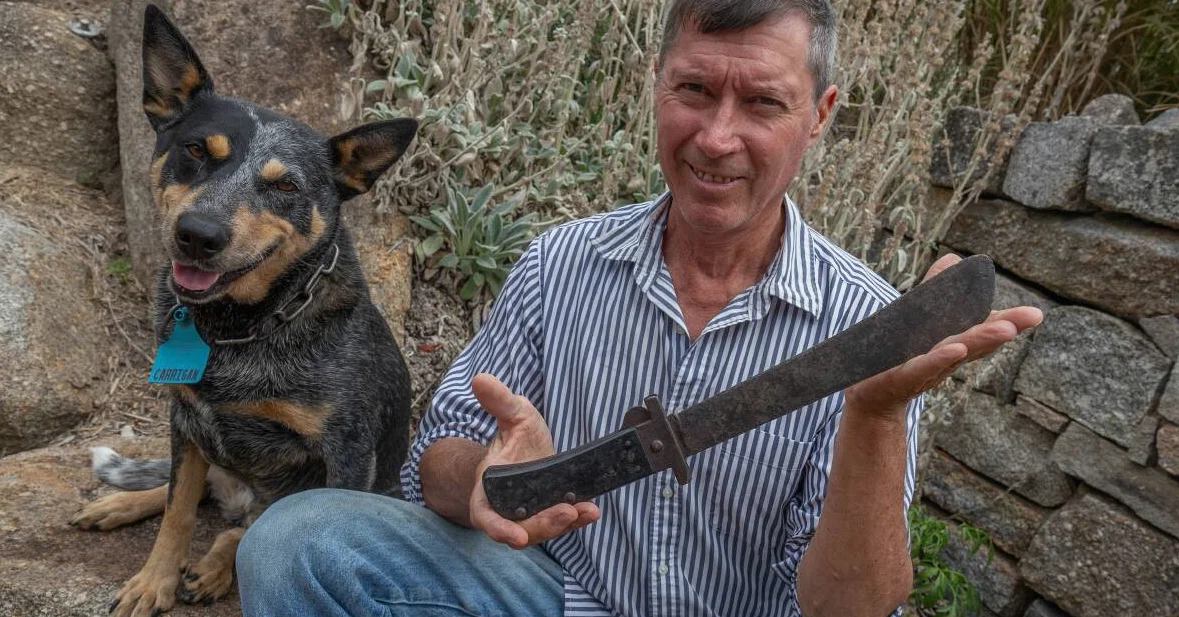
David Carrigan unearthed a folding machete from a rafter in the woolshed at Morunda, a grazing property near Armidale, over 50 years ago. The 1942 Cattaraugus-made blade, part of bailout kits for bomber pilots, now connects directly to Air Marshal Sir James Rowland, who grew up on the property and later served as NSW governor from 1981 to 1989.
Carrigan’s father bought Morunda in 1963 from Louis Rowland, Sir James’s father. The two brothers, then 12 or 13, spotted the machete while climbing in the shed where their father butchered sheep. ‘I always knew it was rare,’ Carrigan said. He oiled the blade periodically to preserve it and recently dug into its history.
Research revealed Sir James, born in Armidale in 1922, trained with pilots in Canada before joining RAF Bomber Command. Carrigan believes the governor picked up the compact, foldable machete there as a keepsake. ‘He was in Canada during the war for training,’ Carrigan said. He suspects Sir James gave it to his father for farm use, and it ended up forgotten behind the rafter.
Sir James flew 34 Lancaster bombing missions. His final one in 1945 ended in disaster when his plane collided with another Allied bomber under heavy anti-aircraft fire near Frankfurt. He parachuted to safety, only to be captured as a prisoner of war. Allied forces liberated him soon after. Back in Australia, he earned a degree in aeronautical engineering.
The war hero rejoined the Royal Australian Air Force as a test pilot. His leadership helped secure Mirage jets and later F-111s to modernize the fleet. Sir James donated many wartime artifacts to Sydney museums in his later years, according to accounts of his collecting habits.
Carrigan, captivated by the machete for decades, wants it displayed properly. He aims to give it to the Hunter River Lancasters museum to honor Sir James’s legacy in the New England region. ‘Most people around here probably never heard of him because he left young,’ Carrigan said. ‘But it’s Armidale history.’
In his memoir Pathfinder ‘Kriegie’ and Gumboot Governor, Sir James reflected on his unexpected governorship. Unfamiliar with politics, he wrote that accepting the role was a duty if one could perform it well.
Morunda shaped Sir James’s early years, but post-war ambitions took him far from the woolshed. The machete’s journey—from Canadian training fields to a dusty rafter and now toward public display—revives that overlooked chapter.




Comments
No comments yet
Be the first to share your thoughts