

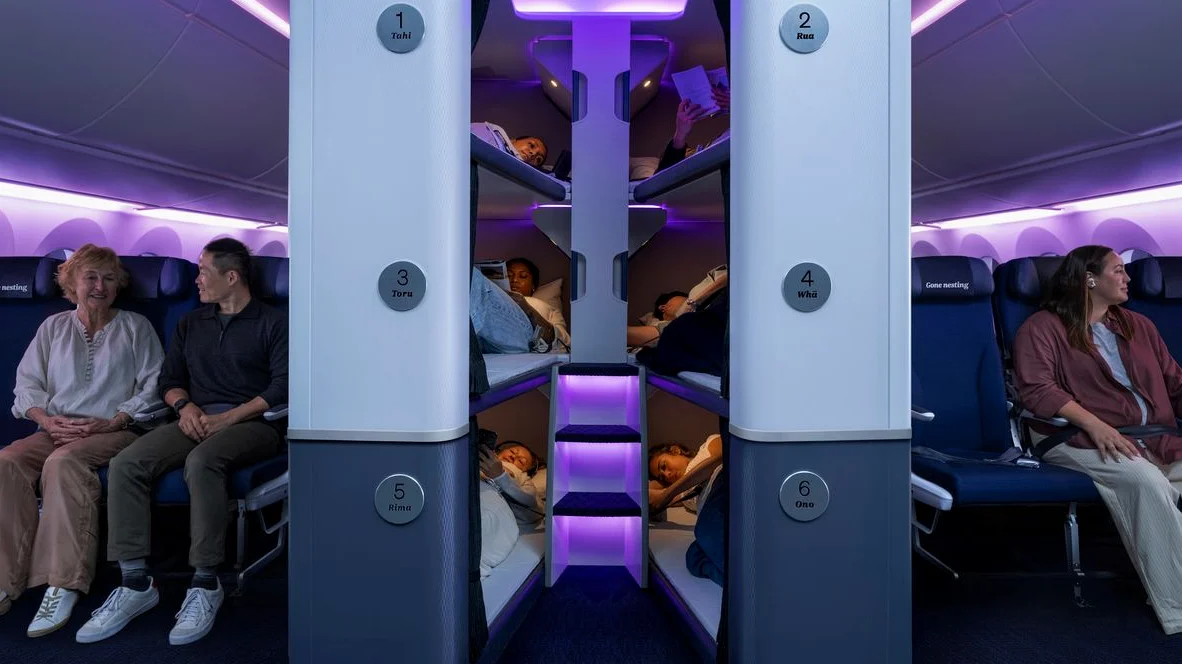
Air New Zealand is set to introduce a unique feature in economy class with the launch of Economy Skynest sleep pods on long-haul flights. The airline. Which already introduced the ‘Skycouch’ option that converts a row of economy seats into a lie-flat bed, will now offer six reclining ‘sleep pods’ in a bunk-style layout aboard its Boeing 787-9 Dreamliner aircraft. The pods will be available on flights between Auckland and New York, a route that takes around 18 hours, according to Spiegel and Expreso.
Design and Availability
Each sleep pod is approximately 203 centimeters long and is designed to provide a more comfortable sleeping experience for economy passengers; the width at shoulder height is 64 centimeters, narrowing to 41 centimeters at the foot end, according to Spiegel. The pods will be accessible via a short staircase and are intended to give passengers a brief respite during their journey — Access is limited to four hours per flight session, with two such sessions available per flight, as reported by Expreso.
Pricing and Booking
The Economy Skynest will be available for booking from May 18, 2026, with flights beginning in November of the same year, but the cost for the four-hour sleep pod access starts at around USD 350, according to Expreso. Air New Zealand’s CEO. Nikhil Ravishankar. Emphasized that the airline’s unique positioning in the Pacific means it understands long-haul travel better than most carriers, adding that the Skynest is designed to make a real difference in the travel experience.
Broader Innovations in Airline Comfort
While the sleep pods are a significant step toward improving economy class travel, the airline has also previously launched the ‘Skycouch,’ which transforms a row of economy seats into a lie-flat bed. These innovations reflect a growing trend among airlines to enhance comfort for economy passengers, particularly on long-haul flights; However, the sleep pod model remains one of the most unique approaches to date, with limited availability and a high price point. According to Spiegel. The feature is unlikely to be relevant for many European travelers, given the indirect nature of the Auckland–New York route.






Comments
No comments yet
Be the first to share your thoughts