

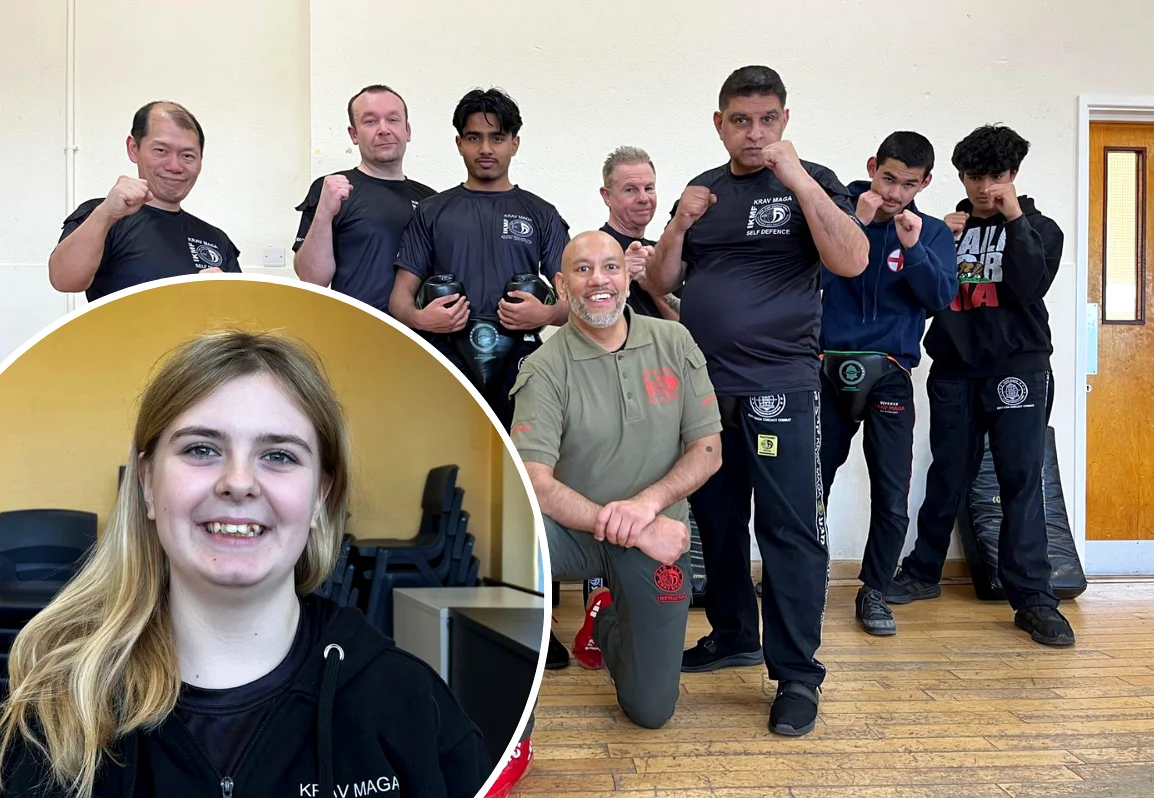
Students at a Krav Maga club in Reading are saying the self-defence system, originally developed by the Israeli Defence Forces, has restored their self-confidence and given them a ‘voice’. Our reporter attended a session to see what the club is all about.
Rooted in Self-Defence, Not Combat
Diverse Krav Maga has been offering self-defence classes to children and adults in Reading for about 20 years, according to head coach Naz Mughal. The club teaches Krav Maga, a practical self-defence system that emphasizes real-world scenarios over traditional forms.
Their website promises to teach students how to ‘prevent, avoid, deter, or deal with all kinds of violent threats and brutal attacks, including those with weapons’. Naz, 55, admitted that Krav Maga—meaning ‘contact combat’ in Hebrew—’gets a bad reputation for being violent’, a perception he believes has been worsened by the Israel-Gaza conflict and negative views of the Israeli Defence Forces (IDF), which trains soldiers in Krav Maga.
For Naz, the club is ‘purely’ about self-defence and helping people in Reading ‘build their confidence’, he said.
A Journey from Fear to Empowerment
I visited the club on a bright Saturday morning, joining a session hosted in an upstairs room at the Tilehurst Youth and Community Centre. While the adults class was warming up, I spoke to 15-year-old Jess Smith, who said she joined the club just over a year ago.
‘I was being badly bullied at school,’ she told me. ‘Girls asked for my money and stuff, and I didn’t know what to do so I gave it to them.’ At her first Krav Maga class, she said she spent most of the time staring at the floor, too scared to look up or speak.
But after a few months, she found her ‘confidence up’ and passed her first grading. Now, she has been to assistant instructor. ‘We have all come quite far and getting this role is a really big achievement,’ she said.
Jess said Krav Maga, with its emphasis on real-world scenarios rather than the more static ‘kata’ patterns common in karate and other traditional martial arts, has helped her build confidence and learn discipline. ‘It’s given me more power and more of a voice,’ she added.
Building Confidence, Not Violence
Ebrahim Basha, 18, echoed similar sentiments. ‘Before Krav Maga, I wasn’t very confident,’ he said. The A-level student said he now feels like he has learned how to de-escalate potential confrontations, having developed ‘the judgement to deal with different things, [to] have that awareness’. However, he admitted he found the ‘aggression’ of Krav Maga scary when he first started training.
When I stepped into the adults class, shrugging on a vest with a Krav Maga logo, it didn’t take long to see why people might find their first session a bit unnerving. After a brief warm-up, we went straight into learning defences against someone trying to strangle you with both hands and then trying to strangle you against a wall.
Naz rounded the session off with defences against multiple attackers and some toned-down sparring. For the students I spoke to, this approach seems to be a big part of the appeal.
Aftab Malik, a taxi driver who has been coming to the classes for two years, told me he used to do kickboxing but decided he preferred Krav Maga because it ‘teaches you how to get out of a situation on the streets, whereas in kickboxing you have to follow the syllabus’.
Dave Patston, another of Naz’s students and the ‘club ambassador’, said he also did other martial arts before joining Krav Maga in 2018. ‘It seemed like something that might actually … get you out of a bad situation,’ he said. At 63, Dave is the club’s oldest member and enjoys the classes as a good form of exercise.
Naz’s own route into Krav Maga was convoluted. He started karate as a kid because he was getting bullied, then trained for years in taekwondo, kickboxing, and kung fu before trying a Krav Maga session, where he was ‘blown away because none of my skills were useful’.
Naz was drawn to Krav Maga because of its emphasis on self-defence and willingness to cannibalise techniques from other fighting styles and martial arts: ‘It takes everything from every other system, everything that it feels is going to be effective.’
The club has grown steadily in Reading, despite a tough patch over the pandemic where they ‘lost every student’ and ‘had to rebuild from scratch’. Now, Naz said, they are in a good place, especially with the kids classes: ‘The kids club is huge.’
Naz described the club as ‘family oriented’, adding: ‘We don’t want to be a fight club, we want to empower and build confidence.’






Comments
No comments yet
Be the first to share your thoughts