

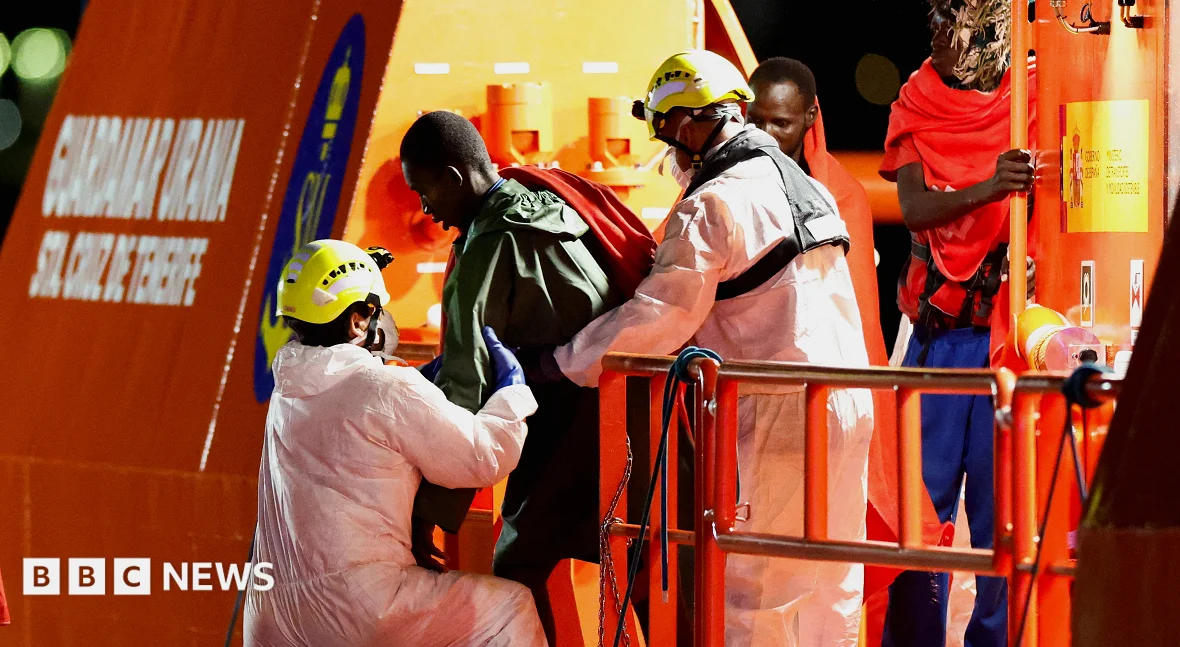
More than 80 migrants are feared dead after a boat was rescued off the Canary Islands with 44 survivors and five bodies found onboard, according to multiple reports. The vessel, believed to have departed The Gambia in early August with 127 occupants, was discovered adrift after 26 days at sea, according to the Spanish charity Caminando Fronteras. Human rights activist Helena Maleno Garzón said 83 people had lost their lives.
Deadliest Journey
The Atlantic route from West Africa to the Canary Islands is one of the world’s deadliest migration crossings, and Thousands attempt the perilous journey each year, facing risks from rough seas, strong currents, and long distances. The boat was located on Wednesday afternoon by a Salvamento Marítimo plane about 120 kilometers south of Gran Canaria, but At the time of the rescue, only 45 people remained alive, with five bodies found onboard. The Spanish search and rescue vessel Guardamar Urania responded to the distress call and reached the boat around midnight.
Rescue Complicated by Weather
Rescuers were forced to leave the five bodies found onboard due to rough sea conditions, as Maritime Rescue said adverse weather — featuring 20-knot winds and 2.5m waves, made it impossible to recover the bodies. The 44 survivors are men from sub-Saharan Africa, including individuals from The Gambia and Mali, according to reports. Three of the survivors were airlifted to hospital in critical condition, while the rest were transported by sea to Gran Canaria, where they disembarked in the early hours of Thursday morning.
Context and Concern
Survivors reportedly told the Red Cross they had left for the Canary Islands with more than 100 people onboard, with many dying during the crossing. The Guardia Civil confirmed to Caminando Fronteras that markings on the cayuco’s hull match those of a vessel that left Gambia on August 7th with 128 occupants. The migrants said they started the journey “with over a hundred people” and that many died during the crossing; this tragedy occurred one day after the Moroccan navy intercepted 201 migrants attempting to reach Spain’s Canary Islands, according to Info Migrants.
Fernando Clavijo, head of the Canary Islands government, posted on X: “It is intolerable that lives continue to be lost. The Canaries cannot get used to or accept as normal the fact that the Atlantic continues to be a death trap.” Caminando Fronteras questioned the level of international cooperation and the search-and-rescue resources available for such vessels. The organization said the boat had initially been carrying 127 people, with more than 80 declared dead or missing.
The Independent has contacted the Maritime Rescue and Guardia Civil for further details, and the vessel remained adrift in the Atlantic Ocean for weeks, marking one of the deadliest crossings recorded on the migratory route to the Canary Islands. The incident adds to the ongoing debate over migration policies and the humanitarian crisis faced by those attempting the dangerous journey across the Atlantic.





Comments
No comments yet
Be the first to share your thoughts