

 BBC
BBC 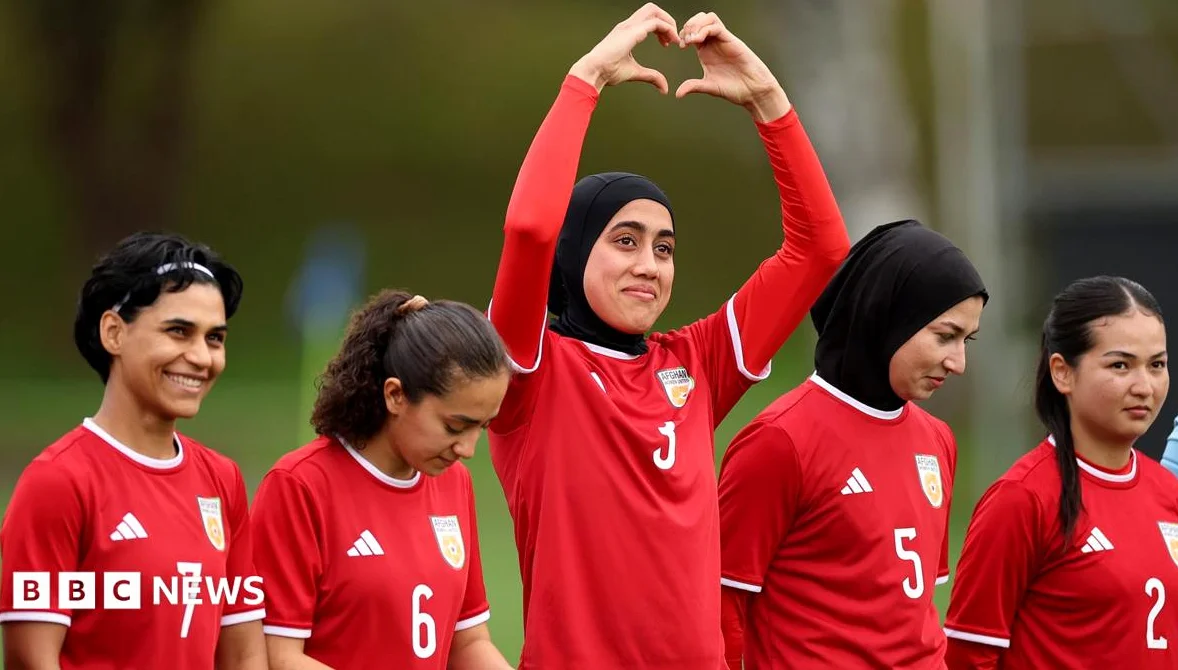
A New Beginning for Afghan Women’s Football
The changing room is busy with footballers going through their pre-match routines. Some stretch and tighten their boots, others embrace. ‘Be strong as always because we are representing Afghan women,’ says midfielder Fatima Haidari to fellow members of Afghan Women United. Applause erupts in the room where an Afghan flag hangs and a patriotic song is played. As the women sing along, some struggle to hold back tears. There’s a final team huddle with words of encouragement from their coach before they head out to the pitch – a place that for years they had been told they did not belong.
The 23-player squad, selected from Afghan players now living abroad, has travelled to New Zealand for a training camp and to play two unofficial friendly games against the Cook Islands. This is the first time they have been together since football governing body FIFA ruled in April that they could represent their country in official matches in the future. Previously, they would have needed the approval of the Afghanistan Football Federation. This was not possible under the Taliban, who returned to power in August 2021, imposing wide-ranging restrictions on women and girls, including barring them from secondary school and university, most professions and organized sport.
A Personal Story of Defiance and Determination
Zahra Joya was only five years old when a huge door closed to her – and to all girls in her home country of Afghanistan. The Taliban had seized power in 1996 and banned females from attending school. But with her father out of the country, Zahra’s mother came up with a daring workaround: presenting her daughter as a little boy. ‘It was my mother’s idea to give me this chance, but I was passionate about learning. I always said, ‘I need to go to school, I need to play outside with boys’. I had the chance to become a self-made boy,’ recalls Zahra, who now lives in the UK and is a bye-fellow at the University of Cambridge’s Hughes Hall.
Zahra, 33, says her passion for female equality is firmly rooted in the childhood days she spent playing the role of a boy called Mohammed: an experience that ‘shifted the course of my life.’ As a child living in a remote mountain village, Zahra swapped her headscarf for a button-up shirt and woollen blazer and made a two-hour walk to school. The distance from her home meant people at school did not know her true identity, but she was still ‘very nervous’ about being discovered. ‘My hair was very, very long, and in my village boys didn’t have long hair. When I first met the headmaster, he asked me to cut my hair short,’ she says. ‘I really didn’t want to hide myself, my identity, but I had to because there was no choice for me otherwise.’
A Legacy of Courage and a Path Forward
One of her relatives helped by teaching her how to play football and go into the mountains,’things boys would do, not girls.’ ‘Other girls were playing dolls but I never had a doll,’ she says. ‘Act of bravery’ Only later did it dawn on Zahra what a risk her family had taken. ‘My mum and grandad were very concerned about if people found out I was a girl, not a boy.’ ‘I really didn’t understand the risk.’
The country’s national women’s team, formed in 2007, could no longer play and its members were among those evacuated and resettled in countries including Australia, the UK and Portugal. Years of campaigning led to the creation of a refugee team, which became Afghan Women United. Thanks to FIFA’s ruling, it can now try to qualify for international competitions such as the Olympics and World Cup.






Comments
No comments yet
Be the first to share your thoughts