

 BBC
BBC 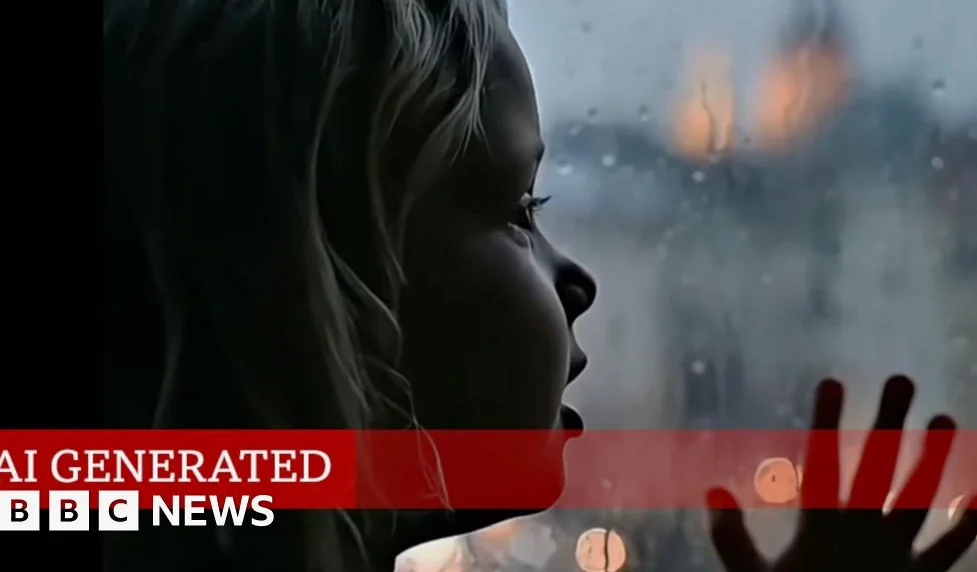
videos have become a tool in Hungary’s election campaign, with Prime Minister Viktor Orbán’s Fidesz party using such content to fuel political rhetoric as he bids for a fourth term in office. The videos. Which include a clip of a blindfolded soldier being executed, were posted on the party’s social media accounts in February ahead of the April 12 election.
Fake Video Targets Election Rival
The video depicts a young girl at a window yearning for her father’s return from war, followed by a scene of the father being bound, blindfolded, and shot. The video was released by Fidesz and targeted Orbán’s election rival, Péter Magyar, who is leading in most opinion polls.
The clip includes the line. ‘The video is an AI video. But the war is really horrible. ‘ suggesting that Magyar does not want the public to see the ‘irreversible tragedy’ of joining the war in Ukraine. Fidesz claims that Magyar’s party. Tisza, would bring Russia’s war to Hungary’s doorstep if elected, even using pension money to support Ukraine and imposing forced conscription.
Rejection of Fidesz Claims
Tisza has rejected these claims, stating in its manifesto that it will not send troops to Ukraine and does not plan to revive conscription. When asked if Fidesz had created the AI video, the ruling party did not respond to the BBC’s questions.
Támas Menczer, communications director of the Fidesz-KNDP alliance, said in an interview with a journalist that the greatest danger is that Hungarian people could die if Tisza wins, as the party supports the war and sending money to Ukraine. However, he did not comment on the video being made with AI.
Magyar condemned the video, calling it ‘heartless manipulation’ and stating that Fidesz has ‘crossed all limits.’ Zsófia Fülöp, a journalist at Hungary’s only dedicated independent fact-checking website, Lakmusz, noted that while such narratives are not new, the use of generative AI is now widespread in the campaign.
Disinformation Campaign
According to Éva Bognár, a researcher at the Central European University’s Democracy Institute, the campaign is a disinformation effort based on a false narrative that Hungary is on the brink of war. She described the situation as ‘a state of hallucination.’
Another video was shared by the pro-Fidesz political activist group NEM, which depicted a phone call between European Commission President Ursula von der Leyen and Magyar discussing sending money to Ukraine. The video was viewed more than 3.7 million times, and the caption read, ‘When the phone rings and a request comes, then he won’t be able to say no.’
Magyar called the video fake, but it was widely shared by pro-government media and Fidesz politicians. Orbán stated that the video was but warned it could become a reality. NEM did not comment when asked about the video’s origin.
Meanwhile, Hungary’s anti-terrorism police arrested seven Ukrainian bank workers who were transiting through the country with $80m (£60m) worth of cash and 9kg (20lb) of gold in cash-transport vehicles. Ukrainian Foreign Minister Andriy Sybiha accused the Hungarian government of taking the group hostage and stealing the money.
Ukraine’s state savings bank, Oschadbank, said the group had a valid licence and that the journey was routine. The Hungarian government alleged that money laundering was taking place to ‘finance pro-Ukraine forces.’ Although the Ukrainian bank workers have been released without charges, the money and gold have not been returned.
Pro-government outlets on Facebook used AI images to report on the arrests, uploading hyper-realistic images that were later labeled as ‘partly false’ by Facebook’s third-party fact-checking service. These images differed significantly from those posted on the Hungarian government’s official Facebook page, with inaccuracies in uniforms and clothing.
Hungary’s relations with Ukraine have deteriorated since Orbán maintained close ties with Russian President Vladimir Putin. A survey by research institute Policy Solutions suggests that anti-Ukrainian sentiment in Hungary is nearly as high as anti-Russian sentiment, with 64% of Hungarians holding a negative opinion of Ukraine’s Volodymyr Zelensky and 67% disliking Putin.
Magyar has been able to cut through the media landscape using social media, according to 20k, a Hungarian election integrity watchdog. His posts on Facebook, TikTok, and Instagram receive twice the level of engagement of Orbán’s. Magyar’s content includes images of him partying, playing volleyball, flipping burgers, and enjoying water sports, presenting himself as a younger and more relatable leader.
Despite this, Magyar has engaged in milder forms of misleading rhetoric, including inaccuracies about the number of Hungarian babies born outside the country. He has also accused Fidesz of wanting to reintroduce compulsory military service, a claim with no evidence to support it.
Péter Krekó, who heads the independent political research institute Political Capital, said Magyar has been able to ‘exploit strong public resentment’ towards the government, particularly among people aged 18 to 40. A survey by the Median agency suggests that support for Tisza remains strongest amongst those under 40, while nearly half of people over 65 support Fidesz.
Despite Magyar’s efforts, Fidesz continues to use its anti-Ukrainian narrative in both traditional media and online, with posters showing Zelensky and Magyar together under the warning ‘They are dangerous!’ If Fidesz wins, the same disinformation tactics will likely continue beyond the election, according to Krekó. If it does not win, there may be a ‘more tumultuous relationship between the media and politicians.’






Comments
No comments yet
Be the first to share your thoughts