

 The Guardian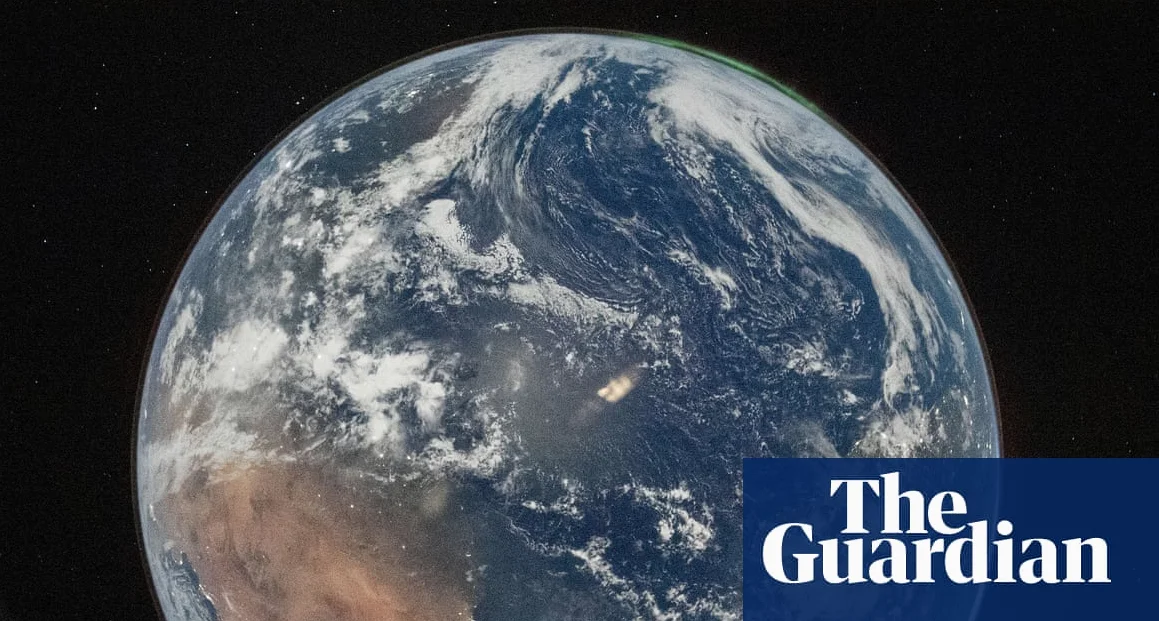
According to NASA, the Artemis II crew is now closer to the moon than to Earth, as the four astronauts completed the third day of their flight to the moon. ‘We can see the moon out of the docking hatch right now. It’s a beautiful sight,’ said an unnamed member of the crew, which NASA shared in a post on X on Saturday morning.
Images from Space Show Earth’s Beauty
By 11am, the Orion spacecraft had travelled more than 152,000 miles (245,000km) away from Earth since its launch on Wednesday. NASA released the crew’s first downlinked images on Friday, one and a half days into the first astronaut moonshot in more than half a century.
The first photo taken by Commander Reid Wiseman showed a curved slice of Earth in one of the capsule’s windows. The second showed the entire globe with the oceans topped by swirling white tendrils of clouds. A green aurora even glows, according to NASA. ‘It’s great to think that, with the exception of our four friends, all of us are represented in this image,’ said NASA’s Lakiesha Hawkins, an exploration systems leader. She added the mission was going well.
Plumbing Problems in Space
But, even in the beauty of space, plumbing problems plague the crew of the Artemis II. Debbie Korth, NASA’s Orion program deputy manager, noted that the space toilet is again on the fritz. Until the Orion capsule’s bathroom is fixed, mission control has instructed the astronauts to break out more of the backup urine collection bags. The so-called lunar loo malfunctioned following Wednesday’s liftoff and has been hit-and-miss ever since.
A version of the Artemis II toilet was tested on the International Space Station several years ago. Engineers suspect ice may be blocking the line that is preventing urine from completely flushing overboard. Solid waste has not been affected. Astronaut Christina Koch reported a ‘burning heater smell’ coming from the bathroom, which is buried in the floor of the capsule with a door and curtain for privacy.
Flight controllers on Saturday morning reoriented the Orion capsule toward the sun, hoping the extra warmth in addition to the capsule’s heaters would melt the frozen vent line. The space agency also shared the menu for the trip, which includes tortillas, vegetable quiche, mango salad and barbecued beef brisket. As there is no refrigeration onboard, all meals are carefully selected to remain safe, shelf-stable and easy to prepare.
Historic Mission with a Free Return Trajectory
Wiseman and his crew should reach their destination on Monday. The three Americans and one Canadian will swing around the moon in their Orion capsule, hang a U-turn and then head straight back home without stopping. They fired Orion’s main engine on Thursday night, which set them on their course.
After mission control shifted the position of their capsule, the entire Earth – complete with northern lights – filled their windows. ‘It was the most spectacular moment, and it paused all four of us in our tracks,’ Wiseman said in a TV interview. They are the first lunar travellers since Apollo 17 in 1972.
Orion will travel about 4,000 miles (6,400km) beyond the moon before turning back, providing unmatched and illuminated views of the lunar far side. If all proceeds smoothly, the astronauts will set a record by venturing farther from Earth than any human before – more than 250,000 miles. The current record is held by the Apollo 13 crew.
The mission is part of a longer-term plan to repeatedly return to the moon, with the aim of establishing a permanent base that will offer a platform for further exploration. On Thursday, after what NASA described as a ‘flawless’ engine firing that lasted just under six minutes, the astronauts said they had been glued to the windows of the capsule as they left Earth.
The Artemis astronaut Christina Koch said: ‘There’s nothing that prepares you for the breathtaking aspect of seeing your home planet both lit up bright as day, and also the moon glow on it at night with the beautiful beam of the sunset.’ Now that the astronauts are moon-bound, there is no turning back: they are on a ‘free return’ trajectory, which uses the moon’s gravity to slingshot around it before heading back towards Earth.






Comments
No comments yet
Be the first to share your thoughts