

 The Guardian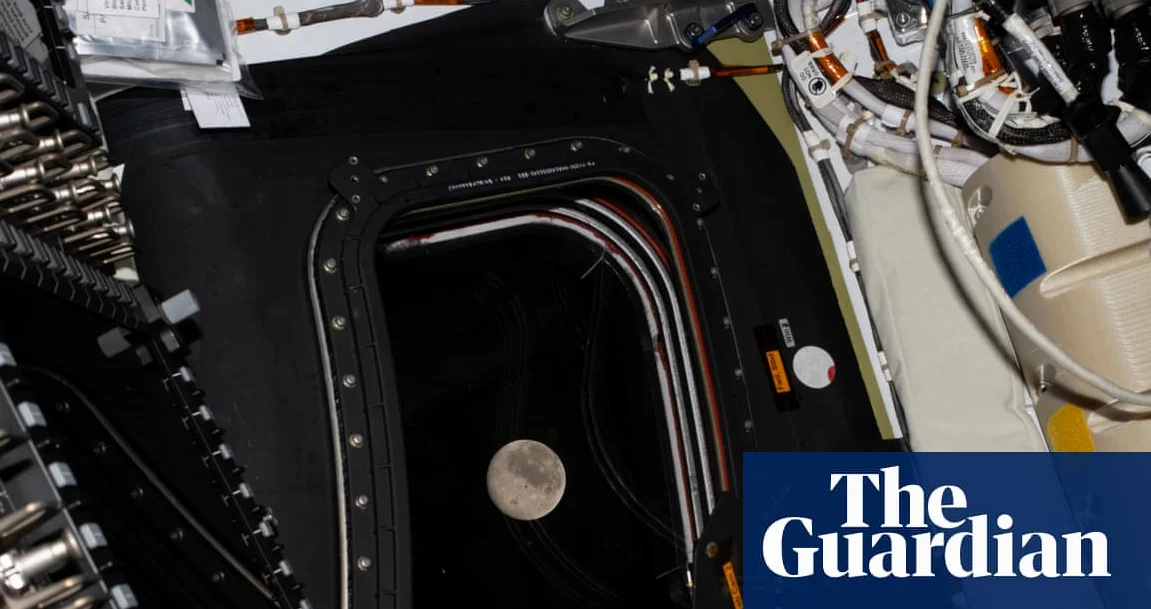
Artemis II astronauts are set to break the record for the farthest distance traveled from Earth during a lunar flyby on Monday, according to The Guardian. The four astronauts – Reid Wiseman. Victor Glover and Christina Koch of NASA, and Canadian Space Agency astronaut Jeremy Hansen – will travel 5,000 miles (8,047km) beyond the moon, surpassing the previous record set by the Apollo 13 mission in 1970.
Apollo 13’s Record and Artemis II’s Goal
The Apollo 13 astronauts – commander Jim Lovell, Fred Haise and Jack Swigert – reached a maximum distance of 248,655 miles (400,171km) from Earth before turning back. Artemis II’s crew is expected to exceed this distance by approximately 4,000 miles (6,437km); the mission marks the sixth day of a lunar journey that has reinvigorated NASA’s space exploration program.
The Orion capsule will conduct a roughly six-hour flyby of the moon on Monday, offering views of the moon’s far side that were previously too dark or difficult to observe by Apollo astronauts over half a century ago. A total solar eclipse is also expected as the moon blocks the sun, revealing glimpses of the sun’s shimmering corona.
Scientific Observations and Communication Challenges
Flight director Judd Frieling said the mission includes mapping the moon and continuing to explore space in a more forceful manner; Orion will be out of contact with mission control for 40 minutes when it is behind the moon. NASA is relying on its Deep Space Network, with antennas in California, Spain and Australia, but these will not have a direct line of sight.
These communication blackouts were a tense time during the Apollo missions, but Frieling noted that physics will ensure the crew returns to the front side of the moon. During the flyby. Astronauts will take turns capturing lunar views out their windows, enabling them to see “definite chunks of the far side that have never been seen” by humans, according to Kelsey Young, NASA’s Artemis II lunar science geologist.
Historic Imagery and Future Missions
Kelsey Young expressed excitement about the upcoming flyby, saying she is looking forward to the astronauts bringing the moon closer to home; NASA Administrator Jared Isaacman told CBS News’s Face the Nation that the Artemis II astronauts have specific observation responsibilities during the flyby. They will use cameras to gather data that will assist future missions, including those aimed at returning to the lunar surface.
Isaacman noted that the crew has had three and a half years to train for this mission and work with scientists to gather the most important information about the moon’s far side. Once the capsule rounds the moon. It will take four days to return to Earth; NASA aims for a splashdown in the Pacific Ocean near San Diego on 10 April, nine days after its Florida launch.
The Artemis II crew will survey potential landing zones for future missions, including the mysterious Reiner Gamma formation – a bright lunar swirl associated with a localized magnetic anomaly. They will also photograph Mercury, Venus, Mars and Saturn at sunrise and sunset; they will attempt to recreate the iconic Earthrise image taken from lunar orbit by astronaut William Anders during the Apollo 8 mission in 1968.
There is hope that this new photo can inspire a similar unifying effect as the original Earthrise image, which is credited with sparking the environmental movement. On Sunday, mission pilot Victor Glover was asked if he had any thoughts on Easter, and he shared reflections on the beauty of Earth in the vast emptiness of space.
Glover said, in part: “In all of this emptiness – this is a whole bunch of nothing, this thing we call the universe – you have this oasis, this beautiful place [on Earth] that we get to exist together. Whether you believe in God or not, this is an opportunity for us to remember where we are, who we are, and that we are the same thing, and that we’ve gotta get through this together.”






Comments
No comments yet
Be the first to share your thoughts