

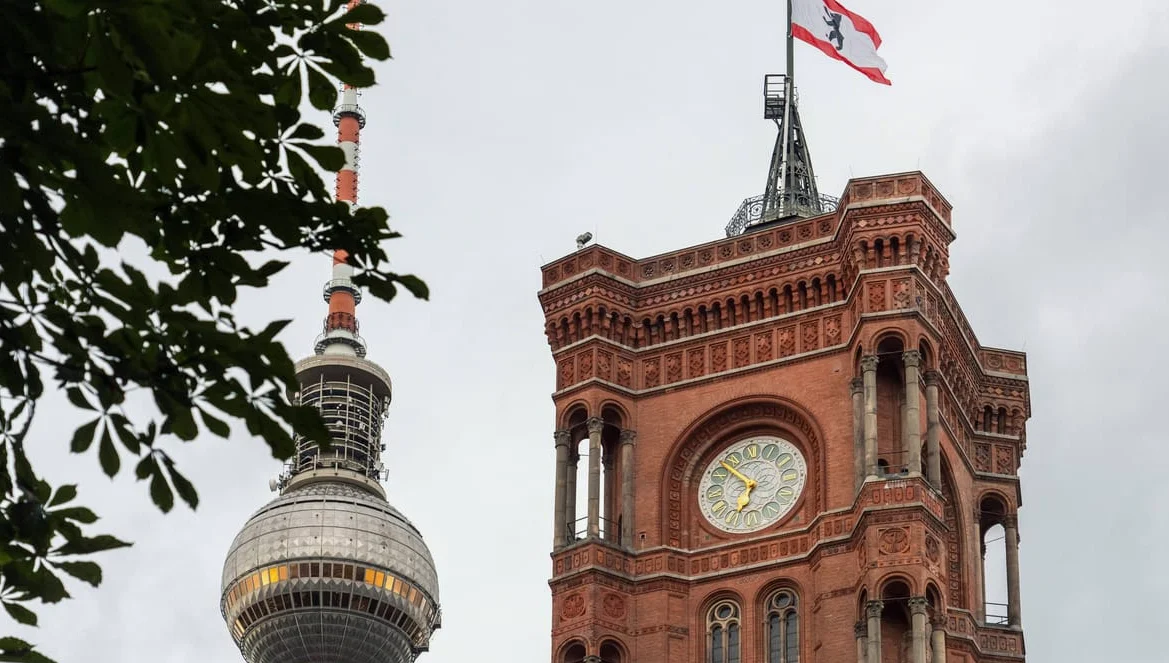
Five weeks before the Berlin Abgeordnetenhaus election on September 20, 2026, the CDU leads in a new Insa poll with 20 percent, just ahead of the Left Party at 19 percent, according to WELT. The AfD comes in third with 17 percent, followed by the Greens at 16 percent and the SPD at 15 percent. FDP and BSW each fall short at 3 percent.
Close Race in Polling
The CDU’s lead is a slight increase from its 19 percent in the previous Insa poll in early July. The Left Party also saw a minor gain from 18 to 19 percent. The AfD, however, dropped two points to 17 percent. The Greens remained stable at 16 percent, while the SPD improved from 13 to 15 percent.
The narrow five-point margin between first and fifth places means the election is shaping up as a “power thriller.” Recent polls have shown the CDU, Left, and AfD alternating in the lead. The SPD, which had previously dropped to as low as 12 percent, appears to have stabilized.
Coalition Scenarios
Current governing coalition CDU and SPD may be part of a potential three-party alliance with the Greens. The poll reveals that no two-party coalition can secure a majority in Berlin. Alternatively, a coalition of the Left, Greens, and SPD is also considered plausible.
Meanwhile, a different Insa poll conducted for Nius showed the AfD briefly at 19 percent, the first time it led in any survey, according to Handelsblatt. That poll, conducted between July 14 and 21, also placed CDU and the Left at 18 percent each. The Greens followed with 16 percent, and the SPD at 13 percent. FDP and BSW each had 4 percent, falling short of the threshold for parliamentary representation.
A separate July 16 survey by Infratest Dimap for RBB placed the Left ahead at 22 percent, with CDU at 20 percent, Greens at 17 percent, and AfD at 16 percent. The SPD was at 12 percent in that poll.
Cultural Policy Discussion
Political discourse in Berlin extends beyond party politics into cultural policy. On June 11, the Akademie der Künste hosted a talk with leading candidates for the Abgeordnetenhaus election, addressing the topic: “How much does Berlin value culture?” The discussion included cultural policy priorities, the role of the future Senator for Culture, and the financial situation of artists, according to the Akademie der Künste.
Participants included representatives from democratic parties, with the debate focusing on the Cultural Promotion Act and broader societal support for the arts. The event was held in the Akademie’s Plenary Hall, overlooking the Brandenburg Gate, and featured podiums, catwalks, and unconventional seating to encourage dynamic interaction.
As of July 21, the CDU had a new lead candidate in Finance Senator Stefan Evers, following the resignation of former mayor Kai Wegner. The Insa poll had a margin of error of plus or minus 3.1 percentage points. All polls reflect trends at the time of survey and are not predictive of the final election outcome.
With no clear majority emerging in any two-party coalition, Berlin voters will have a complex choice in September. The election will determine not just the composition of the Abgeordnetenhaus, but also the future direction of governance and cultural policy in the capital.





Comments
No comments yet
Be the first to share your thoughts