

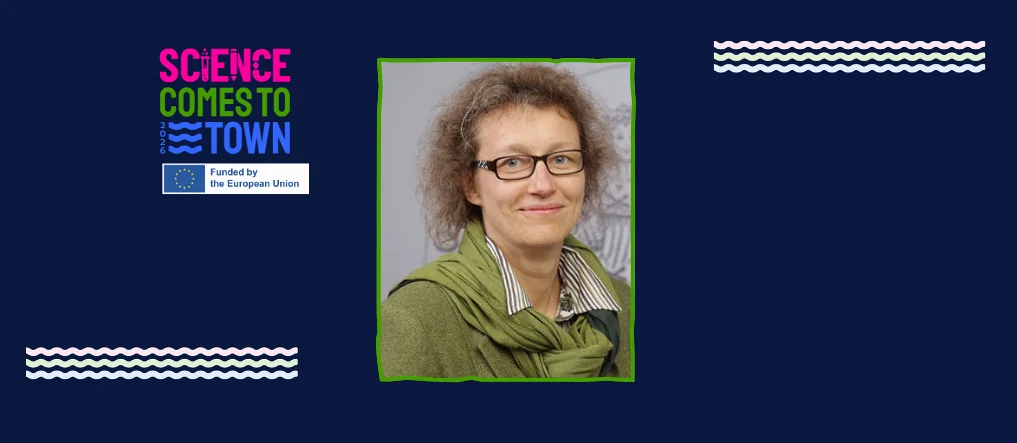
Chemistry, a subject that explores how substances interact and transform, should naturally pique students’ curiosity and provide a sense of discovery. Yet, despite its potential to explain how the world works, interest in the subject is waning across Europe. Ilka Parchmann, a professor of chemistry education at Kiel University in Germany, argues that the challenge lies not in the subject itself but in how it is taught and its perceived relevance to students.
Hands-On Learning and ‘Wow’ Moments
According to Parchmann, hands-on experiences are key to capturing students’ attention. She emphasizes the importance of creating ‘wow’ moments in the classroom, where students can see the practical applications of what they are learning. ‘When they see that they can apply what they have learned and solve a task, they see why what they are learning is relevant,’ she said. ‘These are things that can be done, but they are not done that often in the classroom.’
Parchmann is not only a professor at Kiel University but also heads the Department of Chemistry Education at the Leibniz Institute for Science and Mathematics Education (IPN). She is also an ambassador for Science Comes to Town (SCTT), a European initiative supported by the European Commission that aims to make science more accessible to communities and encourage young people to pursue science education and careers.
Science Comes to Town and the Need for European Collaboration
For Parchmann, SCTT embodies the essence of science education. ‘It is a wonderful way to raise more people’s interest and awareness of why science is so important, and how we can experience science in a good way,’ she said. She also values the cooperation with other countries that is embedded in SCTT. Kiel, along with fellow SCTT host cities Brest (France) and Split (Croatia), are home to top universities and research institutions working to showcase science’s role in society and support European collaboration.
SCTT is particularly timely as Europe aims to turbocharge research, innovation, and competitiveness amid global uncertainty. However, recent studies show troubling trends in STEM education. Germany’s Education and Training Monitor 2025 reveals that the share of low-achieving 15-year-olds in the country rose from 17% to nearly 23% from 2015 to 2024, surpassing the 15% target for 2030. Many European countries also face acute shortages of science teachers, especially in secondary education, while concerns about gender imbalance in some scientific fields add another layer of urgency.
Revising Education Models and Building Cross-Disciplinary Networks
Parchmann believes tackling these challenges requires rethinking traditional education models. One issue in Germany is structural: students must decide at the start of their university studies if they want to become teachers. This limits flexibility for science students who might want to transition to education later. Another challenge is the country’s heavy reliance on homework in primary and secondary education, which can disadvantage students without strong support systems at home.
Universities can play a key role in identifying and sharing solutions, Parchmann says. She and her colleagues at Kiel’s Institute of Human Nutrition and Food Science have tested a new approach by linking their courses in food science and teacher education. This interdisciplinary model has proven to be a win-win for students, allowing them to experience both the joy of science and the joy of teaching and learning.
In addition, the university has opened a study program for students who started in science and only later wish to choose the teaching track. ‘We might not get enough 18-year-olds to say this is my dream, to become a science teacher,’ Parchmann said. ‘But we need good programs to support chemists and other career scientists to transition to education. This is a way to get qualified teachers with on-the-job experience and professional teacher training who are eager to share their knowledge with students.’
School teachers themselves can improve their knowledge through cooperation with practising scientists. Such collaborations can help science teachers design lessons that are more in sync with current scientific developments and better prepare students for careers in STEM. ‘The needs and demands of the professions are often not well known to science teachers, so they don’t really know how to best prepare the students for careers in STEM,’ Parchmann noted. ‘Such collaborations can give the young generation an idea of careers in science and keep them engaged in developments that affect their own future.’
Parchmann’s passion for chemistry began with a simple classroom experiment: heating sulphur and watching it change colour and consistency. ‘That was one of the first things that made me really curious,’ she recalls. ‘I wanted to grasp what was going on.’ Encouraging teachers and supportive parents also played a role in her career trajectory.
Not all children have such advantages, but Parchmann stresses that mentoring and opportunities to see science in action can make it feel relevant, helping students of all backgrounds stay motivated. ‘Extracurricular activities and learning groups can be a real benefit for students who do not, for example, have parental support for whatever reason,’ she said, adding that such programs are especially important in secondary schools, where interest in science often wanes.
Perception also affects student retention in science classes, with chemistry often having negative associations. This is why an initiative like SCTT is important, because it makes science accessible to wider audiences. ‘We need to address some of the stereotypes about chemistry that it is dangerous and show its tangible benefits to society,’ Parchmann adds. ‘Science Comes to Town offers a wonderful way to raise more people’s interest and awareness of why science is so important, and how we can experience science in a good way.’






Comments
No comments yet
Be the first to share your thoughts