

 BBC
BBC 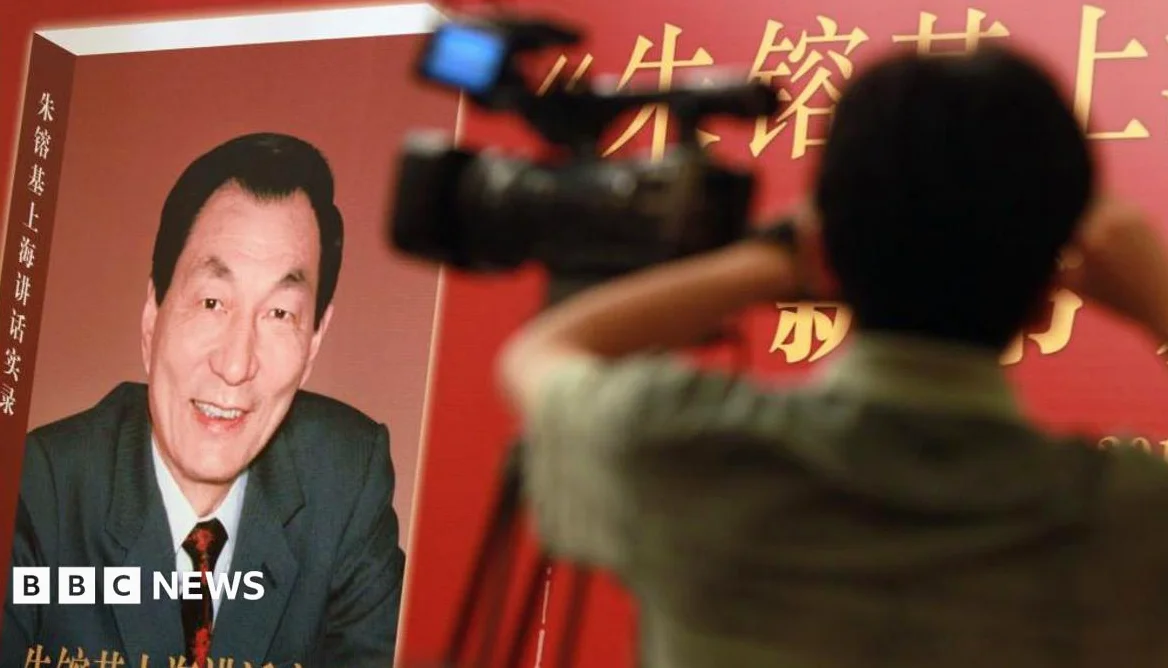
Flags at government sites in Beijing are flying at half-mast, and security vehicles are stationed in the city center as China mourns the death of former Premier Zhu Rongji. Zhu, who served as China’s premier from 1998 to 2003, passed away last week at the age of 97 and was cremated in Beijing on Tuesday.
A Low-Key Ceremony
The funeral was attended by senior leaders, including President Xi Jinping, but the ceremony was kept discreet with no footage released. Zhu is remembered as one of the country’s most significant economic reformers during his tenure as premier.
State media described Zhu as an “outstanding member of the Chinese Communist Party” and a “time-tested and loyal Communist fighter.” He was cremated at the Babaoshan Major Cemetery, a site reserved for high-ranking officials and prominent figures.
Online Censorship and Nostalgia
Online, discussions about Zhu have been censored. An essay by economist Zhao Jian, which reflected on Zhu’s era, was removed from WeChat after its publication. In the essay, Zhao described Zhu’s time as one when people were “properly poor” but had a clear future ahead.
“There were no smartphones then, no short-form videos and no screens filled by the purveyors of anxiety,” Zhao wrote. “The sky was blue, life moved slowly and people could say what they really thought.”
The Chinese government has historically been cautious about public mourning for senior officials and figures, fearing it could evolve into protests. The deaths of former premier Zhou Enlai in 1976 and former CCP general secretary Hu Yaobang in 1989 led to widespread expressions of grief that turned into demonstrations.
Contrast with Current Leadership
Zhu’s death occurred just days before the Communist Party commemorated the birth centenary of former President Jiang Zemin, who passed away in 2022. The deaths of Zhu and Jiang have sparked nostalgia among many Chinese for an era that seemed to offer a different direction for the country—one of openness and greater freedom for its citizens.
Zhu and Jiang worked together from 1998 to 2003, steering China through rapid economic growth and its entry into global trade. During this period, China implemented tough reforms, including shutting down unprofitable state firms and transitioning from an old housing system to a commercial property market. It also endured the Asian financial crisis and joined the World Trade Organization in 2001.
Zhu was known for his candid style, once calling rogue bankers “half-wits” and describing flood dykes along the Yangtze River as “flimsy and porous as tofu dregs.” He was also known for his humor, as shown in a 1999 news conference where he joked about China’s political contributions to the U.S. Democratic Party.
“If the political contribution were to be really that effective, and I have $146 billion of foreign exchange reserve, I can put out at least $10 billion for that purpose. Why just $300,000? That would be too foolish,” Zhu said, drawing laughter from the audience.
A state media documentary about Jiang Zemin featured Zhu discussing the implementation of tough reforms. “I’m not here to talk about pros and cons. I am here to talk about how to get things done,” he said in the documentary.
On social media, a circulating image shows Jiang and Zhu laughing together, with a caption praising their candid communication and dedication to serving the people.
Today, the leadership style under President Xi Jinping is markedly different, with greater central control and a focus on technological autonomy and strategic industries. In a recent speech, Xi emphasized carrying forward Jiang’s legacy, positioning the current leadership as the continuation of his political and ideological project.
Xi has also highlighted the need for vigilance against potential dangers, calling for an “indomitable fighting spirit” to address challenges such as economic slowdown and demographic decline. House prices have fallen, youth unemployment is high, and factory output is slowing.
Kerry Brown, Professor of Chinese Studies and Director of the Law China Institute at King’s College London, noted that Xi is committed to the “great renaissance of the Chinese nation.” He added that the current leadership aims to present a unified historical narrative, ensuring that alternative future paths suggested by past leaders are not publicly discussed.
“Instead, their lives will be knitted into the narrative that everything they did transformed China into what it is now, rather than dwell on any other ‘What If’s,'” Brown said.



Comments
No comments yet
Be the first to share your thoughts