

 The Guardian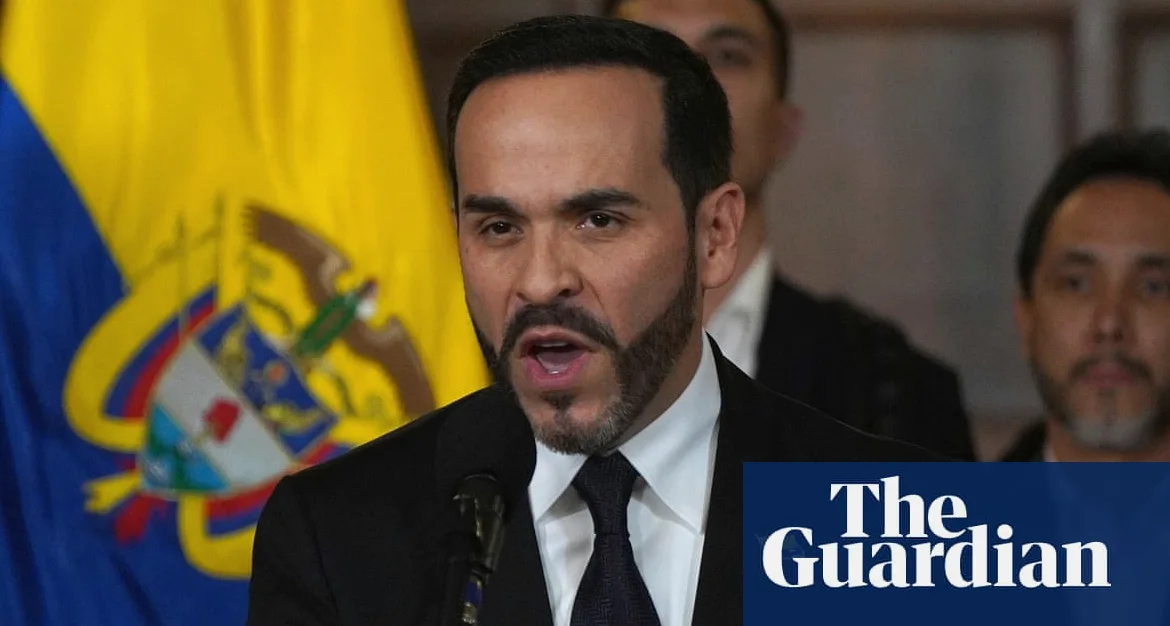
Policy Announced Amid Earthquake Aftermath
In office for just over two weeks, the millionaire former lawyer made the announcement on Sunday as the country continued to grapple with the aftermath of a 7.4-magnitude earthquake on 10 August that killed more than 300 people and destroyed more than 30,000 homes.
De la Espriella said the first joint operations involving the police and the migration authority should begin “this very week.”
“Let the coordinated operations begin to track down illegal immigrants: first, those committing crimes; second, those who have not regularised their status and who will have to be deported immediately,” de la Espriella said during a cabinet meeting held on Sunday in Barranquilla, the Caribbean city that has in effect been turned into an alternative capital.
Alignment with Trump-Backed Rhetoric
He echoed the “Americans first” rhetoric of his ally, US president Donald Trump, saying that from now on it would be “Colombians first, Colombians second and Colombians third.”
The Colombian president has joined other Trump-aligned leaders in the region who have also tightened migration rules, including Argentina’s Javier Milei and Chile’s José Antonio Kast.
De la Espriella’s order is facing criticism from the opposition and human rights activists, who say it will end a migration policy that endured for more than a decade under both rightwing and leftwing governments and benefited above all migrants fleeing the humanitarian crisis in neighbouring Venezuela.
Although he used the anti-immigration rhetoric characteristic of other far-right candidates during his campaign, his platform focused chiefly on his promise to pursue an iron-fist policy against criminal groups.
In the same announcement, he also declared that all gangs involved in drug trafficking, illegal mining, extortion and smuggling were “terrorists and we will treat them as such. Whatever happens, we will defeat them, by reason or by force.”
Concerns About Implementation and Legal Challenges
The president did not directly mention Venezuelans when discussing immigration, but they account for roughly 90% of all migrants in the country, as Of the 2.8 million Venezuelans living in Colombia, about 848,000 are in an irregular situation, including 193,000 children and adolescents.
The leftwing senator María José Pizarro Rodríguez reposted the president’s announcement and asked whether he was “proposing a Colombian ICE against fellow Latin Americans,” in reference to the US Immigration and Customs Enforcement (ICE). She added that the “order to deport irregular migrants is pure xenophobia and aporophobia.”
“Instead of persecuting people fleeing poverty and violence, regularise their status; there are thousands of migrants who work hard and contribute to the economies of the countries that receive them,” she wrote.
The Colombian newspaper El Tiempo reported that sources within the migration department believe the agency does not have enough staff to carry out the operations De la Espriella has promised.
Analysts have also noted that under Colombian law there is no such category as an “illegal” immigrant, as De la Espriella said, but rather migrants in an “irregular” situation, since being in the country without the proper documentation is not a crime.



Comments
No comments yet
Be the first to share your thoughts