

 BBC
BBC 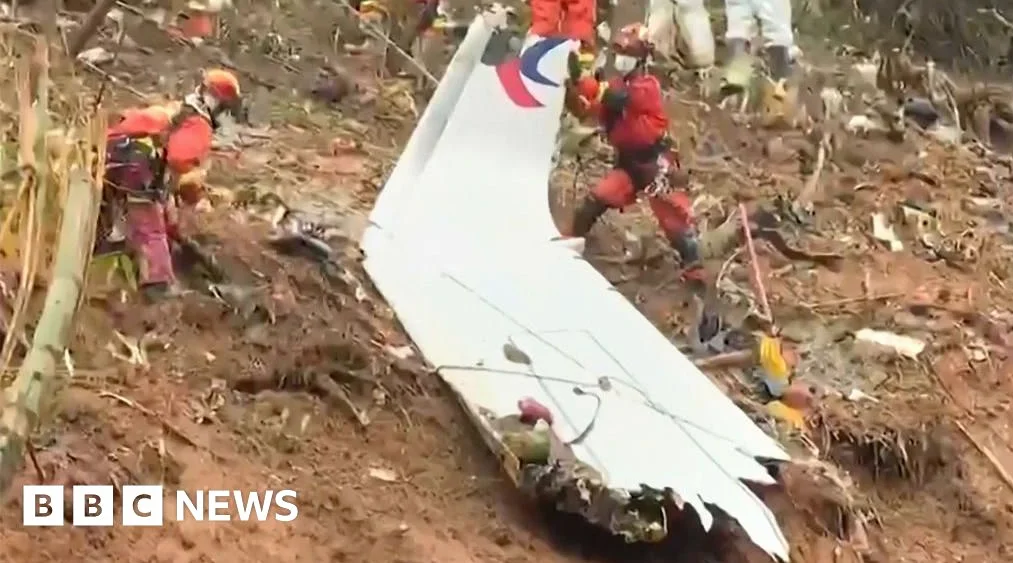
Fuel Switches Moved to ‘Cut-Off’ Position
The NTSB report revealed that the fuel switches on both engines of China Eastern Airlines Flight MU5735 were moved to the “cut-off” position while the plane was cruising at an altitude of 8,839 meters (29,000 feet). This supports a theory that the crash was intentional.
The crash, the deadliest air disaster in China in decades, occurred when the Boeing 737 jetliner plummeted into a mountainous region in Guangxi province, but the cause of the incident had long remained a mystery, as China has yet to release a final report, citing national security concerns.
Fuel Switches and Engine Performance
The NTSB report, released under the Freedom of Information Act, noted that the plane’s engine speeds “decreased after the fuel switch movement.” Fuel switches are controls used by pilots to regulate fuel flow into a plane’s engines, typically for starting or shutting down the engines mid-flight.
The data was taken from one of the plane’s “black boxes,” which record operational data. The black box was recovered from the wreckage and sent to the NTSB’s laboratory in Washington, D.C., for analysis.
After being in the air for more than an hour, the plane suddenly plummeted from cruising height. The flight had departed from Kunming, the capital of Yunnan province, and was scheduled to land in Guangzhou the same afternoon. Tracking data showed it dropped thousands of meters in under three minutes.
Investigation and Controversy
According to tracking site FlightRadar24, the plane was at an altitude of 29,100 feet (9,000 meters), but within two minutes and 15 seconds, it was recorded at 9,075 feet. The last available data on the flight showed it at 3,225 feet at 14:22 local time.
China’s Civil Aviation Administration (CAA) led the investigation since the crash took place in China and involved a Chinese airline. However, because the Boeing 737 was designed and built in the U.S., the NTSB appointed a senior air safety investigator to assist.
Investigators considered several possible causes, including deliberate action, pilot error, or technical issues such as a structural failure or mid-air collision. Zhu Tao, director of the CAA’s aviation safety office, said in the immediate aftermath of the crash that the cause was still unclear and that air controllers had received no response from the aircraft during its descent.
Despite the lack of a response, the CAA stated that the crew held valid licenses, were adequately rested, and passed health checks before the flight. However, the CAA denied speculation that the crash was a case of pilot suicide, calling such rumors “seriously misleading” and “interfering with the investigation,” as stated by CAA official Wu Shijie in a press conference in April 2022.
China has faced criticism for not releasing a final report on the incident. The CAA has warned that disclosing details could endanger national security and social stability. Airplane crashes remain rare in China, where air safety and aviation standards have significantly improved in recent decades.






Comments
No comments yet
Be the first to share your thoughts