

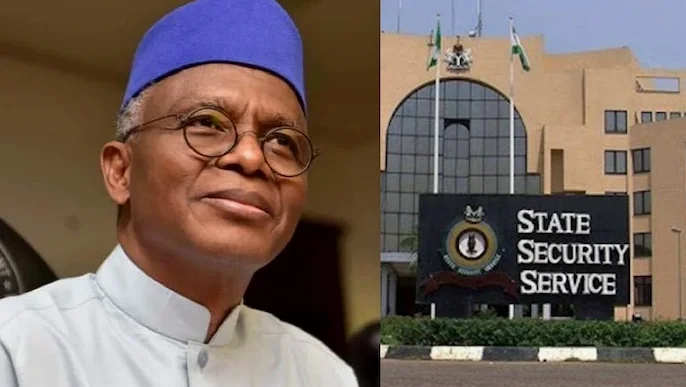
The arraignment of former Kaduna State Governor Nasir El-Rufai has been adjourned to April 23 after the Department of State Services (DSS) failed to present him in court for his scheduled proceedings. According to court documents, El-Rufai remains in the custody of the Independent Corrupt Practices and Other Offences Commission (ICPC), where he is reportedly under investigation for alleged misappropriation of funds.
Legal Proceedings and Court Rulings
Justice Joyce Abdulmalik, presiding over the case, adjourned the matter after the DSS failed to produce El-Rufai for his arraignment. The court session resumed with the prosecutor, Oluwole Aladejoye, informing the court that the former governor was still under ICPC custody.
El-Rufai faces three-count charges under the Cybercrimes Act and the Nigerian Communications Act. He is accused of unlawfully intercepting the National Security Adviser, Nuhu Ribadu’s, phone communications, using technical systems in a manner that allegedly compromised public safety and national security, and instilling public apprehension.
Origins of the Charges
The charges stem from comments El-Rufai made during a February 13 interview with ARISE News, in which he claimed knowledge of intercepted phone communications involving the National Security Adviser. He allegedly suggested that these communications were related to a planned arrest attempt against him.
The Nigerian Cybercrimes Act prohibits unauthorized interception of communications, and the Nigerian Communications Act prohibits actions that could compromise public safety or national security. El-Rufai’s statements, according to the prosecution, may have violated these provisions.
The court proceedings marked the first time El-Rufai has appeared in court in relation to these specific charges, though he has been under investigation by the ICPC for some time. The ICPC has not made public the exact nature of the allegations against him, but officials have stated that the investigation is ongoing.
Impact on Governance and Public Trust
The adjournment of El-Rufai’s arraignment has raised concerns about the efficiency and transparency of the judicial system in Nigeria. Analysts say the delay could have implications for public trust in the rule of law, particularly given the high-profile nature of the case.
According to legal experts, the ICPC’s involvement in the case adds complexity to the proceedings, as it is a specialized body focused on combating corruption. The fact that El-Rufai remains in their custody suggests that the investigation into his alleged misappropriation of funds may be ongoing.
El-Rufai, a prominent political figure in Kaduna State, has been a vocal critic of various government policies and has often been at the center of political controversies. His arrest and subsequent detention by the ICPC have drawn attention from both supporters and detractors.
“The adjournment highlights the challenges faced by the judiciary in handling high-profile cases,” said one legal analyst, who requested anonymity. “It also highlights the need for timely and transparent legal processes to maintain public confidence in the system.”
The case has also sparked discussions about the balance between national security and individual rights, particularly in the context of cybercrime legislation. Some civil society groups have called for a review of the laws to ensure they are not used to suppress dissent or target political opponents.
As the case moves forward, the court has scheduled the next arraignment for April 23. During this time, the ICPC is expected to provide more information about the nature of the investigation and whether El-Rufai will be released or held in custody.
With the adjournment, the case remains under the spotlight, and the outcome is likely to have broader implications for the political landscape in Kaduna State and beyond.





Comments
No comments yet
Be the first to share your thoughts