

 The Guardian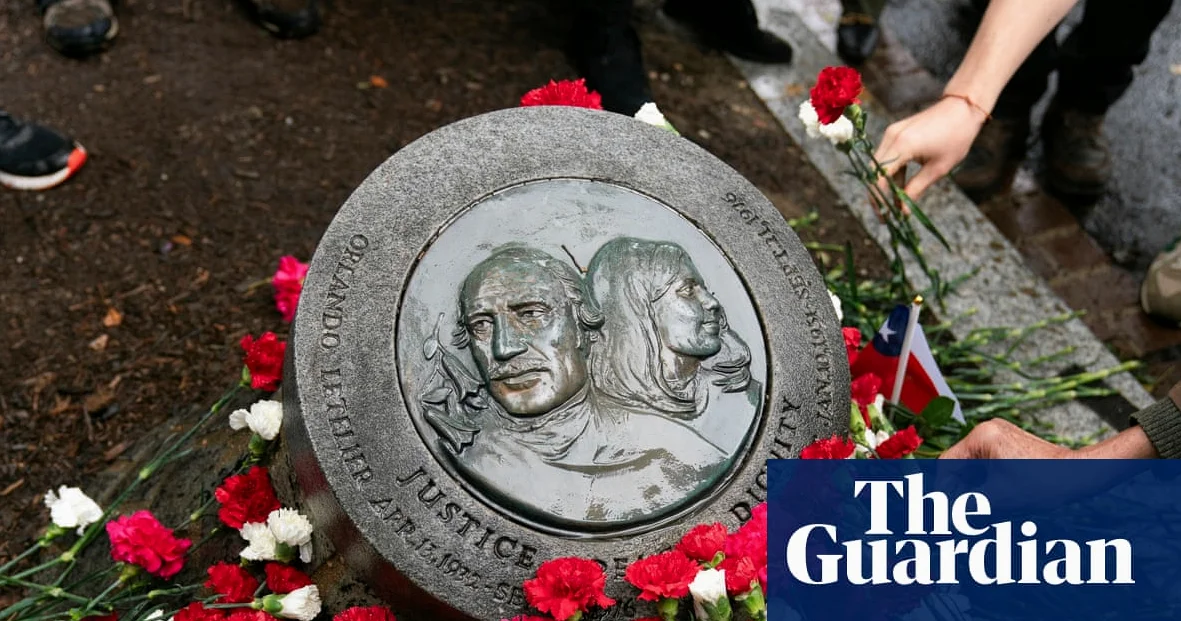
Chile’s special minister for human rights, Judge Paola Plaza, sentenced Pedro Espinoza, José Zara, and Raúl Iturriaga to 15 years in prison for their roles in the killing of Ronni Karpen Moffitt, who was 25 at the time of the attack. The three men were agents of the Dirección Nacional de Inteligencia (Dina), Pinochet’s secret police, known for hunting down political opponents both in Chile and abroad.
Agents and Their Background
Espinoza and Iturriaga, who is already serving over 500 years in prison for multiple human rights violations, were already in custody at a high-security facility outside Santiago. Zara, however, had been released in August 2023 after completing a 15-year jail term and was rearrested following the court’s decision.
Historical Context and Victims
The bombing occurred on 21 September 1976, when Letelier and Moffitt were driving to work. The blast happened as they rounded a bend on Massachusetts Avenue Northwest. Orlando Letelier, a former Chilean minister and ambassador to the US, had become a vocal critic of the Pinochet government while living in exile in the United States. He was stripped of his citizenship on 10 September 1976, just 11 days before his death.
According to the court ruling, the agents, led by Dina chief Manuel Contreras, had devised a plan for extrajudicial killings on foreign soil. Letelier’s murder was initially investigated separately, but the court later determined that Moffitt’s case required a specific investigation due to the Chilean nationality of the perpetrators.
Juan Gabriel Valdés, who served as Chile’s ambassador in Washington DC until March 2026 and had known Letelier and Moffitt during his own exile in the US, posted on social media: “Justice took 49 years and 97 days to arrive,” he wrote, recalling Moffitt’s cheerful greeting at the Institute of Policy Studies where she worked.
Broader Implications and Reactions
Several high-ranking Chilean military officials were sentenced in the 1990s for their roles in the case. US citizen Michael Townley, a collaborator with Dina, confessed to his role in the murders in 1978. However, in 2012, a Santiago appeals court ruled that Moffitt’s case must be reopened because the perpetrators were Chilean nationals.
Rebecca Karpen, Moffitt’s niece, stated in a press release: “These sentences are not just a victory for our family, but are a reminder that the countless lives ruined by the Pinochet administration are still being fought for, that the pain of the Chilean people will not be forgotten.” Juan Pablo Letelier, the son of Orlando Letelier, called on the US to pursue justice against the remaining perpetrators.
Letelier had arrived in the US in January 1975 after being imprisoned for a year in a concentration camp on a frozen Patagonian island and later transferred to another on Chile’s central coastline. At an anti-Pinochet rally at Madison Square Garden in New York on the day his citizenship was revoked, he declared: “I was born a Chilean, I am a Chilean, and I will die a Chilean. They were born traitors, they live as traitors, and they will be known forever as fascist traitors.”
The 1976 killings in Washington DC strained relations between Chile and the United States. The US had previously supported Pinochet’s 11 September 1973 coup d’état and faced growing domestic pressure to distance itself from the administration. In response to the bombing, the US Congress ordered an investigation into the murders and imposed an arms embargo on Chile. Pinochet’s government disbanded the Dina but replaced it with the Central Nacional de Informaciones (CNI) a few months later.






Comments
No comments yet
Be the first to share your thoughts