

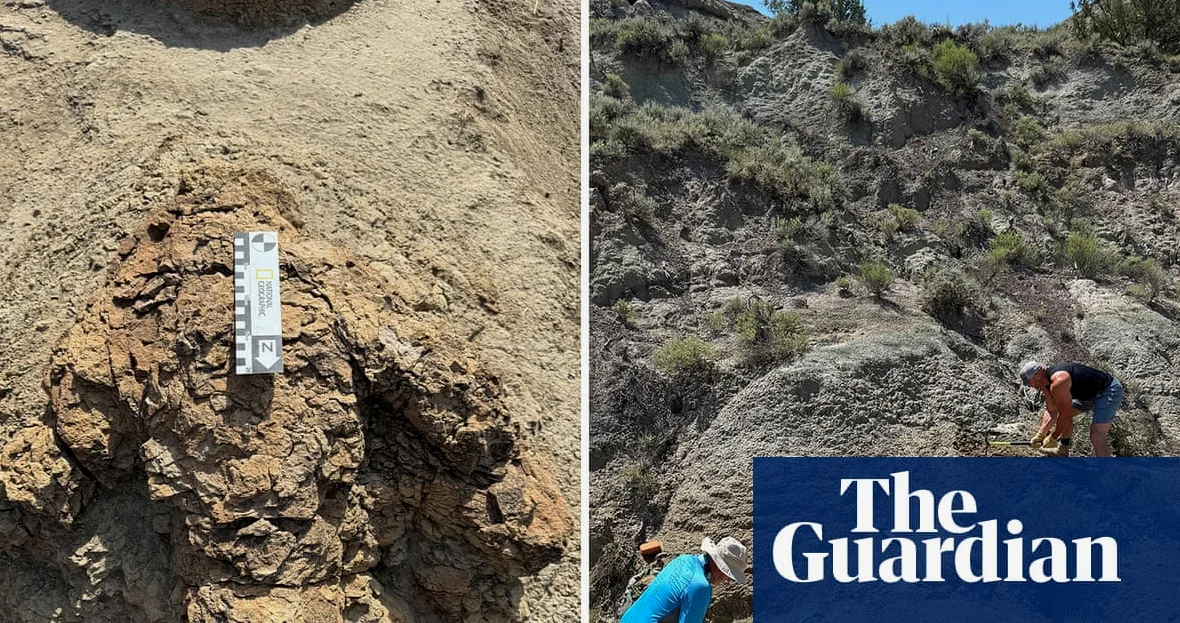
The newly discovered footprints, dating to 66.5 million years ago, are the first to be attributed to a wandering adult T. rex. While isolated prints and tracks from juvenile or related species have been found before, this is the first known trackway made by a full-grown T. rex.
Footprints capture a moment in time
“Bones tell us an enormous amount about these animals, but footprints capture a moment of behavior,” said Tyler Lyson, senior curator of vertebrate paleontology at the Denver museum, according to The Guardian. “With a trackway, we can actually follow an animal as it moved across the terrain; that is incredibly rare for T rex.”
Each of the footprints is about 3ft (0.91m) long, with a stride of about 13ft (3.96m); Using high-resolution 3D surface scanning, the research team documented the prints and created physical 3D reproductions. Based on these scans, the researchers estimated the T. rex was walking at a pace of 3.5,4.5mph,about the same as a brisk human walking pace.
A discovery by a dedicated volunteer
The discovery was made by Kent Hups, a high school teacher and longtime museum volunteer in Denver. After undergoing a knee replacement, Hups was exploring a narrow, rocky valley in the North Dakota badlands when he noticed something unusual protruding from the ground. “I saw something sticking up out of the ground, and it looked really peculiar,” he said, according to National Geographic. “Like nothing I’d ever seen before.”
Hups, who has spent 30 years searching for ancient footprints, recognized the shape of three giant toes and immediately texted Lyson: “Hey just found a T. rex footprint!!!!!!” Lyson, who was excavating a few miles away, responded with a familiar request: “Send me a pic!”
Lyson initially doubted the discovery, given that only two adult T. rex footprints had ever been identified,both in New Mexico and Montana; “Finding any dinosaur footprint is rare enough,” Lyson said, “but especially so in the Hell Creek Formation.”
Significance and future plans
The T. rex lived about 66,68 million years ago during the Cretaceous period, according to the known fossil record, though these creatures stood 12–13ft tall and were among the last non-avian dinosaurs before a mass extinction event wiped them out. The footprints, found in the Hell Creek Formation, offer new insight into the behavior of the animal and its movement across the ancient terrain.
Three of the discovered footprints are set to be recovered by helicopter later this year and transported to the Denver museum, and the discovery has been a particularly rewarding moment for Hups, who is also a co-author of the study. “As a teacher, I’m always telling my students that science starts with curiosity, passion and careful observation,” Hups said; “I never imagined that could lead me to a discovery like this.”






Comments
No comments yet
Be the first to share your thoughts