

 BBC
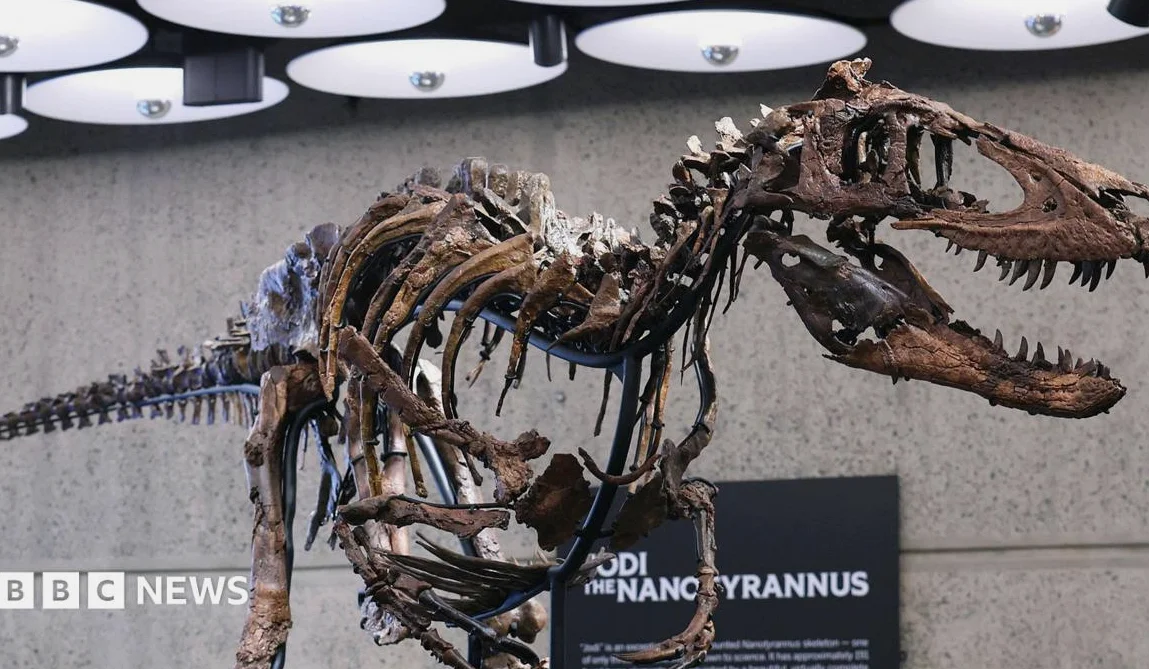
The mounted skeleton of a newly-identified dinosaur once mistaken for a young Tyrannosaurus rex has sold at auction for $47.3m (£35.5m), according to BBC. Nicknamed Jodi, the roughly 10-foot-tall (3m) skeleton was auctioned by Sotheby’s in New York. The sale comes a year after researchers confirmed that the skeleton belongs to a distinct genus.
Scientific Significance and Debate
The Late Cretaceous carnivore was expected to fetch at least $9m when it went under the hammer on Tuesday. The auction comes after Sotheby’s sold a Tyrannosaurus rex, dubbed Gus, for a record $50.1m in July. The sale has reignited debate in the scientific community over whether dinosaur remains should be sold privately or displayed publicly.
Megan Jacobs, a palaeontologist at the University of Portsmouth, told BBC Radio 4’s Today programme on Tuesday that Nanotyrannus “was for a very long time believed to be sort of a teenager of T. rex.” “But it’s a lot smaller and its a lot more gracile. So it’s very sort-of sleek, slender, [with] blade-like teeth for slicing through meat,” Jacobs said.
Discovery and Auction Details
Jodi was initially exhibited as a juvenile T. rex at London’s Frieze Masters international art fair in October 2023, before the Nanotyrannus genus was classified. The skeleton was discovered in the US state of Montana by rancher Jodi Pierson on her land in the Hell Creek Formation, a heavily studied geological site. It was later excavated by commercial palaeontologist Clayton Phipps.
Phipps also discovered the famous “Dueling Dinosaurs” fossil. That specimen, which shows the remains of a Nanotyrannus and Triceratops apparently in combat, was found eight miles (13km) away from Jodi in 2006. The “Dueling Dinosaurs” discovery became crucial to the research published by Lindsay Zanno and James Napoli that classified Nanotyrannus as separate from T. rex. Their paper ended decades of debate over whether the dinosaurs were distinct from one another.
Concerns and Reactions
The auction of Jodi comes as some scientists warn that auctions could herald a new era in fossil collecting by the ultra-rich. Researchers told the BBC after the sale of Gus that such remains should be exhibited in public spaces where they can be more freely studied. Prof Steve Brusatte, a palaeontologist at the University of Edinburgh and consultant on the Jurassic Park films, told BBC World Service’s What in the World programme in July that the T. rex’s auction was “concerning.”
“I don’t know of any museum or university that can afford a price tag like that,” he said. “Imagine if the Mona Lisa was just owned by a super-wealthy person and it wasn’t on display and people couldn’t see it, couldn’t enjoy it.” He said at the time that he hoped such a sale didn’t become a trend, adding it could adversely affect scientific research and public education.
Responding to Tuesday’s auction, Brusatte called it “harrowing” that Jodi could disappear from public view. “We’ve really just found out that Nanotyrannus is real, and now one of the best skeletons is about to be sold to the highest bidder, and it’s harrowing to think it could disappear into the vaults of a collector rather than displayed on a museum where it can wow and inspire kids and families and the public at large,” he told the BBC.
But Jacobs told the Today programme on Tuesday there were two sides to the debate, and that a lot of time, effort and money went into excavating the specimens. “I don’t begrudge the people involved for wanting to sell it for such a large amount of money,” she said. “Although its a scary prospect, actually a lot of them have ended up in the public eye… these things without a doubt will end up in a museum at some point.”





Comments
No comments yet
Be the first to share your thoughts