

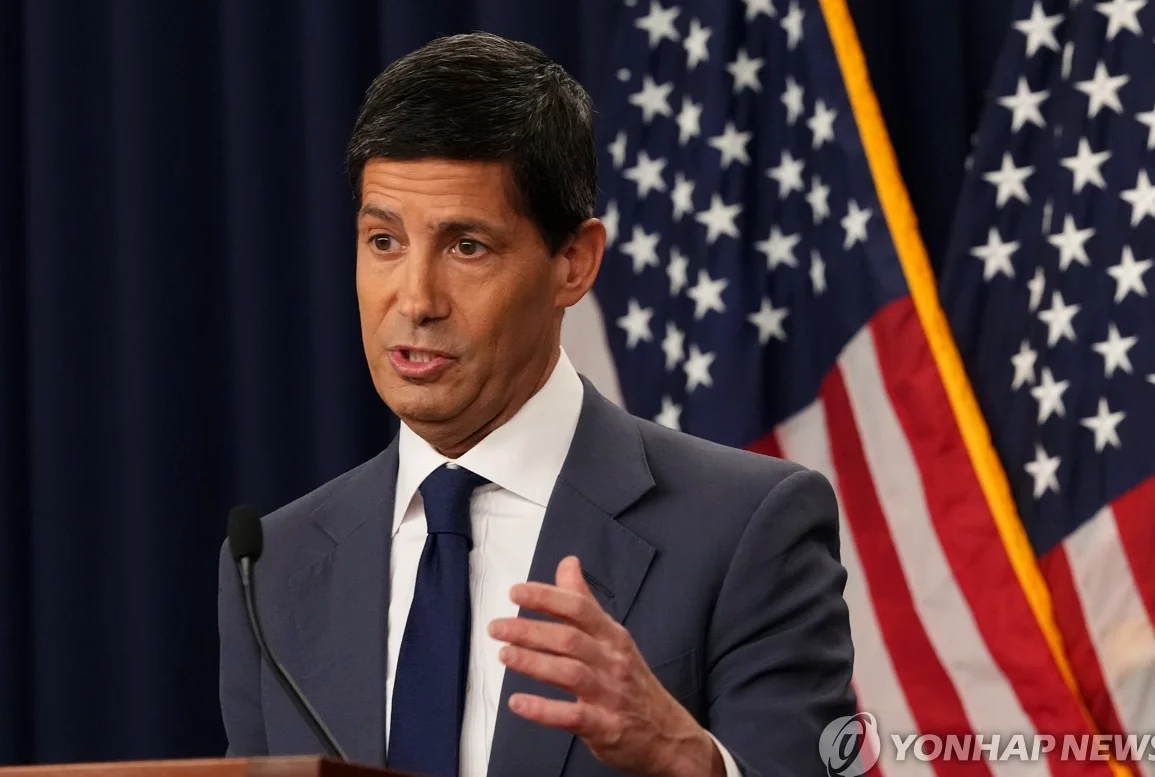
The U.S. Federal Reserve on Wednesday decided to hold its benchmark interest rate steady, maintaining it within the 3.75-4.00 percent range during a two-day meeting of the Federal Open Market Committee (FOMC). The decision followed a quarter percentage point increase in the previous month and came in a 10-2 vote. ‘The Committee is continuing its policy of maintaining ample reserves in the banking system,’ the Fed said in a statement.
Fed Cautious on Inflation Amid Uncertainty
The Fed noted that economic activity is expanding at a strong pace, with domestic spending remaining resilient despite elevated uncertainty from geopolitical developments. Productivity growth and job gains have kept pace with the workforce, and the unemployment rate has remained stable. However, the central bank emphasized that inflation is still ‘too high,’ with energy and related prices rising in recent weeks.
Fed Chair Kevin Warsh told reporters during a press briefing that the Fed’s focus remains on price stability. ‘It’s our responsibility to get inflation down,’ he said, adding that the FOMC discussions over the past few days centered on ensuring inflation returns to the 2 percent target in a timely manner. ‘Energy and related prices have moved higher again in recent weeks, and our job is to ensure that relative price changes in some sectors do not broaden out across the economy,’ Warsh said.
Rate Hike Seen Possible Before Year’s End
While the Fed opted not to raise rates in this meeting, Warsh said the accumulation of more information and data will help the FOMC determine the appropriate policy stance. The central bank has signaled the possibility of another increase later this year, with Global bond investment manager Pacific Investment Management Co. (PIMCO) projecting a potential quarter-point hike in December.
The Fed’s decision to keep rates steady aligns with overall market expectations. Last month, the Fed raised rates for the first time since July 2023, bringing the key interest rate to its current range. The decision to hold rates also left a 1 percentage point gap between the key interest rates of the U.S. and South Korea.
Warsh Expresses Interest in South Korean Economy
Warsh expressed particular interest in the South Korean economy, noting its role in supplying key components for the ongoing technology boom. ‘When I’m looking at the feedstocks effectively for this new surge in technology, a lot of it’s coming from Japan and Korea, some from Singapore,’ he said. He also praised Bank of Korea (BOK) Governor Shin Hyun-song, describing him as a ‘very talented guy and a good friend’ whom he has known for 20 years.
The Fed also announced a change to the schedule of FOMC meetings next year, with plans to hold rate-setting votes at seven out of eight meetings in 2027. In 2028, the number of rate-setting meetings is expected to be reduced to six.
Warsh emphasized that politics played no role in the decision. ‘I didn’t hear an utterance about politics,’ he said, noting that the decision was made ahead of the upcoming midterm elections. The Fed’s decision to hold rates steady reflects a wait-and-see approach as it continues to monitor inflation and economic developments.
Comments
No comments yet
Be the first to share your thoughts