

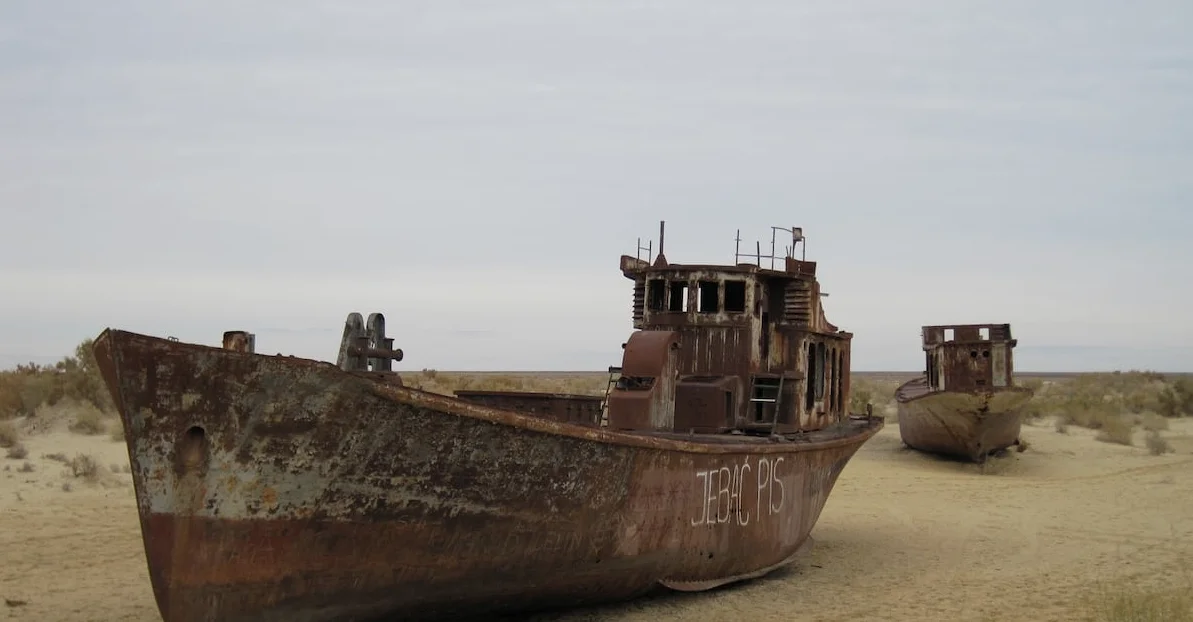
Kazakhstan is preparing to host the 2026 Regional Ecological Summit, a major event aimed at addressing environmental and energy challenges in Central Asia. The summit, organized by Kazakhstan’s Ministry of Ecology and Natural Resources, will be supported by the International Renewable Energy Agency, based in Abu Dhabi. More than 20,000 visitors are expected to attend the conference, which follows the UN COP29 climate talks hosted in Baku last year.
The Central Asian region, rich in oil and gas resources, is facing significant environmental challenges, including the near disappearance of the Aral Sea. Once the third-largest lake in the world, the Aral Sea has been reduced to a small northern remnant in Kazakhstan due to overuse of water for agriculture. A dam has helped raise water levels in the northern part, but the historic Amu Darya river now ends in a dry depression short of the Aral Sea.
The Caspian Sea, another key water body in the region, is also under threat from climate change. Rising temperatures and reduced rainfall could lead to a drop in water levels by 9 to 18 meters by 2100, affecting oil production in the northern sector. Kazakhstan and Russia share this area, which includes the Kashagan oil field, one of the world’s largest.
Gulf countries have increased their energy and environmental engagement with Central Asia in recent years. Dubai-based Dragon Oil has been producing oil in the Turkmen sector of the Caspian Sea for years. In May, Adnoc’s international unit XRG acquired a 38% stake in Turkmenistan’s Block I gas asset. State company Turkmengaz has been discussing cooperation with Adnoc on the Galkynysh gasfield, a vital supplier to China.
Adnoc has also expanded its presence in the region by acquiring a 30% stake in Azerbaijan’s Absheron gasfield in August 2023. Recently, XRG finalized a stake in the Southern Gas Corridor company, giving it interests in the crucial Shah Deniz gasfield, which supplies gas through pipelines to Europe.
The UAE’s Masdar and Saudi Arabia’s Acwa Power have major renewable energy projects across Central Asia, including solar, wind, and hydropower initiatives. Earlier this month, Acwa Power commissioned a major battery storage system in Uzbekistan. Qatar’s Nebras Power has also launched a joint venture for electricity generation in Kazakhstan and Azerbaijan.
Uzbekistan began its first green hydrogen project in September, backed by Acwa Power. The project uses renewable energy to replace natural gas feedstock for fertilizers. Kazakhstan and Azerbaijan also have significant green hydrogen ambitions. However, green hydrogen production requires substantial amounts of water, prompting discussions on sustainable desalination and cloud seeding to combat arid conditions and rising temperatures.
Turkmenistan has been working to reduce methane leakage, a major source of greenhouse gas emissions. After satellite images highlighted the problem, the country has taken steps to clean up. Adnoc, meanwhile, has one of the lowest methane escape rates among global oil producers.
Kazakhstan extracts large amounts of sulfur from sour gas, which accumulates in pyramids in the steppe. Adnoc, facing a similar challenge, is one of the world’s largest sulfur exporters. Both countries are exploring new markets for sulfur, including innovative sulfur-based cements that are highly resistant to corrosive and salty environments.
Carbon capture and storage is another area of collaboration. Gulf countries have expertise in this field, which relies on a deep understanding of subsurface geology. Carbon storage in ecosystems, such as expanding mangroves and tackling desertification, is a key part of net-zero strategies.
Conservation is also a shared mission. The UAE and Oman have successfully reintroduced the oryx to the wild after hunting reduced their numbers. Kazakhstan is working to preserve snow leopards, the Caspian seal, and has brought back the saiga antelope and Przewalski’s wild horse.
The Gulf is a key stopover for migratory birds traveling between East Africa and Central Asia. The UAE supports the International Fund for Houbara Conservation and the Sheikh Khalifa Houbara Breeding Centre in Kazakhstan, which hosts 80% of the wild population of this endangered bird.
Both regions are seeking a just low-carbon transition that acknowledges the continuing essential role of their hydrocarbons. By working together on energy and environmental issues, the Gulf and Central Asia aim to ensure the flow of energy while restoring water resources.



Comments
No comments yet
Be the first to share your thoughts