

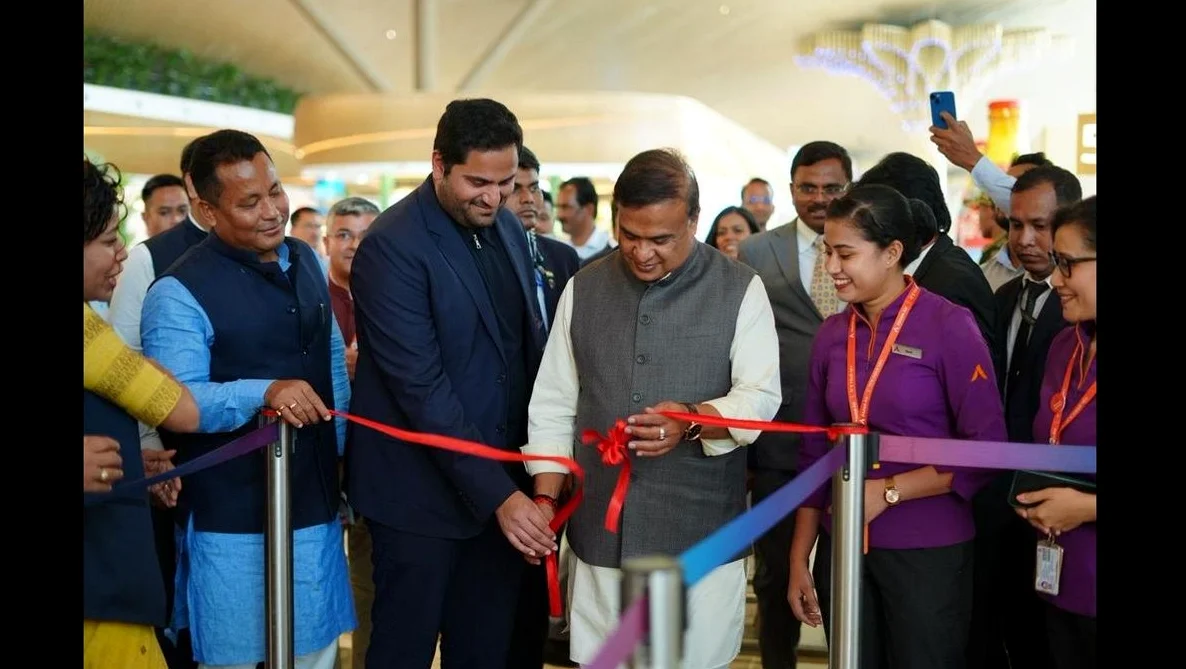
The new terminal at Lokapriya Gopinath Bardoloi International Airport in Guwahati has significantly boosted the region’s aviation capacity, raising annual passenger handling to 13.1 million. This expansion marks a major step forward for Assam’s infrastructure and is expected to enhance the region’s connectivity with domestic and international destinations.
Operational Launch and Infrastructure Upgrades
The new terminal began commercial operations on Sunday after a phased transition process that included system validation, live trials of check-in, baggage handling, security, and aircraft turnaround operations. The terminal was inaugurated by Prime Minister Narendra Modi on December 20, 2025, and its operational launch was attended by Assam Chief Minister Himanta Biswa Sarma, Jeet Adani of Adani Airport Holdings Ltd, and local officials.
The event was marked by the issuance of a ceremonial boarding pass to the first departing passenger and the arrival of an Akasa Air flight from Mumbai at the new terminal. Cultural performances and traditional ceremonies were also held to reflect Assam’s heritage and community participation. Chief Minister Himanta Biswa Sarma stated that the new terminal would play a key role in strengthening Assam’s infrastructure and tourism potential.
According to Sarma, the Adani Group has committed to invest Rs 50,000 crore in the state, and the upgraded facility is expected to drive economic growth and enhance the region’s connectivity. Jeet Adani described the expansion as an important milestone for Assam and the North-East, aligning with the broader vision of building future-ready infrastructure.
Connectivity and Economic Impact
Guwahati airport has emerged as one of India’s fastest-growing non-metro airports, handling more than nine million passengers annually in recent years. It currently connects 21 domestic destinations and three international cities, including Bangkok, Paro, and Singapore, and manages over 130 aircraft movements daily.
The expanded capacity is expected to support additional routes, increase flight frequencies, and strengthen Guwahati’s position as a regional aviation hub connecting the North-East with mainland India and Southeast Asia. The new terminal also integrates digital technologies such as Digi Yatra-enabled passenger processing, centralised communication systems, and integrated wayfinding solutions to enhance passenger convenience.
Architecturally, the terminal reflects the cultural identity of the North-East, drawing inspiration from Assam’s kopou phool and traditional bamboo craftsmanship. More than 140 metric tonnes of bamboo have been used in the structure, incorporating regional design elements associated with Assam and neighbouring Arunachal Pradesh.
Operated by Guwahati International Airport Limited, a subsidiary of Adani Airport Holdings Ltd, the airport continues to play a vital role in improving connectivity, boosting tourism, and supporting economic development across Assam and the wider North-Eastern region. The operationalisation of the new terminal marks a significant milestone in India’s aviation infrastructure expansion and is expected to further strengthen the North-East’s integration with national and global air networks.
Future Outlook and Implications
With the new terminal in place, Guwahati is well-positioned to handle the growing demand for air travel in the region. The airport is expected to see increased passenger traffic, which could lead to the introduction of new routes and the expansion of existing services. This development is likely to have a ripple effect on local businesses, tourism, and employment opportunities in the area.
The integration of digital technologies and the use of traditional materials in the terminal’s design highlight a forward-looking approach to infrastructure development that is both functional and culturally resonant. As the airport continues to grow, it is anticipated that the region will see a significant boost in economic activity and regional connectivity.
Analysts suggest that the expansion of Guwahati’s airport will not only benefit Assam but also contribute to the broader economic development of the North-East. The improved infrastructure is expected to facilitate trade, tourism, and investment, further integrating the region into national and international markets.






Comments
No comments yet
Be the first to share your thoughts