

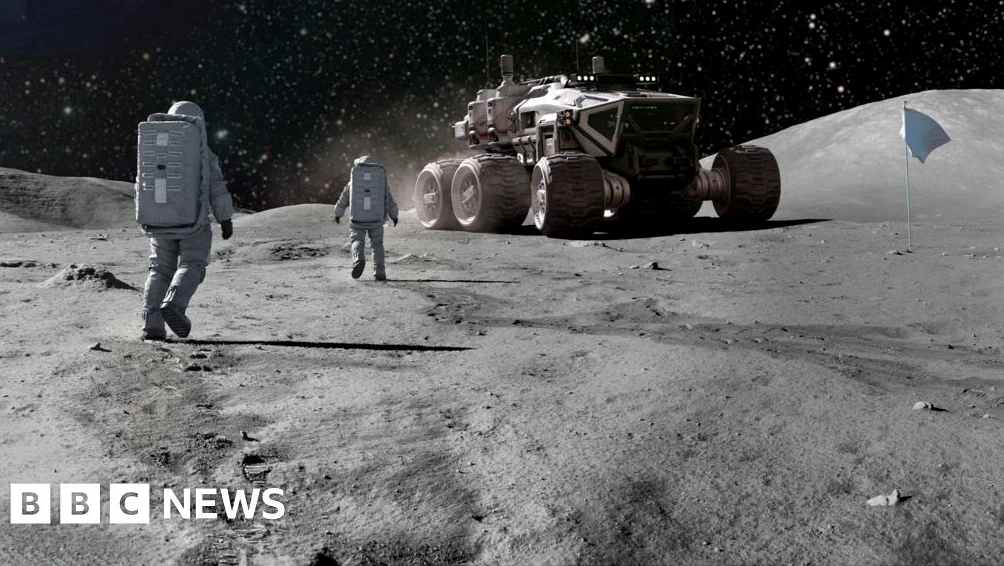
Helium-3, a rare isotope of helium, is one of the most expensive materials in the world, with a single litre costing roughly $2,000, according to BBC. This isotope has potential applications in nuclear fusion and quantum computing, but its supply is currently limited to the decay of tritium in nuclear weapons; As global demand for helium-3 may outstrip supply, attention is turning to the moon as a potential source.
Lunar Abundance and Mining Challenges
The moon’s surface. Specifically the layer of regolith. Is believed to contain helium-3 at relatively high concentrations, according to BBC, and the isotope has been implanted there over billions of years via the solar wind. However, extracting helium-3 from the regolith is a complex task. David Lawrence, a planetary scientist at the Johns Hopkins Applied Physics Laboratory, said that mapping helium-3 using high-energy gamma rays is unlikely due to the low abundance of the isotope, estimated at tens of parts per billion.
Instead, Lawrence suggested looking for helium-3 through its association with the titanium-bearing mineral ilmenite, according to Space.com. This method may be more effective, but the overall feasibility of lunar mining remains uncertain.
Private Sector and Government Investment
Interlune, a startup co-founded by former Blue Origin employees, is seeking to mine helium-3 from the moon. The company has raised $15 million and aims to develop the necessary technology, according to GameStar. Interlune is also supported by NASA, which has invested $6.9 million (10 billion KRW) in the company to develop regolith processing equipment, according to 경향신문. The goal of this initiative is to extract hydrogen as a rocket propellant and helium-3 as a potential fusion fuel, supporting the establishment of a permanent lunar base.
Helium-3 is not naturally found on Earth, making the moon an attractive source. It is carried to the moon by the solar wind, as Earth’s magnetic field shields it from such particles, according to GameStar. This makes the moon a unique repository of helium-3, which could be critical for future energy needs.
Scientific and Economic Potential
Helium-3 is being used in scientific experiments, such as detecting dark matter particles. Dima Zmeev, a senior lecturer, explained that helium-3 is used in tiny chambers to detect collisions with dark matter, according to BBC. However, the broader application of helium-3 in nuclear fusion could revolutionize energy production. Despite these possibilities, the economic viability of mining helium-3 remains questionable.
Companies and researchers argue that new sources of helium-3 are needed, as current supply from nuclear weapons may not meet future demand. Yet, the costs and technical challenges of mining and transporting the isotope from the moon to Earth are significant hurdles. Proponents of lunar mining liken the endeavor to the California Gold Rush, with helium-3 as the valuable resource, according to GameStar. However, the success of such efforts will depend on proving that there is a sustainable market for the isotope.






Comments
No comments yet
Be the first to share your thoughts