

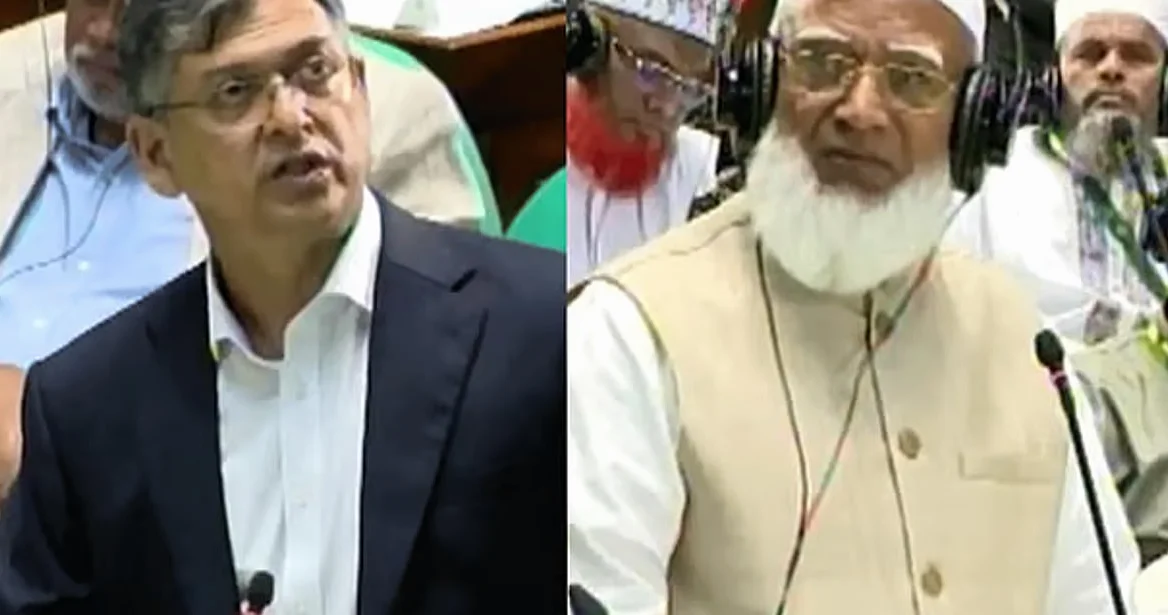
A heated debate over the formation of a constitutional reform council unfolded in Bangladesh’s Jatiya Sangsad (national parliament) on Sunday, with Home Minister Salahuddin Ahmed and Jamaat-e-Islami Ameer Shafiqur Rahman clashing over the legal basis for its existence.
Opposition Leader Challenges Delay in Reform Council
Shafiqur Rahman, the opposition leader and head of the Jamaat-e-Islami party, raised concerns during the parliamentary session about the failure to convene the constitutional reform council within the stipulated time frame outlined in the July National Charter (Constitutional Reform) Implementation Order.
Rahman emphasized that the delay in establishing the council undermines the spirit of the July National Charter, which was meant to usher in a new era of governance and reform. He argued that the government’s inaction on this issue reflects a lack of commitment to constitutional processes.
“The constitutional reform council is a key mechanism to ensure transparency and public participation in the reform process,” Rahman stated during the debate. “Its absence creates a vacuum that can be exploited by those who seek to bypass democratic principles.”
Home Minister Denies Legal Existence of Reform Council
In response, Home Minister Salahuddin Ahmed denied the existence of a constitutional reform council, stating that the Bangladesh Constitution does not recognize such a body. He argued that the prime minister has no authority to advise the president on convening the council, as it is not legally recognized.
“The constitution does not provide for a constitutional reform council, and therefore, the president has not convened such a session,” Ahmed said. “The opposition is raising this issue in a way that may not be grounded in legal reality.”
He further proposed that Rahman bring up the matter of constitutional reform at the business advisory committee of parliament, suggesting that the issue should be addressed through more formal parliamentary procedures.
According to the July National Charter (Constitutional Reform) Implementation Order, the reform council was to be established within a specific timeframe to oversee the implementation of constitutional amendments. However, no session has been convened yet, leading to growing concerns among opposition figures.
Parliamentary Session and Unprecedented Debate
The unscheduled debate took place during an unscheduled discussion session in parliament, which began at 11:00 am on Sunday. The session was called at the request of Shafiqur Rahman, who sought time for an unscheduled discussion on the constitutional reform council.
Speaker Hafiz Uddin Ahmad granted Rahman the floor after the question-answer session, allowing the debate to proceed. The discussion quickly turned contentious, with both sides presenting their legal and constitutional arguments.
The parliamentary session, which was not part of the regular agenda, drew attention from lawmakers, legal experts, and civil society groups. Many observers noted that the debate highlighted deepening divisions within the political landscape of Bangladesh.
Analysts have pointed out that the issue of constitutional reform is not new. Similar debates have occurred in the past, particularly around the 1972 constitution and subsequent amendments. However, the current disagreement centers on the July National Charter, which was adopted in 2024 as part of a broader reform initiative.
According to legal experts, the absence of a constitutional reform council may hinder the implementation of key reforms, as the process lacks a formal oversight mechanism. The July National Charter was designed to streamline the reform process and ensure public participation, but its effectiveness remains in question without the council’s involvement.
“The reform council was intended to be the cornerstone of the July National Charter, ensuring that all constitutional changes are made with transparency and public support,” said Dr. Farid Ahmed, a constitutional law expert at Dhaka University. “Without it, the reform process risks becoming arbitrary and politically driven.”
With the upcoming parliamentary session set to continue into the next week, the debate over the constitutional reform council is expected to remain a focal point. The government has not yet announced any plans to establish the council, despite the legal provisions outlined in the July National Charter.
As the political and legal landscape in Bangladesh continues to evolve, the formation of the constitutional reform council may become a litmus test for the government’s commitment to democratic principles and constitutional reform.






Comments
No comments yet
Be the first to share your thoughts